Mill Community Record Mansfield
FIND ‘MILL COMMUNITIES’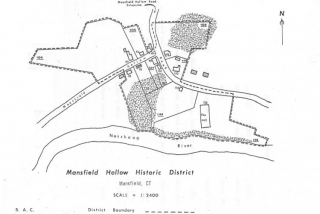
- Architectural and Historical Information
Number of Existing Buildings
Two.
Dates of Construction
Mid 19th c.
Housing Types
n/a
Brief Description
Mansfield Hollow is a cohesive village of late 18th and 19th century structures, including residences, a former store and a silk mill. The district is both historically and architecturally significant. Most of the houses original owners were connected with the Hollow's early enterprises, which included grist, saw, carding, fulling, oil, cotton and silk mills and a machine shop. The importance of small-scale manufacturing to the Hollo's economy is recalled today by the stone mill, which like the earlier mills, was powered by the swift Natchaug River flowing along the District's southern boundary. The village is typical of rural Connecticut architecture and shows development of the basic farmhouse inherited from the 18th century. Most of the early inhabitants combined farming with their mill activities. Despite modifications to some of the buildings, the district's small scale and clustering of houses retain the feel of a 19th century village. [2] The district highlights the significance of the National Thread Co. Mill (#3036) and includes the factory complex, several company-owned houses, and a number of nearby residences and outbuildings. The company-owned houses consist of two multi-family vernacular wood-frame residences located opposite from the mill on the north side of Mansfield Hollow Road. Both were built during the mid 19th century and served as boardinghouses.