Mill Record Meriden
RETURN TO ‘FIND MILLS’Disclaimer: Content for these properties was compiled in 2014-2017 from a variety of sources and is subject to change. Updates are occasionally made under Property Information, however the Connecticut Trust for Historic Preservation (dba Preservation Connecticut) makes no representation or warranty that the information is complete or up-to-date.
- Complex Name (Common)
- Aeolian Co.
- Complex Name (Historic)
-
- Aeolian Co.
- Address or Location
- 85 Tremont Street, Meriden
- County
- New Haven
- Historic Designation
- Associated Mill Community
- n/a

- Historic Information
Companies Associated w/Complex
- Aeolian Co. 1895-1930
- Aeolian Organ and Music Co. 1887-1895
- General Electric Co. ca.1950
Use (Historic)
Largest Documented Workforce
500 (1906).
Historic Narrative
Listed on the National Register 1/2023. The Aeolian Company was originally established in 1887 as the Aeolian Organ and Music Company. The firm manufactured automatic organs and music rolls and was formed as a result of the merger of the Mechanical Orguinette Company of Greenpoint, New York, and the Automatic Music Company of Boston, Massachusetts. The combined firm was led by H.B. Tremaine, who originally founded Mechanical Orguinette for the production of automated reed organs in 1878. The Aeolian Organ and Music Company originally erected its Meriden plant for the manufacture of the perforated music rolls used in its organs, however, the plant was significantly expanded after the firm introduced a successful line of player pianos, known as pianolas, in 1895. Following the induction of the pianola, the Aeolian Organ and Music Company was reorganized as the Aeolian Company. This was led by H.B. Tremaine, president, and Frederick L. Wood, superintendent. By 1906, the Aeolian Company had acquired a number of its competitors and operated seven factories throughout the United States. In addition to the Meriden plant, these included four plants in New York City, one in Aeolian, New Jersey, and one in Worcester, Massachusetts. The Meriden factory employed over 500 workers and manufactured the majority of music rolls used on all brands of automatic instruments used in the United States and abroad at the time. By 1918, this work was supplemented by the manufacture of not only player piano and organ hardware, but also phonograph motors, parts, and records. The popularity of player pianos and similar automatic instruments grew significantly through the 1910s before reaching an apex during the 1920s. Meriden was home to two of the most prominent American producers in this period, with the other entity being the Wilcox and White Organ Company, which was located on the north side of Cambridge Street opposite the Aeolian Company plant. Sales of player pianos peaked in the United States in 1924, largely as a result of the increasing accessibility of radios, phonographs, and moving pictures. While the onset of the Great Depression in 1929 effectively killed the player piano business, the Aeolian Company survived the period and its hardships through a series of consolidations and mergers during the 1930s. The firm’s Meriden plant was closed and all activities located there moved to New Jersey in 1930, by which time employment at the Connecticut plant had been reduced to some 100 workers. After the Aeolian Company’s equipment was removed, the Tremont Street complex was subsequently occupied by a variety of businesses, including the General Electric Company, which leased the factory during the early 1950s. The plant presently stands largely vacant, however, a small percentage remains occupied by commercial tenants.
- Architectural Information
Number of Existing Buildings
Ten (10) primary blocks.
Dates of Construction
ca. 1887, ca. 1895, ca. 1900, ca. 1920.
Architect
Henry M Jones 1877 block TBCfmd
Builder
n/a
Building Type
Architectural Description
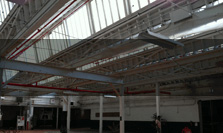
The Aeolian Company plant is comprised of approximately ten primary adjoining and freestanding blocks located at the southeast corner of the intersection of Tremont and Cambridge Streets. The earliest section of the plant is that situated immediately southwest of the corner of Tremont and Cambridge Streets, which consists of three red brick manufacturing blocks and an associated powerhouse erected in 1887. The manufacturing blocks form a unified L-shaped footprint with 102’ of frontage on Tremont Street and 138’ of frontage along Cambridge Street. The depth of both wings is 40’. The original plant is of standard brick mill construction and has a raised basement level, circular masonry wall anchors, segmental-arched window openings with stone wills, a corbelled and denticulated brick cornice, and a flat roof. The factory’s primary entrance is located on the north (Tremont Street) elevation and is set within a gabled brick portico with a flat-arch opening, stone keystones, and brick corbels. A stone plaque above the entry reads “1887.” A painted sign that reads “THE AEOLIAN ORGAN AND MUSIC COMPANY” spans the third floor of the north elevation, however, this has faded to a point of near illegibility. A four-and-a-half-story red brick addition was erected at the eastern end of the plant along Cambridge Street ca. 1895. This measures 49’ x 66’ and largely mimics the details of the earlier blocks. A five-story brick stairwell is located on the building’s east elevation, however, this was not constructed until the 1920s. Expansion of the Aeolian Company plant south along Tremont Street was completed starting ca. 1900 after the firm increased its production of pianolas. A four-and-a-half-story, 146’ x 50’ red brick block was erected adjoining the south elevation of the 1887 building, this likewise replicating the architectural details of the original structure. Further enlargement took place ca. 1920 when two additional blocks were built at the southern end of the plant abutting the south and east elevations of the ca. 1900 building. The former is a four-and-a-half-story, 60’ x 56’ red brick block, while the latter is a four-and-a-half-story, 50’ x 100’ reinforced concrete building with red brick apron walls. Despite being of concrete slab construction, however, the original façade details are continued across the Tremont Street elevation and the concrete structural components are only visible on the south and east sides of the addition. The final notable blocks associated with the Aeolian Company plant are the former boiler houses, these located on the interior side of the complex south of Cambridge Street. These consist of a group of three two-story red brick blocks erected in 1887, and a pair of two-story reinforced concrete buildings constructed ca. 1920. The former measure roughly 45’ x 86’ overall, while the latter measure approximately 46’ x 34’ and 30’ x 25’. A cylindrical red brick chimney stands on the north side of the 1887 powerplant.
Exterior Material(s)
Structural System(s)
Roof Form
Roof Material
Power Source
Condition
Fair
Condition Notes
The factory is in overall fair condition. The majority of the blocks appear to be structurally sound, however, many of the exterior walls are heavily stained and/or in need of repointing and all of the original windows have been replaced.
- Property Information
-
Specific Location
One legal parcel (85 Tremont St.) totaling 2.19 acres located at the southeast corner of the intersection of Tremont and Cambridge Streets.
Adjacent To
n/a
Exterior Visible from Public Road?
Yes
Parcel ID / Assessor Record Link
- 0407-149C-0053-0056 / Link →
Acreage
2.19
Use (Present)
- Other: Feb 2022, Meriden Planning Office approved Boston developer Trinity Financial plan to rehab as apartments. NR nom in process 2022; listed 1/2023. 11/2022 DECD awarded $1.49m grant to remediate and abate complex in anticipation of 82 mixed income units by Trinity Financials. Ground breaking 10/2024.
- Residential
- Sources
-
Form Completed By
Lucas A. Karmazinas
Date
05/22/2015
Bibliography
- List of Connecticut Manufacturers, 1922, 1924, 1930, 1932.
- Directory of Connecticut State Manufacturers, 1936, 1939.
- Industrial Directory of Connecticut, 1947.
- Register of War Production Facilities in Connecticut, 1951.
- Map of New Haven County, H & C.T. Smith, 1856.
- Atlas of New Haven County, Beers, Ellis & Soule, 1868.
- Birdseye View of Meriden, Connecticut, O.H. Bailey & Co., 1875.
- Birdseye View of Meriden, Connecticut, Hughes and Bailey, 1918.
- Sanborn Map Company, 1884, 1891, 1896, 1901, 1950, 1953.
- Hartford Courant, 1899, 1906, 1930.
- An Historic Record and Pictorial Description of the Town of Meriden, Connecticut; Gillespie, C. Bancroft, ed., 1906.
- A Modern History of New Haven and Eastern New Haven County; Hill, Everett G., 1918.
- History of New Haven County, Connecticut; Rockey, John L., 1892.
- Representative View(s)Click on image to view full file
-


Photographer
Lucas A. Karmazinas
Photography Date
05/22/2015