Mill Record Stamford
RETURN TO ‘FIND MILLS’Disclaimer: Content for these properties was compiled in 2014-2017 from a variety of sources and is subject to change. Updates are occasionally made under Property Information, however the Connecticut Trust for Historic Preservation (dba Preservation Connecticut) makes no representation or warranty that the information is complete or up-to-date.
- Complex Name (Common)
- American Cyanamid Co.
- Complex Name (Historic)
-
- American Cyanamid Co.
- H.E. Verran Co.
- Address or Location
- 1937 West Main Street, Stamford
- County
- Fairfield
- Historic Designation
- Associated Mill Community
- n/a
- Historic Information
Companies Associated w/Complex
- American Cyanamid Research Laboratories, aka Stamford Research Laboratories 1935-
- Barrymore Seamless Wiltons Inc. 1930-1935
- H. E. Verran Co. 1924-1930
- Reflectone c.1960s
Use (Historic)
- Rubber & Chemicals
- Textiles
- Other: Research lab
Largest Documented Workforce
600
Historic Narrative
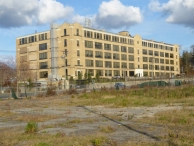
The former H. E. Verran Co. works is Stamford’s largest surviving example of a daylight factory loft built for textile production, an unusual local industry. The adaptation of the textile factory into a research laboratory began a trend in Stamford toward product development in place of manufacturing that would last into the 1960s. During the building’s longer use by American Cyanamid, several nationally distributed products were developed at the plant. The plant was developed Harry Eugene Verran (1869-1930), who found employment in Charles E. Bentley’s lace and embroidery factory on lower Broadway upon his arrival in New York from Wisconsin. Verran bought out the business around 1912, renaming it the H. E. Verran Co. specializing in 'art needle work' and relocating to 17-19 Union Square West. Verron relocated to Stamford in 1924, building the 200,000 square foot building to manufacture silk textiles. The company dissolved upon his death, and the factory was sold to Barrymore Seamless Wiltons, a Philidelphia based carpet manufacturer and subsidiary of the Canadian-owned Toronto Carpet Company. Barrymore, founded by F. Barry Hayes (d.1937) had recently become the exclusive supplier of Wilton carpeting to W. and J. Sloane, a major distributor, and expected to relocate the bulk of its workers from Philadelphia within six months of acquisition in late 1930. It is not clear however that Barrymore ever started production here, for the wholesale prices of carpeting dropped significantly in December 1930, and Masland became Sloane’s exclusive supplier in 1935. Masland acquired Barrymore in 1936 when the building was sold to American Cyanamid Co. for its Stamford Research Laboratories. Amercican Cyanamid was founded in 1907 to produce cyanamid, a fertilizer, but found the agricultural market for the single product to be cyclical. The company’s commitment to research grew from its initial successes in the 1920s to extract from cyanamid cyanide used in extracting gold and silver from ores, and hydrocyanic acid used in vulcanizing rubber. Following the acquisitions of Kalbfleish (heavy chemicals), Selden (sulfuric acid), Calco (dyes), and Lederle Labs (pharmaceuticals), American Cyanamid established the Stamford Research Lab to gather scientists from these sectors under one roof 'to effect a sound correlation of the chemical, physical, engineering, and patent problems involved in each particular development.' In the process, the research labs pioneered the development of a broad range of product encompassing chemicals, insecticides, serums, vaccines, pharmaceuticals, paints, lacquers, dyes, dynamite and blasting supplies, and chemicals for paper, rubber, textiles and metals. Several breakthrough practical applications of plastics were pioneered in Stamford, including Melmar, a thermosetting plastic molding material used to make military dishware and helmets in World War II, countertops (as the material used in Formica), resilient flooring and dishware for American homes sold under names such as Meladur (designed by Russel Wright). Polyacrylonitrile , an acrylic fiber sold as Creslan and used in clothing, sails and industrial filters, was also developed in here.
- Architectural Information
Number of Existing Buildings
Two (2) adjoining blocks.
Dates of Construction
1924, c.1936, c.1953
Architect
n/a
Builder
n/a
Building Type
Architectural Description
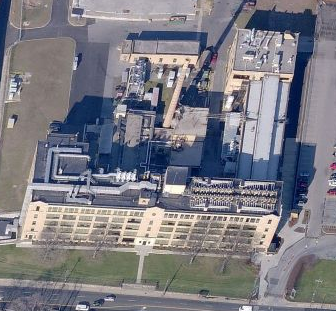
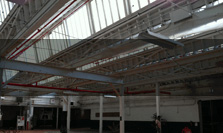
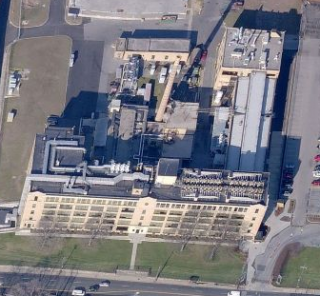
The former H. E. Verran Co. factory is located on the north side of West Main Street (US 1) near the Greenwich town line and encloses about 230,500 square feet. It was built in two phases, beginning with a five story daylight factory loft built in 1924 for silk manufacturing. The 1924 main block was L-shaped in plan, with two identically massed wings, a south wing parallel to West Main Street and a west wing extending northward from the south’s west end. Each wing was approximately 76 x 365 feet in plan, built with a reinforced concrete frame clad with buff brick on the exterior. The piers project at the corners and centers of the elevations below pedimented parapets to suggest pavilions with buttresses. Between the pavilions, the pier buttresses project with a shallow reveal beyond the plane of the spandrels to the fourth story. All buttresses terminate in simple, shallow cast stone weatherings. Fenestration within the pavilions consists of a door openings on the south elevation enframed with precast rectilinear classical surrounds. Elsewhere, the pavilions have single window opening per floor. The wall areas between the pavilions have large window openings spanning between piers above narrow spandrels. Window openings have slate sills and flush steel lintels. The original core was reduced in size by the demolition of 10 bays of the original west wing after 1970. The building’s plan attained an overall u-shape configuration with the phased addition of a three-story east wing and smaller special-purpose buildings within the resulting court between c.1936 and c.1965 during its use as a chemical research lab. The footprint of the east wing as built was similar in footprint to the west wing and continued the bay division of the earlier building. The east wing has two full width stories below a monitor-like third floor structure (possibly originally a greenhouse) and terminates in a three story pavilion without pedimented parapets. Within the court is a group of one- and two-story rectangular planned buildings including a powerhouse with a tall stack.
Exterior Material(s)
Structural System(s)
Roof Form
Roof Material
Power Source
Condition
Fair
Condition Notes
The building is largely occupied and appears to be structurally sound and weathertight but maintenance has been neglected. It has been reduced in size from its original construction by partial demolition of its west wing, but otherwise the massing of the 1924-1936 campaigns has been preserved. Original window openings have been retained but most sash has been replaced.
- Property Information
-
Specific Location
One 8.81 acre parcel on the north side of West Main Street (US 1) east of Alvord Lane; apparent access via Acosta Street from the north.
Adjacent To
Exterior Visible from Public Road?
Yes
Parcel ID / Assessor Record Link
- 004/ 3103 buildings / Link →
Acreage
8.81
Use (Present)
- Commercial
- Industrial
- Other: Cytex Solvay ?
- Sources
-
Form Completed By
Wes Haynes
Date
September 2016
Bibliography
- Sanborn Map Co., 1951.
- 'Harry E. Verran, Head of Textile Firm [Obituary],' New York Times, September 2, 1930.
- 'Acquires Stamford Plant:Philadelphia Carpet Co. Will Move to $1,100,000 Factory,' New York Times, October 17, 1930.
- 'Rug Market Upset by Sharp Reduction,' New York Times, December 2, 1930.
- 'Masland to Produce Wiltons,' New York Times, December 27, 1935.
- 'F. Barry Hughes [Obituary],' New York Times, June 18, 1937.
- 'Research Work of Cyanamid Co. is Centered Here,' Stamford Advocate Tercentenary Edition, June 7, 1941, 116.
- Representative View(s)Click on image to view full file
-
Photographer
n/a
Photography Date
September 2016