Mill Record Vernon
RETURN TO ‘FIND MILLS’Disclaimer: Content for these properties was compiled in 2014-2017 from a variety of sources and is subject to change. Updates are occasionally made under Property Information, however the Connecticut Trust for Historic Preservation (dba Preservation Connecticut) makes no representation or warranty that the information is complete or up-to-date.
- Complex Name (Common)
- American Mills Co.
- Complex Name (Historic)
-
- American Mills Co.
- Address or Location
- 40 Brooklyn Street, Rockville, Vernon
- County
- Tolland
- Historic Designation
- Associated Mill Community
- n/a
- Historic Information
Companies Associated w/Complex
- American Mills Co. ca. 1895-1918
- American Mills Co., div. Hockanum Mills Co. 1918-1934
- Anocoil Corp. 1958-Present (2016)
- M.T. Stevens & Sons Co. 1934-1951
Use (Historic)
Largest Documented Workforce
200 (1932).
Historic Narrative
The American Mills Company was organized in the Rockville section of Vernon, Connecticut by Phineas Talcott and Nelson Kingsbury in 1847. The firm manufactured high-quality woolen textiles, such as cassimeres, and occupied a massive six-story stone and wood mill formerly located east of the present plant. At the time of its establishment, the American Mills Company numbered among several other prominent Rockville textile producers, such as the Springville Manufacturing Company on West Main Street, however, it was one of the first operations to benefit from non-local investment. The company also drew a large number of its employees from a large immigrant population, which helped Rockville develop into a bustling industrial center as the textile mills expanded rapidly in the post-Civil War period. The American Mills Company continued to operate and expand its Rockville plant into the early-20th century. In 1918, however, the firm and mill complex were sold to the Hockanum Mill Company, a holding company formed in 1906 that operated three other textile mills in Rockville at the time of the acquisition. The Hockanum Mill Company retained the American Mills Company’s name, management, and some 200 employees, among them being the firm’s 95-year old president George Talcott. Significant additions to the American Mills Company plant were completed in 1932, however, the Hockanum Mill Company and its 1,200 Rockville employees were in turn acquired by the North Andover, Massachusetts-based textile conglomerate, M.T. Stevens and Sons Company just two years later. In addition to its Rockville holdings, the M.T. Stevens and Sons Company also operated textile mills in Andover, North Andover, Lowell, and Haverhill, Massachusetts; and Peacedale, Rhode Island. Like many of these plants, the American Mills Company suffered from declining demand for woolens as synthetic fabrics became more popular during the late 1940s. The M.T. Stevens and Sons Company closed all of its Rockville mills in 1951 and the former American Mills Company plant subsequently fell vacant until the late 1950s. In 1958, the mill was acquired by the Rockville-based Anocoil Corporation, a manufacturer of thermal and ultraviolet lithographic plates used by the printing industry. The original American Mills Company mill was destroyed by a massive fire in 1960, however, the Anocoil Corporation continues to occupy the remainder of the facility. At present, the Anocoil Corporation ranks as one of the largest producers of analog and digital offset printing plates in North America.
- Architectural Information
Number of Existing Buildings
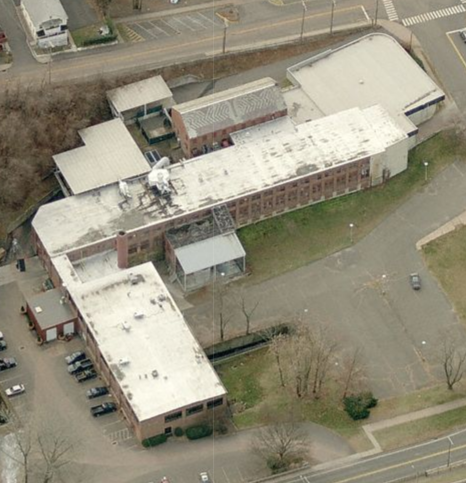
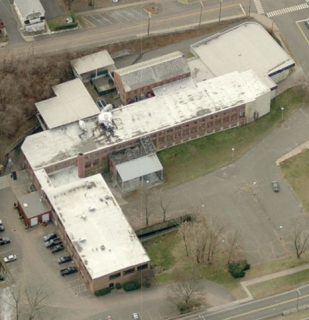
Roughly five (5) adjoining primary blocks.
Dates of Construction
ca. 1895, ca. 1930, 1934, ca. 1940, ca. 1970.
Architect
n/a
Builder
n/a
Building Type
Architectural Description
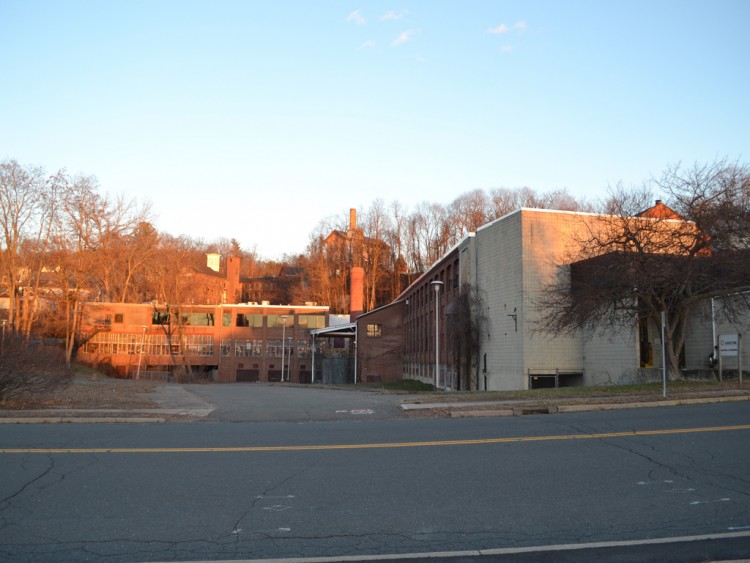
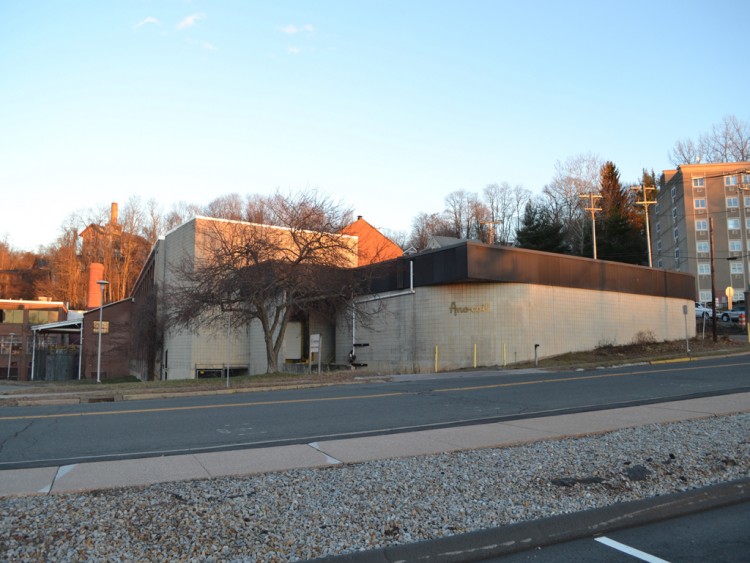
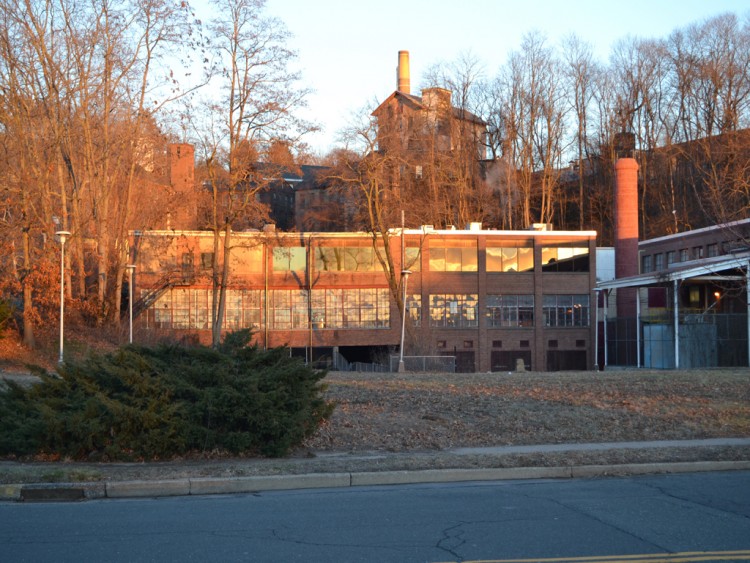
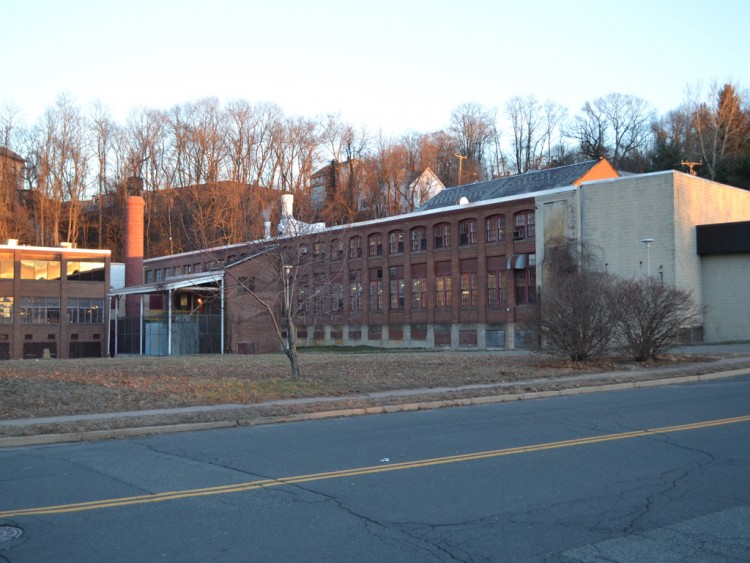
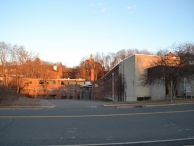
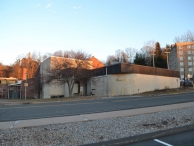
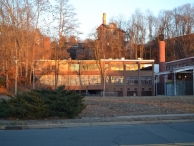
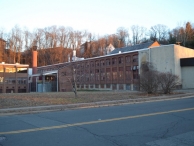
The former American Mills Company plant is comprised of roughly five adjoining primary blocks located on the north side of Brooklyn Street, at the northeast corner of Brooklyn Street’s intersection with Court Street. The oldest block associated with the plant appears to be a two-story, 82’ x 36’ red brick yarn and wool storage building erected ca. 1895. This is located on the south side of the factory and has rectangular window openings with stone sills and lintels, a corbelled brick cornice, and a side-gabled roof with slate shingles. The original windows consisted of six-over-six double-hung wood sash, however, all but a limited few have been removed and the openings boarded up. A two-story, 275’ x 50’ red brick block adjoins the north elevation of the yarn and wool storage building. This building was erected in two phases, with the eastern third of the block having been constructed ca. 1930, and the western two-thirds likely built in 1932. The details of the two sections make them clearly discernible from one another. The older portion has rectangular window openings with multi-pane metal sash, while the section built in 1932 has rectangular window openings on the first floor and segmental-arched openings on the second. Fenestration throughout the 1932 block consists of paired double-hung wood sash, these in either nine-over-nine or six-over-six arrangements. The entirety of the building has a concrete foundation, corbelled brick cornice, and a flat roof (although the ca. 1930 block originally had a side-gabled roof). A one-story, 52’ x 30’ red brick boiler plant joins the ca. 1930/1932 block with another two-story manufacturing building. The latter was likewise built in two phases, with the northern half erected ca. 1930 and the southern portion constructed ca. 1940. The resultant unified block is of brick construction and has red brick walls, large rectangular window openings with concrete sills, multipane metal sash with pivot-style openings, and a flat roof. The center of the block spans the Hockanum River, which passes into a culvert immediately west of the building. The final primary block associated with the former American Mills Company plant is a one- and two-story concrete block shipping ell erected adjoining the 1932 building ca. 1970. This lacks window openings and has a flat roof. A single loading bay with a metal roll-up door is located on its west elevation and the northwest corner of the building bears curved, cursive metal lettering that reads ‘Ano-coil.’
Exterior Material(s)
Structural System(s)
Roof Form
Roof Material
Power Source
Condition
Fair
Condition Notes
The complex is in fair condition. Although a number of windows throughout the plant have been replaced with modern units, the entirety of the facility appears to be well maintained.
- Property Information
-
Specific Location
One 4.3-acre parcel (40 Brooklyn Street) located on the north side of Brooklyn Street, at the northeast corner of Brooklyn Street’s intersection with Court Street.
Located in the City of Rockville Historic District (1984).
http://npgallery.nps.gov/nrhp/GetAsset?assetID=dbc02af8-eea0-4694-92fb-72190cecb3a7Adjacent To
Exterior Visible from Public Road?
Yes
Parcel ID / Assessor Record Link
- 40/0117/00004. / Link →
Acreage
4.3
Use (Present)
- Sources
-
Form Completed By
Lucas A. Karmazinas
Date
01/11/2016
Bibliography
- List of Connecticut Manufacturers, 1922, 1924, 1930, 1932.
- Directory of Connecticut State Manufacturers, 1936, 1939.
- Industrial Directory of Connecticut, 1947.
- Register of War Production Facilities in Connecticut, 1951.
- Map of Tolland County, Wm. C. Eaton & H.C. Osborn, 1857.
- Atlas of Tolland County, O.W. Gray, 1869.
- Sanborn Map Company, 1885, 1892, 1897, 1903, 1911, 1921, 1946.
- Aerial Survey of Connecticut, 1934, 1951, 1965, 1970, 1985.
- Hartford Courant, 1918, 1932, 1934.
- A Century of Vernon, Connecticut, 1808-1908; Smith, Harry Conklin, 1911.
- Rockville Heritage Trail website.
- Representative View(s)Click on image to view full file
-
Photographer
Lucas A. Karmazinas
Photography Date
01/11/2016