Mill Record New Haven
RETURN TO ‘FIND MILLS’Disclaimer: Content for these properties was compiled in 2014-2017 from a variety of sources and is subject to change. Updates are occasionally made under Property Information, however the Connecticut Trust for Historic Preservation (dba Preservation Connecticut) makes no representation or warranty that the information is complete or up-to-date.
- Complex Name (Common)
- American Steel and Wire Co.
- Complex Name (Historic)
-
- American Steel and Wire Co.
- Address or Location
- 100 Wheeler Street, Annex, New Haven
- County
- New Haven
- Historic Designation
- Associated Mill Community
- n/a
- Historic Information
Companies Associated w/Complex
- American Steel and Wire Co. 1907-1979
- National Wire Corp. 1901-1907
Use (Historic)
Largest Documented Workforce
1,200 (1949).
Historic Narrative
The site of the former American Steel and Wire Company plant was first used for industrial purposes in the early 1860s when the firm of Pook and Bushnell built gunboats for the Union Navy during the Civil War. Pook and Bushnell went bankrupt shortly after the war, and in 1871 the property was purchased by the newly-organized New Haven Wire Company, which built a factory in the vicinity of the present plant. The New Haven Wire Company remained profitable for some 15 years before falling into receivership in 1887. The company struggled on for three more years, whereupon the firm finally regained its footing and was reorganized as the New Haven Wire Manufacturing Company. This restructured and revitalized business was eventually incorporated as the National Wire Company with $200,000 in capital in 1899, which was in turn reorganized as the National Wire Corporation, with $1,000,000 in capital, in 1900. The National Wire Corporation met with dramatic initial success and employment as the firm reached 500 hands by 1901. The need to expand production in order to keep up with demand soon led to significant increases in the size of the company’s plant and although the five-acre facility was almost entirely destroyed by fire in February 1901, the damage was rapidly repaired and the size of the plant doubled by the end of the year. The process of financing the new construction forced the managers of the National Wire Corporation to merge the firm with several other wire manufacturers under the umbrella of the American Steel and Wire Company in February 1902. This holding company had assets in excess of $18 million and included a number of notable firms among its members: the DeKalb and Union Fence Company of DeKalb, Illinois; the Safety Insulated Wire and Cable Company of Bayonne, New Jersey; and the Pacific Steel and Wire Company of Oakland, California. The National Wire Corporation remained profitable until December 1906, whereupon it fell into receivership under F.B. Farnsworth and H. Stuart Hotchkiss. The business was not revived, however, and it was closed just several months later. In December 1907, the United States Steel Corporation acquired all of the assets of the National Wire Corporation. This included the corporation’s New Haven plant, which was eventually reactivated under the auspices of the American Steel and Wire Company, late in 1908. The complex employed some 29 hands in December 1908, however, this soon rebounded to over 500. By the 1930s, the American Steel and Wire Company’s New Haven plant manufactured a variety of wire goods, yet its specialty was rope wire and wire rope. This was produced in a range of sizes used for elevators, dredges, lumbering, mining, oil well drilling, suspension bridges, cranes, etc. The operation was the largest in world in 1930 and operations continued to expand over the following decades. By 1949, the plant employed over 1,200 workers manufacturing both steel wire and cold strip steel. Much of the business’s growth during this period was driven by the firm’s expansion into tramway engineering, the headquarters for which were located at the New Haven facility. The American Steel and Wire Company’s New Haven plant remained profitable for the U.S. Steel Corporation for three more decades, though it was eventually closed along with 16 other U.S. Steel facilities across the country in 1979. The complex presently houses a variety of tenants, these primarily involved in shipping and storage operations.
- Architectural Information
Number of Existing Buildings
Roughly five (5) primary blocks.
Dates of Construction
1901.
Architect
n/a
Builder
n/a
Building Type
Architectural Description
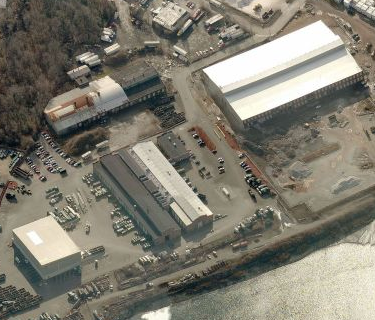
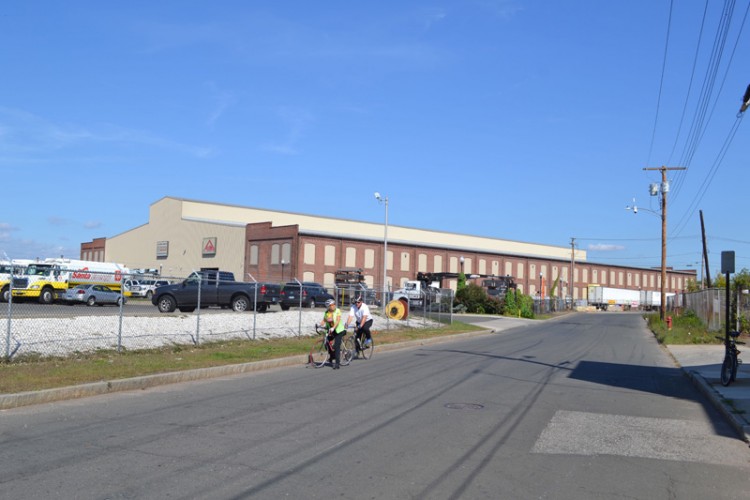
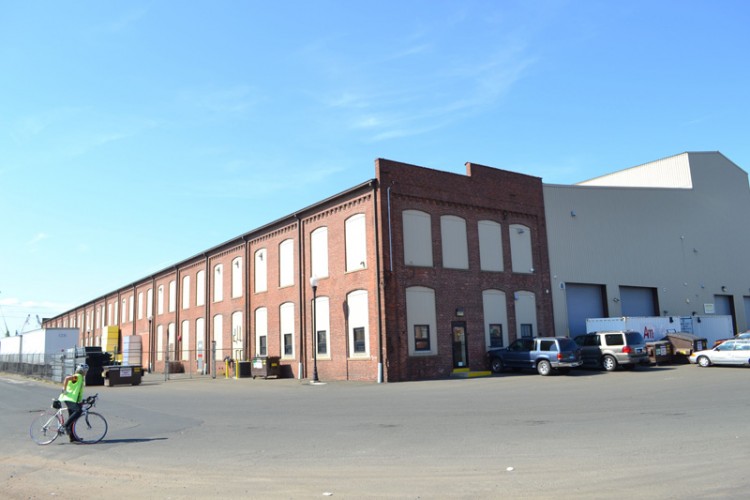
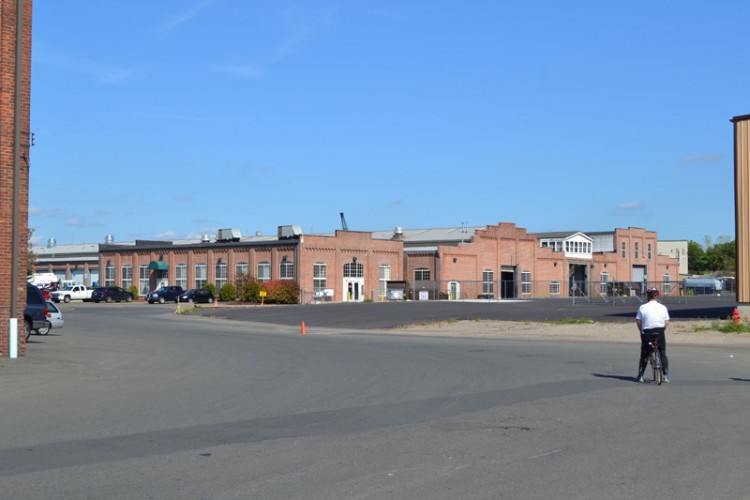
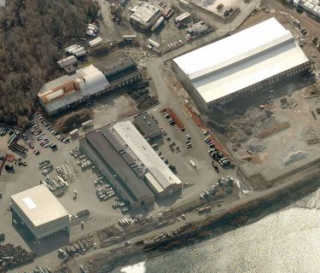
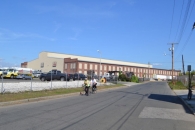
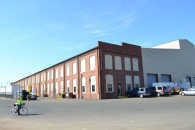
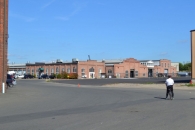
The former American Steel and Wire Company’s New Haven plant is comprised of roughly five primary adjoining and freestanding blocks located on the west side of Wheeler Street, at the northwest corner of Wheeler Street’s intersection with Goodwin Street. All of the blocks were built in 1901 after a massive fire destroyed an earlier facility. The largest and most notable building stands roughly 100’ northwest of Wheeler Street and is a two-story, 244’ x 408’ red brick mill that after recent partial sheathing with aluminum siding appears as an aluminum-sided block flanked by red brick ells. The ells have large segmental-arched window openings with concrete sills, brick corbel-lined cornices, and stepped brick parapets. The building is unified under a low-pitch front-facing gable roof, this with a clerestory monitor (since blocked up with aluminum siding) extending the full length of the building’s ridgeline. Except for large loading bays with roll-up style doors, all of the details of the central section of the building have been obscured by the application of aluminum siding. Three interconnected blocks are located roughly 200’ northeast of the aforementioned building. These are all of brick pier construction and stand one story in height. From west to east they measure 52’ x 102’, 88’ x 360’, and 88’ x 360’, respectively. The blocks share many exterior details including large segmental-arched window openings with concrete sills, brick corbel-lined cornices, and stepped brick parapets, however each has a slightly different roof and parapet design. The westernmost block has a low-pitch front-facing gable roof with a short parapet. The central block has a low-pitch front-facing gable roof with a gabled clerestory monitor that is taller and has more steps than the block to the west. The easternmost of the three blocks has a flat roof with a tall, flat-roofed clerestory monitor. Windows in the gable-end of the parapet give the appearance of the block being two stories tall, however, these provide light into the interior of the building via the monitor. The final building associated with the plant is a non-historic two-story metal-frame garage located at the northern end of the property. The building has five large loading doors on its south elevation and has aluminum siding and a flat roof.
Exterior Material(s)
Structural System(s)
Roof Form
Roof Material
Power Source
Condition
Fair
Condition Notes
The complex is in fair condition. Although a majority of the original windows throughout the complex have been replaced or infilled and some of the blocks sheathed with modern siding, most of the various sections of the plant are well maintained.
- Property Information
-
Specific Location
One legal parcel (100 Wheeler Street) totaling 10.65 acres located on the west side of Wheeler Street, at the northwest corner of Wheeler Street’s intersection with Goodwin Street.
Adjacent To
Exterior Visible from Public Road?
Yes
Parcel ID / Assessor Record Link
- 082/0974/02002. / Link →
Acreage
10.65
Use (Present)
- Sources
-
Form Completed By
Lucas A. Karmazinas
Date
10/08/2015
Bibliography
- List of Connecticut Manufacturers, 1922, 1924, 1930, 1932.
- Directory of Connecticut State Manufacturers, 1936, 1939.
- Industrial Directory of Connecticut, 1947.
- Register of War Production Facilities in Connecticut, 1951.
- Map of New Haven County; Clark, Richard, 1859.
- Atlas of New Haven County, Beers, Ellis & Soule, 1868.
- Aerial Survey of Connecticut, 1934, 1965.
- Sanborn Map Company, 1901, 1911, 1923, 1950.
- New Haven City Directory; Various editions.
- History of the City of New Haven to the Present Time, 1887.
- A Modern History of New Haven and Eastern New Haven County, 1920.
- Hartford Courant, 1900, 1901, 1930, 1949, 1979.
- Representative View(s)Click on image to view full file
-
Photographer
Lucas A. Karmazinas
Photography Date
10/08/2015