Mill Record West Haven
RETURN TO ‘FIND MILLS’Disclaimer: Content for these properties was compiled in 2014-2017 from a variety of sources and is subject to change. Updates are occasionally made under Property Information, however the Connecticut Trust for Historic Preservation (dba Preservation Connecticut) makes no representation or warranty that the information is complete or up-to-date.
- Complex Name (Common)
- Armstrong Rubber Co.
- Complex Name (Historic)
-
- Armstrong Rubber Co.
- Address or Location
- 475 Elm Street, West Haven
- County
- New Haven
- Historic Designation
- Associated Mill Community
- n/a
- Historic Information
Companies Associated w/Complex
- Armstrong Rubber Co. 1937-1982
Use (Historic)
Largest Documented Workforce
720 (1979).
Historic Narrative
The Armstrong Rubber Company was established by George F. Armstrong in Garfield, New Jersey, in 1912. The company was organized for the manufacture of rubber automobile and tractor tires and expanded rapidly during the 1910s and 1920s through the aggressive acquisition of competing manufacturers. Included among the latter were two West Haven firms, the Kelly Tire and Rubber Company and Martin Tire and Rubber Company, which were acquired by the West Haven Rubber Company, a holding company organized by Armstrong, in 1922. The aforementioned West Haven tire firms shared a three-story plant on Elm Street, which soon operated as a branch factory maintained by the Armstrong Rubber Company (since demolished). The plant was significantly enlarged during the 1930s and 1940s as both the increasing prevalence of privately-owned automobiles and the military’s need for tires during World War Two resulted in unprecedented demand for the company’s products. This growth persisted through the 1950s and into the 1960s, with overall tire production jumping from 119 million to 200 million over the course of the latter decade. The firm employed upwards of 5,000 hands throughout the 1960s and in 1968 the company hired Marcel Breuer and Robert F. Gatje to design a new $7 million headquarters building on Sargent Drive in New Haven, which would become an icon of Modernist architecture. In 1969 the Armstrong Rubber Company’s net sales topped $201 million, making it the 5th-largest tire manufacturer in the country. This would prove to be the peak of the firm’s prosperity as the 1970s ushered in a variety of challenges – recession, gas shortages, etc. – which subsequently led to dramatic declines in the demand for automobile tires. By the late 1970s the Armstrong Rubber Company’s West Haven plant was the most expensive of seven factories maintained by the firm. Despite eliminating 120 jobs in 1979, the company was eventually forced to close the factory and lay off the remaining 600 hands in 1982. Although the Armstrong Rubber Company retained the property as a warehouse, it use was discontinued after Armstrong was sold to Pirelli and C. S.p.A., an Italian tire firm in 1988.
- Architectural Information
Number of Existing Buildings
Roughly six (6) adjoining and freestanding primary blocks.
Dates of Construction
1937, 1944, ca. 1945, ca. 1960, ca. 1970.
Architect
Fletcher Thompson (1944), Leo F. Caproni (1966)
Builder
n/a
Building Type
Architectural Description
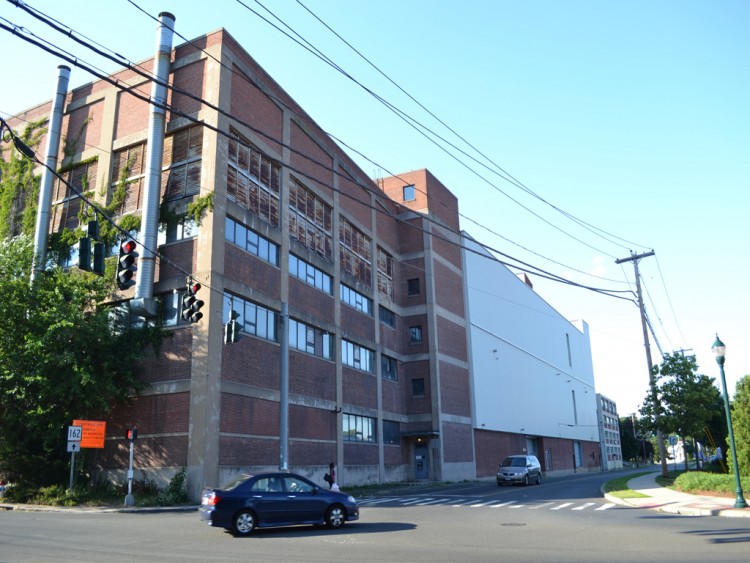
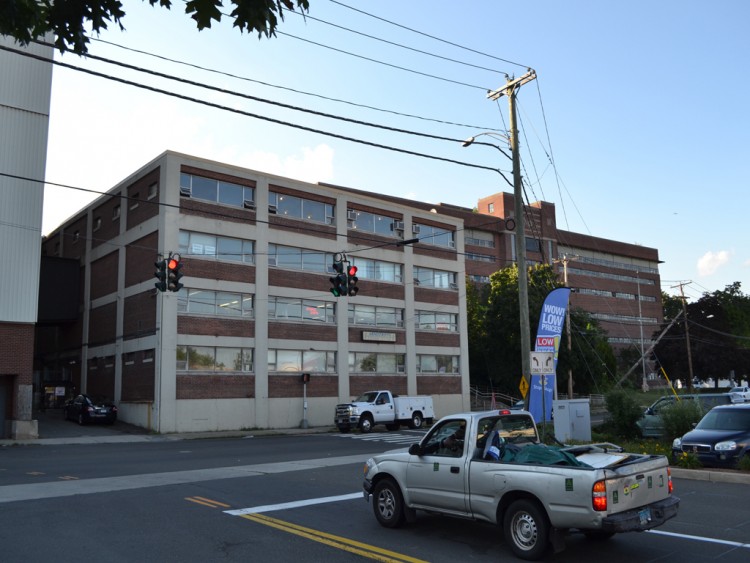
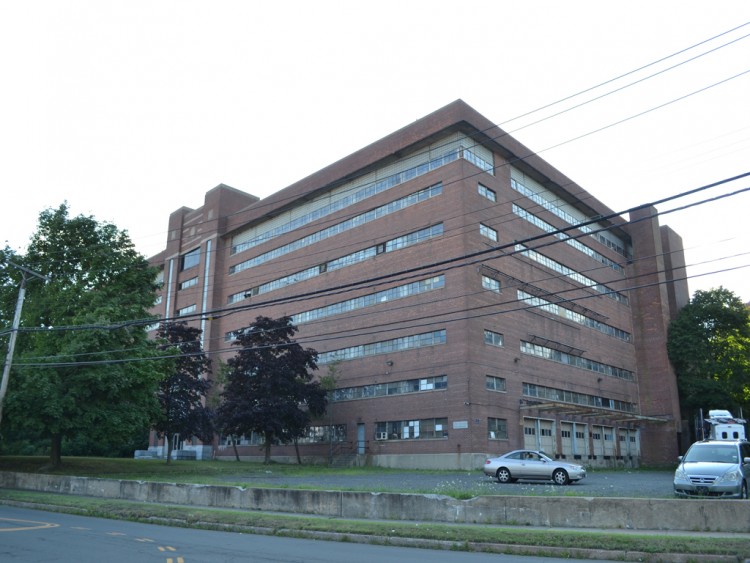
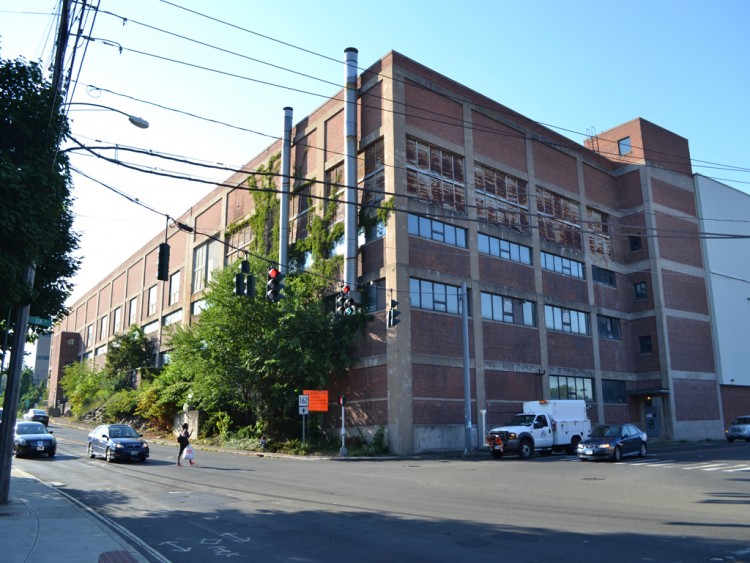
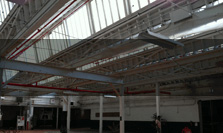
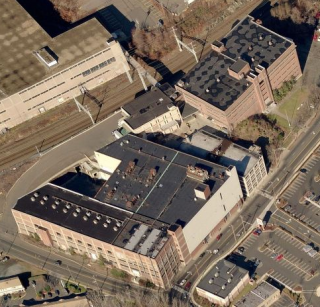
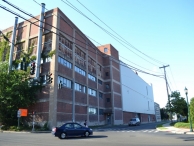
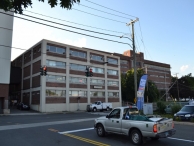
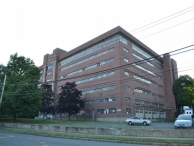
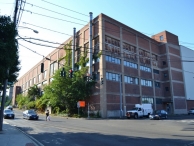
The former Armstrong Rubber Company complex is comprised of roughly six primary adjoining and freestanding blocks flanking the New York-New Haven rail line on the east side of Sawmill Road, north side of Elm Street, and south side of West Clark Street. The oldest portion of the plant is a four-story, 80’ x 187’ reinforced concrete warehouse located at the center of the plant along Elm Street. The block was erected in 1937 and has exposed concrete framing, red brick apron walls, ribbon windows with hopper-style openings, and a flat roof. Immediately to the northeast there is a five-story, 266’ x 144’ reinforced concrete and red brick office and warehouse building. Erected between 1946 and 1947, this is the most notable of the structures associated with the former Armstrong Rubber Company plant as its massive scale and Art Deco styling present a distinctive structure that looms over Elm Street. A six-story entry pavilion with full-height sidelights and concrete detailing in its parapet is centered on the block’s façade (south elevation), while ribbon windows span the elevation’s of the first through fourth floors and wrap around the corners of the front of the building at the fifth-floor level. A five-story, 222’ x 287’ manufacturing block stands immediately west of the 1937 warehouse. This was erected ca. 1970 and has a concrete foundation, red brick basement level, corrugated metal walls, and a flat roof. A five-story reinforced concrete and red brick manufacturing building adjoins its west elevation. The latter block was originally built along Sawmill Road in 1944 and was enlarged from 255’ x 112’ to its present size of 364’ x 112’ after an addition was erected at the corner of Sawmill Road and Elm Street ca. 1945. The building has an exposed concrete frame, red brick apron walls, large window openings with metal sash, and a flat roof. The final two primary blocks associated with the former Armstrong Rubber Company plant flank the railroad line and are linked by an enclosed second-story passageway. These consist of a three-story, 162’ x 88’ reinforced concrete structure that adjoins the northwest corner of the office and warehouse building; and a three-story, 600’ x 370’ warehouse that runs along Sawmill Road south of West Clark Street. The smaller block was built ca. 1970 and has exposed concrete framing, red brick apron walls, and a flat roof, while the warehouse and is of similar detailing yet dates to ca. 1960 and has concrete block apron walls. Leo F. Caproni designed an addition in 1966 (Engineering News Record, 1966), likely the part of the building with the brick first level & corrugated metal upper levels. Fletcher & Thompson appear to have done the work circa 1944 (Steel Magazine, 1944, Google Books).
Exterior Material(s)
Structural System(s)
Roof Form
Roof Material
Power Source
Condition
Fair
Condition Notes
The complex is in fair condition. Although sections of the exterior walls are in need of cleaning and minor repairs, the mill appears to be structurally sound. A number of the original wood or metal windows remain, however, most are in dire need of repairs.
- Property Information
-
Specific Location
Two legal parcels (475 Elm Street and 82 West Clark Street) totaling 15.32 acres and flanking the New York-New Haven rail line on the east side of Sawmill Road, north side of Elm Street, and south side of West Clark Street.
Adjacent To
Exterior Visible from Public Road?
Yes
Parcel ID / Assessor Record Link
Acreage
15.32
Use (Present)
- Commercial
- Industrial
- Other: Purchased 10/2021 by Bronx based Kajraktari Realty for eventual residential redev.
- Vacant
- Sources
-
Form Completed By
Lucas A. Karmazinas
Date
08/04/2015
Bibliography
- List of Connecticut Manufacturers, 1922, 1924, 1930, 1932.
- Directory of Connecticut State Manufacturers, 1936, 1939.
- Industrial Directory of Connecticut, 1947.
- Register of War Production Facilities in Connecticut, 1951.
- Map of New Haven County; Clark, Richard, 1859.
- Atlas of New Haven County, Beers, Ellis & Soule, 1868.
- Aerial Survey of Connecticut, 1934, 1965.
- Sanborn Map Company, 1901, 1923, 1951.
- History of the City of New Haven to the Present Time, 1887.
- A Modern History of New Haven and Eastern New Haven County, 1920.
- ConnecticutHistory.org website:.
- Information, historic photographs and sources for Leo Caproni courtesy Gregg Bateman (2018).
- Representative View(s)Click on image to view full file
-
Photographer
Lucas A. Karmazinas
Photography Date
08/04/2015