Mill Record Southington
RETURN TO ‘FIND MILLS’Disclaimer: Content for these properties was compiled in 2014-2017 from a variety of sources and is subject to change. Updates are occasionally made under Property Information, however the Connecticut Trust for Historic Preservation (dba Preservation Connecticut) makes no representation or warranty that the information is complete or up-to-date.
- Complex Name (Common)
- Clark Brothers Factory No. 1 DEMO’d
- Complex Name (Historic)
-
- Clark Brothers Factory No. 1 DEMO'd
- Historic Industrial Complexes of Southington TR
- Address or Location
- 1331 South Main Street, Southington
- County
- Hartford
- Historic Designation
- Associated Mill Community
- n/a
- Historic Information
Companies Associated w/Complex
Use (Historic)
Largest Documented Workforce
n/a
Historic Narrative
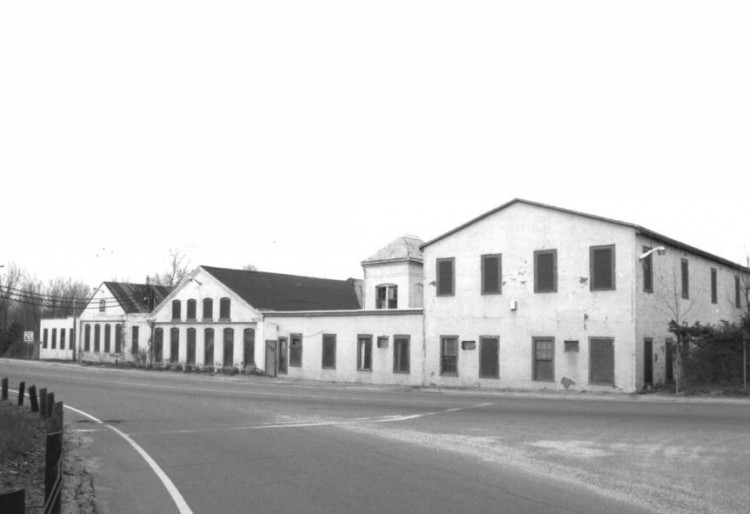
For historical significance see National Register application: http://pdfhost.focus.nps.gov/docs/NRHP/Text/88002680.pdf William Clark opened a shop to make cold-pressed nuts in 1851. By 1854 he was also producing carriage bolts made on forming equipment developed by employees Micah Rugg and Martin Barnes. From 1840 to 1849 Rugg and Barnes had run their own bolt shop, where they first developed several of the metal-forming techniques that led to complete mechanization of carriage-bolt manufacture, The first step was the hammer lathe, which featured a treadle-operated hammer that headed a bolt at the same time the threads were being cut. They also devised dies for trimming bolt heads and several other powered operations before the business was sold. Clark and his workmen expanded and refined the machine-based processes with equipment such as presses for rounding and pointing, and later, rolls for forming threads. In 1864 Clark constructed machines to form carriage bolts from round stock, rather than from the square bars used previously. Before that process was developed the square shoulder of a carriage bolt was simply the portion of the square stock that was neither headed nor rounded for the threads; in Clark's method the square shoulder was upset and formed from the round stock. The square shoulder was necessary to anchor the carriage bolt in wood; this shoulder could not be turned on a lathe, which is one reason why the mechanization of carriage-bolt production followed a path of development that was based on metal-forming. (In contrast, the elements of a machine screw were all concentric, therefore they could be cut on a lathe; the screw machine, a complex and specialized form of lathe, culminated the 19th-century development of metal cutting techniques in manufacture of threaded parts.) In 1893 Clark's earliest shops were destroyed by fire, whereupon the extant factories were built. In 1911 Clark Brothers Bolt Co., so named upon incorporation in 1903, moved from this site into a new plant alongside the New Haven and Northampton Division of the New Haven Railroad. The older plant is now occupied by a chemical firm. (Roth)
- Architectural Information
Number of Existing Buildings
n/a
Dates of Construction
c.1893
Architect
n/a
Builder
n/a
Building Type
n/a
Architectural Description
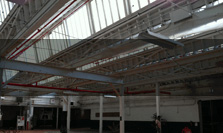
For description see National Register application: http://pdfhost.focus.nps.gov/docs/NRHP/Text/88002679.pdf The main factory, 1-story and 259' x 57', is built of brick with timber framing and has a near-flat roof. The other 1-story brick factory was originally 190' x 84' but has gained large wings at both ends. West of the plant (across South Main St.) stands the Clark dam, about 10' high and made from brownstone blocks. (Roth)
Exterior Material(s)
Structural System(s)
Roof Form
Roof Material
n/a
Power Source
n/a
Condition
n/a
Condition Notes
n/a
- Property Information
-
Specific Location
east side of South Main Street opposite Clark Street on south bank of Quinnipiac River
Adjacent To
n/a
Exterior Visible from Public Road?
Yes
Parcel ID / Assessor Record Link
n/a
Acreage
n/a
Use (Present)
n/a
- Sources
-
Form Completed By
n/a
Date
n/a
Bibliography
- Roth, Matthew, et al, Connecticut: An Inventory of Historic Engineering and Industrial Sites (Washington DC: SIA, 1981).
- Representative View(s)Click on image to view full file