Mill Record New Haven
RETURN TO ‘FIND MILLS’Disclaimer: Content for these properties was compiled in 2014-2017 from a variety of sources and is subject to change. Updates are occasionally made under Property Information, however the Connecticut Trust for Historic Preservation (dba Preservation Connecticut) makes no representation or warranty that the information is complete or up-to-date.
- Complex Name (Common)
- Connecticut Co.
- Complex Name (Historic)
-
- Connecticut Co.
- Address or Location
- 470 James Street, New Haven
- County
- New Haven
- Historic Designation
- Associated Mill Community
- n/a
 What can you do at this mill?
- Historic Information
Companies Associated w/Complex
- Connecticut Co. ca. 1948-1976
- Connecticut Transit 1976-2010
Use (Historic)
Largest Documented Workforce
Unknown.
Historic Narrative
Streetcar operations in New Haven effectively began in 1860 with the organization of the Fair Haven and Westville Railroad. Service under this company began with horse-drawn cars on May 6, 1861, and was electrified by the 1890s. While the Fair Haven and Westville Railroad initially served sections of the eastern part of New Haven, numerous additional street railway companies were soon formed to meet the needs of customers throughout the remainder of the city. Included among them at various periods of time were the New Haven and West Haven Horse Railroad, the Winchester Avenue Railroad, the West Shore Railway Company, the New Haven and Centreville Horse Railway, the Whitney Avenue Horse Railroad, the State Street Horse Railroad, and the New Haven Street Railway. Over the course of the second half of the 19th century, the Fair Haven and Westville Railroad moved aggressively to absorb the numerous other streetcar lines operating in New Haven during the late-19th century. The firm acquired financial control of the last independent competitor operating in the city, the Winchester Avenue Railroad, in 1901, and on May 20, 1904, the latter entity was merged with the parent company. The Fair Haven and Westville Railroad was acquired by the Consolidated Street Railway Company, a subsidiary of the New York, New Haven and Hartford Railroad, just three days later. In 1907, executives at the New York, New Haven and Hartford Railroad organized a new entity, the Connecticut Company, for the purpose of consolidating the railroad’s extensive network of streetcar lines and the various companies that operated them. The Consolidated Street Railway Company was included in this merger, thus giving the New York, New Haven and Hartford Railroad effective control of all trolley services in New Haven, Bridgeport, Hartford, New London, Stamford, and Waterbury. The only Connecticut cities outside of the Connecticut Company’s network were those in Bristol and Danbury. This system of streetcars continued to operate into the 1920s, however, during the 1920s and 1930s many lines were discontinued and replaced with bus service. The last streetcars to operate in Connecticut ceased operation in New Haven in September 1948. The Connecticut Company maintained an extensive network of support services for its trolley lines, including car barns, repair facilities, and power stations. These were scattered throughout the city and were upgraded or replaced as needs arose. The trolley barn at the corner of State and James Streets was built ca. 1920 and was used to store the majority of off-duty trolleys in the New Haven system. The Connecticut Company retained the State Street property until streetcar service was ended in 1948. That year it was supplanted by a new bus facility across the street on the west side of James Street, which housed offices, a 350-bus garage, and various repair and body shops. The trolley barn passed to a mix of industrial tenants including the New Haven Electotype division of the Electrographic Corporation, the New Haven Container Corporation, and the New Haven Paper Box Company. The Connecticut Company continued to operate until 1976, whereupon the firm and its transportation network was purchased by the State of Connecticut. Connecticut Transit continued to use the James Street facility until 2010.
- Architectural Information
Number of Existing Buildings
Five (5) adjoining primary blocks.
Dates of Construction
ca. 1948.
Architect
n/a
Builder
n/a
Building Type
Architectural Description
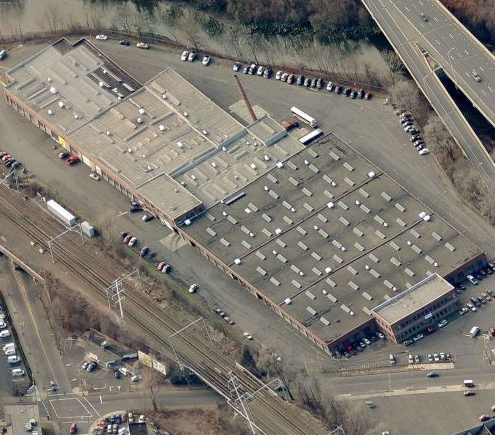
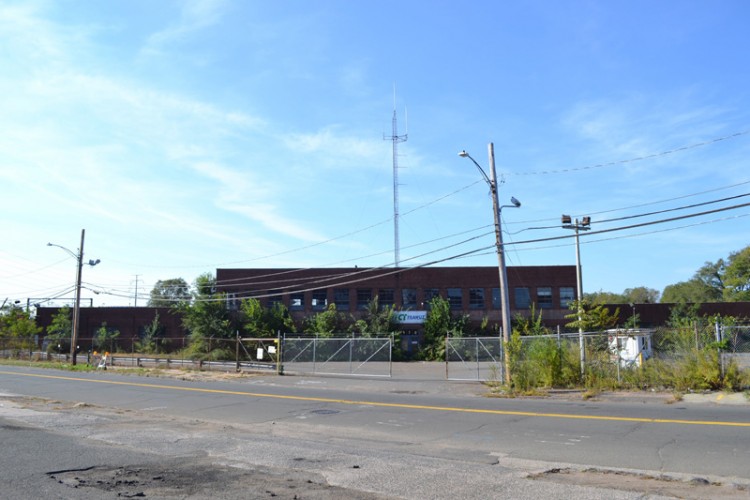
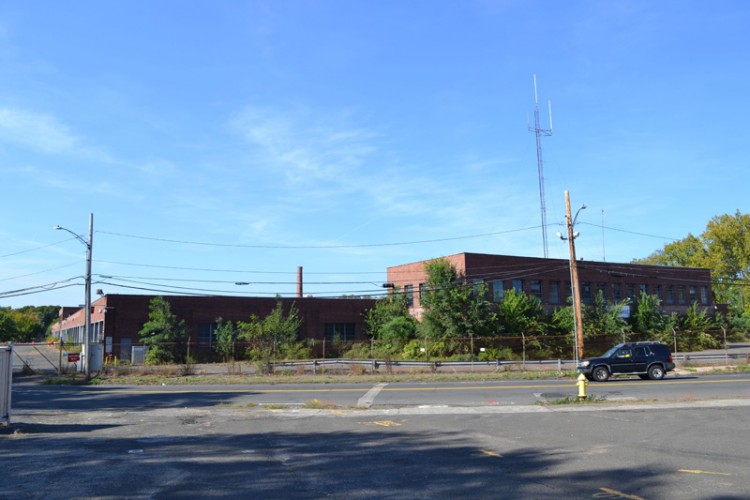
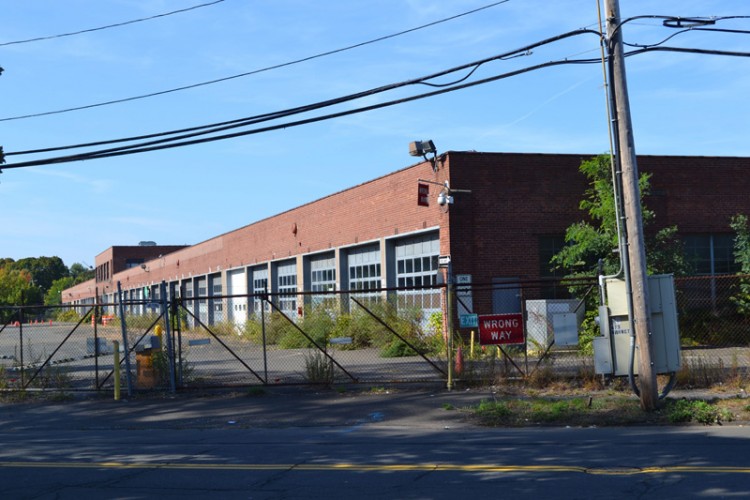
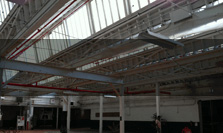
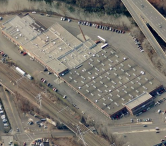
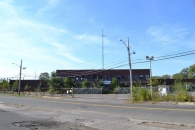
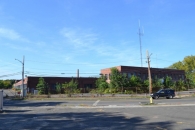
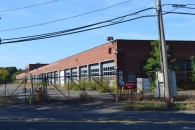
The Connecticut Company’s former James Street office, bus storage, and repair facility is comprised of five primary adjoining blocks located on the west side of James Street, at the southwest corner of James Street’s intersection with State Street. All five blocks were erected ca. 1948 and are of steel-frame construction with red brick apron walls, rectangular window openings with concrete sills, tile coping, and flat roofs. The easternmost block is a two-story, 124’ x 42’ office building that is 16 bays wide and 5 bays deep. The windows consist of large multi-pane metal sash with pivot-style openings. The block’s main entry is located just north of center on the first story of the east (façade) elevation. This consists of a pair of wood and glass entry doors with a large three-light transom above. The facility’s bus garage adjoins the west elevation of the office block. It is a one-and-a-half-story, 302’ x 332’ building that formerly housed up to 350 buses and a tire repair workshop. The block has four large window openings on each side of the east elevation flanking the office block and 18 garage bays extending along each of the north and south (side) elevations. The majority of the bays retain their original doors, which are of wood and glass paneled construction. Dozens of multi-pane wire-glass skylights dot the roof of the block. A one- and two-story, 252’ x 84’ block adjoins the garage’s west elevation. This formerly housed the facility’s repair office, stockroom, service shop, filling station, and boiler room. The block has a mix of garage bays, pass-through doors, and window openings on the first floor of the north and south elevations, and large window openings on all four elevations of the two-story portion of the southern end of the block. Sawtooth monitors line the block’s roof. A one-story, 210’ x 168’ block adjoins the west elevation of the office and repair block. This housed additional repair facilities and bus repair pits. The block has nine garage doors on each of the north and south elevations and sawtooth monitors scattered along the flat roof. The final block associated with the facility is a one-story, 156’ x 151’ building that formerly served as the facility’s body and paint shop. This has seven garage bays on each of the north and south elevations, and a mix of garage bays and window openings along the west elevation of the building. As with the neighboring block, sawtooth monitors line the roof.
Exterior Material(s)
Structural System(s)
Roof Form
Roof Material
Power Source
Condition
Fair
Condition Notes
The complex is in fair condition. The exterior walls are in need of cleaning and minor repairs, however, most of the original windows have been retained and the facility have been generally well maintained. In 2016 a high tech business hub, District, was approved and redevelopment began.
- Property Information
-
Specific Location
One legal parcel (470 James Street) totaling 6.95 acres located on the west side of James Street, at the southwest corner of James Street’s intersection with State Street.
Adjacent To
Exterior Visible from Public Road?
Yes
Parcel ID / Assessor Record Link
- 181/0603/01100. / Link →
Acreage
6.95
Use (Present)
- Mixed-Use
- Other: State approved clean-up funds 2016. Tech Hub in development 2017. District New Haven opened 2018 with co-work spaces to fit the needs of companies of various sizes and includes an athletic club, restaurant, beer garden, walking trail, and a campus kayak and paddleboard launch. The office space is occupied by more than 50 companies and about 180 workers.
- Sources
-
Form Completed By
Lucas A. Karmazinas
Date
10/08/2015
Bibliography
- List of Connecticut Manufacturers, 1922, 1924, 1930, 1932.
- Directory of Connecticut State Manufacturers, 1936, 1939.
- Industrial Directory of Connecticut, 1947.
- Register of War Production Facilities in Connecticut, 1951.
- Map of New Haven County; Clark, Richard, 1859.
- Atlas of New Haven County, Beers, Ellis & Soule, 1868.
- Aerial Survey of Connecticut, 1934, 1965.
- Sanborn Map Company, 1901, 1911, 1923, 1950.
- New Haven City Directory; Various editions.
- History of the City of New Haven to the Present Time, 1887.
- A Modern History of New Haven and Eastern New Haven County, 1920.
- New Haven Streetcars; Branford Electric Railway Assoc., 2003.
- Western Connecticut Trolleys; Connecticut Motor Coach Museum, 2007.
- Representative View(s)Click on image to view full file
-
Photographer
Lucas A. Karmazinas
Photography Date
10/08/2015