Mill Record Greenwich
RETURN TO ‘FIND MILLS’Disclaimer: Content for these properties was compiled in 2014-2017 from a variety of sources and is subject to change. Updates are occasionally made under Property Information, however the Connecticut Trust for Historic Preservation (dba Preservation Connecticut) makes no representation or warranty that the information is complete or up-to-date.
- Historic Information
Companies Associated w/Complex
Use (Historic)
- Other: Power generation (coal)
Largest Documented Workforce
n/a
Historic Narrative
For historical significance see National Register nomination: http://pdfhost.focus.nps.gov/docs/NRHP/Text/90001096.pdf Cos Cob Power Plant, built 1905-07, supplied power to the first mainline, long-distance electrified rail way in the U. S. -- the Shoreline (formerly New York) Division of the New York, New Haven and Hartford Railroad. Electrification was initiated in response to the New York State Legislature's requirement, enacted in 1903, that locomotives within New York City be powered by some means not requiring combustion on the train itself. Both lines affected by the law, the New York Central and the New York, New Haven and Hartford, extended the zone of electrification because heavy traffic in the city would have been complicated further by changing between steam and electric traction at the city limits. The New York Central electrified the 13 miles of its line between Grand Central Terminal and Woodlawn, NY using low-volltage direct current, picked up by the locomotives from a side-mounted third rail. Electricity was generated as high-voltage alternating current, transmitted to substations located about five miles apart along the track. At these it was converted to the 666-volt direct current of the third rail. The New York, New Haven and Hartford, however, envisioned electrification as far east as New Haven, 66 miles from Woodlawn. Earlier experience with the electrification of short sections of the system gave evidence that over such a distance the use of high-voltage alternating current for both transmission and operation would be more economical. Besides offering lower operating costs, such a system obviated the need for substations. The system, completed in 1907, set the standard for power characteristics in American railroad electrification: single-phase alternating current at 11,000 volts and 25 cycles. Initially the railroad electrified the 21 miles of track between Woodlawn and Stamford, CT, extending it 45 miles eastward to New Haven in 1911-1914. The future of the plant is uncertain. (Roth)
- Architectural Information
Number of Existing Buildings
n/a
Dates of Construction
c.1905, c.1911
Architect
n/a
Builder
n/a
Building Type
Architectural Description
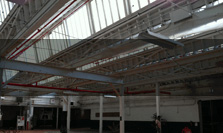
For description see National Register nomination: http://pdfhost.focus.nps.gov/docs/NRHP/Text/90001096.pdf Cos Cob power house still serves its original purpose, though most equipment has been replaced and additions have hidden or eliminated many details of the Spanish Mission-style exterior. Walls of the plant (original dimensions 248' x 112') are plain-faced concrete blocks made with gneiss excavated on the site. All interior columns are of concrete blocks, except for steel columns in the boiler room. Steel trusses, carried on interior pilasters, support the roof, which is reinforced cinder concrete faced with tile. With the [1911-1914] extension the powerhouse doubled in size by the addition of a wing to the west. Some early auxiliary equipment survives: two c.1912 overhead, weighing larry cars and the c. 1907 reinforced concrete, cylindrical feedwater tank (600,000 gallon) by the building's northwest corner. (Roth 1981)
Exterior Material(s)
Structural System(s)
Roof Form
n/a
Roof Material
n/a
Power Source
n/a
Condition
n/a
Condition Notes
Demolished.
- Property Information
-
Specific Location
Roughly bounded by Metro North RR tracks, the Mianus R. and Sound Shore Dr.
Adjacent To
n/a
Exterior Visible from Public Road?
Yes
Parcel ID / Assessor Record Link
n/a
Acreage
6
Use (Present)
n/a
- Sources
-
Form Completed By
n/a
Date
n/a
Bibliography
- Roth, Matthew, et al, Connecticut: An Inventory of Historic Engineering and Industrial Sites (Washington DC: SIA, 1981).
- Roth, Matthew, and Bruce Clouette. 1990. Cos Cob Power Station National Register Nomination No. 90001096. National Park Service.
- Representative View(s)Click on image to view full file