Mill Record Meriden
RETURN TO ‘FIND MILLS’Disclaimer: Content for these properties was compiled in 2014-2017 from a variety of sources and is subject to change. Updates are occasionally made under Property Information, however the Connecticut Trust for Historic Preservation (dba Preservation Connecticut) makes no representation or warranty that the information is complete or up-to-date.
- Complex Name (Common)
- Cuno Engineering Corp.
- Complex Name (Historic)
-
- Cuno Engineering Corp.
- Address or Location
- 80 South Vine Street, Meriden
- County
- New Haven
- Historic Designation
- Associated Mill Community
- n/a

- Historic Information
Companies Associated w/Complex
- Browne and Dowd Mfg. Co. 1912-ca.1930
- C. G. Armstrong Mfg. Co. 1912-ca.1940
- Cuno Engineering Corp. 1912-1969
- H.W. Stowe Co. 1912-ca. 1920
Use (Historic)
Largest Documented Workforce
370 (1969).
Historic Narrative
The Cuno Engineering Corporation was established by Charles F. Cuno in 1912. Born in Berlin, Germany, on February 3, 1863, Cuno emigrated to the United States in 1881 and found work as a mechanic in Milwaukee, Wisconsin. In 1907, Cuno moved to Meriden, where he was hired as a chief engineer and designing engineer by the Connecticut Telephone and Electric Company. Cuno remained at the firm until 1912, when he organized his own company for the manufacture of a variety of automobile accessories. The Cuno Engineering Corporation began production in a building on South Vine Street that had been erected in 1912 by the Meriden Board of Trade Industrial Corporation for the purpose of providing small start-up companies with affordable factory space. The firm joined three other companies within the building, these being the C.G. Armstrong Manufacturing Company, a novelty jewelry manufacturer; the Browne and Dodd Manufacturing Company, a household hardware manufacturer; and the H.W. Stowe Company, a producer of power pneumatics used in player pianos. These firms vacated the plant by 1940, 1930, and 1920, respectively, with the Cuno Engineering Corporation assuming the entirety of the plant, as well as erecting a substantial addition to it, by 1940. Much of the Cuno Engineering Corporation’s early success was driven by a product known as the ‘Cuno Electric Match,’ which was a dashboard-mounted cigarette lighter that was marketed as being safer than using traditional matches while driving. The company began producing filtration products for automotive and industrial applications in 1926, and this became the majority of the firm’s business by the 1950s. The company entered into the aerospace industry during the late-1950s following development of a line of filters used in guided missiles which it produced in collaboration with the United Aircraft Corporation. In 1960 the Cuno Engineering Corporation was acquired by the American Machine and Foundry Company (AMF), a recreational equipment manufacturing company based in Brooklyn, New York. The Cuno Engineering Corporation continued to operate as a semi-independent branch of AMF and maintained its South Vine Street factory until 1969 when a new $4.6 million 250,000 square foot plant was built in a suburban industrial park in the southeast corner of Meriden. The original complex has since passed to the Thompson Chocolate Company, a confectionary firm established in Meriden in 1879, which occupies the southern half of the plant.
- Architectural Information
Number of Existing Buildings
Four (4) primary blocks.
Dates of Construction
1912, 1938, ca. 1940, 1950, ca. 1960.
Architect
Malcolm R. Knox (c.1940 office addition); Leo F. Caproni (1950 addition)
Builder
n/a
Building Type
Architectural Description
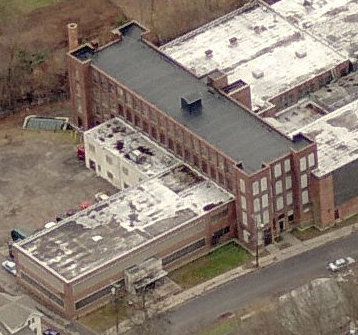
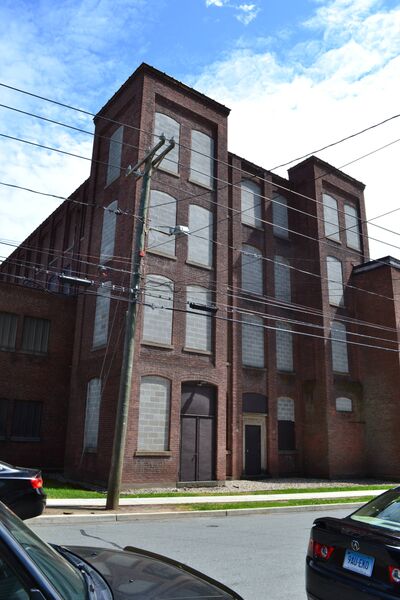
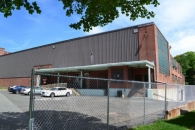
The Cuno Engineering Corporation plant is comprised of approximately four primary adjoining blocks located on the east side of South Vine Street, roughly 775’ south of South Vine Street’s intersection with West Main Street. The earliest section of the plant is a four-story, 38’ x 158’ red brick manufacturing block erected in 1912. The building is of typical brick mill construction and has a concrete foundation, segmental-arched window openings with concrete sills, a denticulated and corbelled brick cornice, and a flat roof. Four-story stairtowers are located at all four corners of the building. The window openings at the western (façade) end of the building have been infilled with concrete block, while those throughout the remained of the building have been boarded up with sheets of plywood. A two-story, 50’ x 130’ office block built ca. 1940 adjoins the north elevation of the original building; the architect is listed as Malcolm R. Knox in Engineering News Record, 1946. This of steel-frame construction and has red brick curtain walls, rectangular ribbon window openings with concrete frames, a plain concrete cornice, and a flat roof. All of the windows have been infilled with vertically oriented aluminum siding. A large two-story manufacturing block adjoins the south elevation of the original building. This was built up in phases completed in 1938, ca. 1940, and 1951. The completed block measures 210’ x 182’ overall and is of steel-frame construction with red brick curtain walls. The building’s large window openings have concrete sills and the original fenestration consisted of multi-pane steel sash. The latter are still visible on the south (side) and east (rear) elevations, however, the façade windows have been covered with vertically oriented aluminum siding spanning the full width of the building. The final primary block associated with the plant is a two-story, 28’ x 64’ concrete block structure erected adjoining the north elevation of the original factory ca. 1960. The 1950 addition was designed by Leo F. Caproni, according to an AIA questionnaire the architect completed in 1953.
Exterior Material(s)
Structural System(s)
Roof Form
Roof Material
Power Source
Condition
Fair
Condition Notes
The factory is in overall fair condition. The majority of the blocks appear to be well maintained, however, most of the original window openings have either been infilled or covered with plywood or aluminum siding.
- Property Information
-
Specific Location
One legal parcel (80 South Vine St.) totaling 2.10 acres located on the east side of South Vine Street, roughly 775’ south of South Vine Street’s intersection with West Main Street.
Adjacent To
n/a
Exterior Visible from Public Road?
Yes
Parcel ID / Assessor Record Link
- 0612-193D-0020-0000 / Link →
Acreage
2.1
Use (Present)
- Sources
-
Form Completed By
Lucas A. Karmazinas
Date
05/22/2015
Bibliography
- List of Connecticut Manufacturers, 1922, 1924, 1930, 1932.
- Directory of Connecticut State Manufacturers, 1936, 1939.
- Industrial Directory of Connecticut, 1947.
- Register of War Production Facilities in Connecticut, 1951.
- Map of New Haven County, H & C.T. Smith, 1856.
- Atlas of New Haven County, Beers, Ellis & Soule, 1868.
- Birdseye View of Meriden, Connecticut, O.H. Bailey & Co., 1875.
- Birdseye View of Meriden, Connecticut, Hughes and Bailey, 1918.
- Sanborn Map Company, 1884, 1891, 1896, 1901, 1950, 1953.
- Hartford Courant, 1919, 1941, 1956, 1960, 1967, 1969.
- An Historic Record and Pictorial Description of the Town of Meriden, Connecticut; Gillespie, C. Bancroft, ed., 1906.
- A Modern History of New Haven and Eastern New Haven County; Hill, Everett G., 1918.
- History of New Haven County, Connecticut; Rockey, John L., 1892.
- Information, historic photographs and sources for Leo Caproni courtesy Gregg Bateman (2018).
- Representative View(s)Click on image to view full file
-



Photographer
Lucas A. Karmazinas
Photography Date
05/22/2015