Mill Record Stamford
RETURN TO ‘FIND MILLS’Disclaimer: Content for these properties was compiled in 2014-2017 from a variety of sources and is subject to change. Updates are occasionally made under Property Information, however the Connecticut Trust for Historic Preservation (dba Preservation Connecticut) makes no representation or warranty that the information is complete or up-to-date.
- Complex Name (Common)
- Deering Milliken Research Trust
- Complex Name (Historic)
-
- Deering Milliken Research Trust
- Address or Location
- 375 Fairfield Avenue, Waterside, Stamford
- County
- Fairfield
- Historic Designation
- Associated Mill Community
- n/a
- Historic Information
Companies Associated w/Complex
- Deering Milliken Research Trust 1945-1950
Use (Historic)
Largest Documented Workforce
n/a
Historic Narrative
The building is significant for its occupancy from 1945-1950 by the Deering Milliken Research Trust, a non-profit subsidiary of the Deering Milliken textile conglomerate. The foundation was the second product development concern to locate in an existing industrial building in Stamford. During the time of its occupancy, Deering Milliken began to conduct proprietary research on new applications of nylon for military and industrial uses, flame-resistant textiles and consumer apparel. Deering Milliken originated in Portland, Maine in 1865 with the partnership of Seth Mellen Milliken (1836-1920) from New Hampshire and William Deering (1826-1913) who invested in a retail business there. A fire prompted the firm’s relocation to New York, where Deering had an idea to develop harvesting equipment and left for Chicago, founding the Deering Harvesting Machinery Company, which later became International Harvester. Milliken kept the Deering name in his mercantile business in New York that both represented and invested in textile companies in New England and the south. Milliken’s investments and those of his son Gerrish Hill Milliken (1877-1947) led to Deering Milliken’s gradual acquisition of 19 formerly independent southern textile mills during the depression when production could not keep pace with debt repayment. By the 1930s, Deering Milliken produced a diversified line of wool, cotton and rayon yarns and fabrics. Prior to succeeding his father Gerrish as president in 1947, Roger Milliken (1915- 2010) joined the family business a decade earlier to run four of the southern mills and expand their operations. During World War II, textile mills that sold through Deering Milliken produced a wide range of yarns and fabrics. An important need for the war effort was tire cord, and in 1944, the War Production Board issued a Certificate of Necessity for Deering Milliken to produce nylon tire cord as a more durable substitute for rayon tire cord. Roger Milliken designed a new facility, the Excelsior Tire Cord Plant in Clemson, SC, the first windowless textile mill in the country. It was built for the single purpose to manufacture tire cord as efficiently as possible. There in 1945 he launched the company’s first research team, the Deering Milliken Research Trust as a non-profit incorporated in Maine. Soon after, the Trust’s research laboratories were relocated to Stamford with its patent office nearby in Greenwich. In 1949, Milliken moved the main research operations of the Trust back to an upper floor of the Clemson plant. The Stamford factory remained occupied by Southern Mills, Inc., a distributor of flame-proof nylon-based fabrics through the 1970s.
- Architectural Information
Number of Existing Buildings
One (1) block.
Dates of Construction
c.1930
Architect
n/a
Builder
n/a
Building Type
Architectural Description
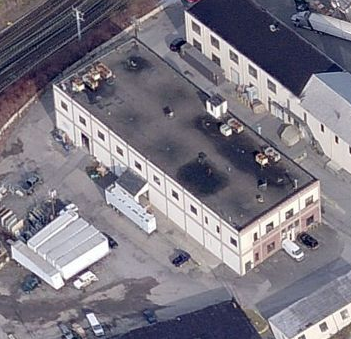
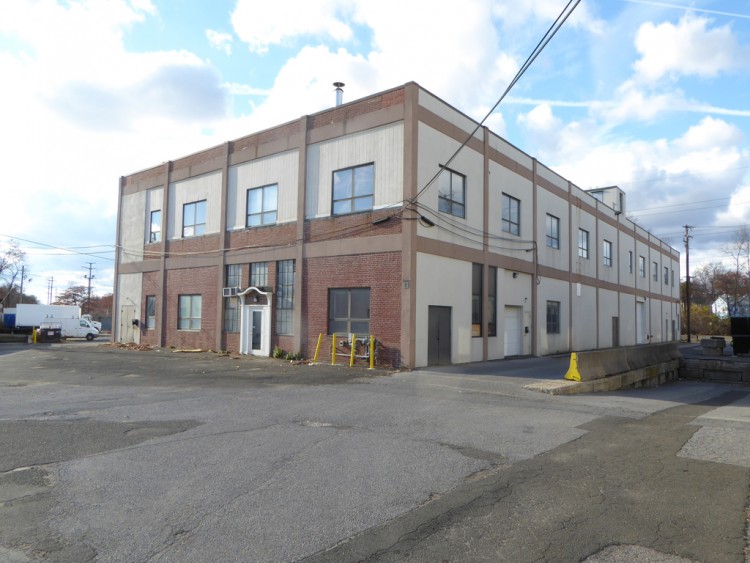
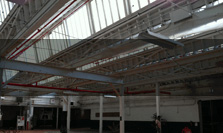
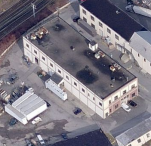
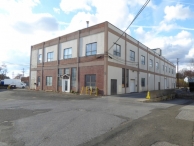
The building occupied by the former Deering Milliken Research Trust from c.1945 to 1949 is a two-story, reinforced concrete daylight factory loft enclosing 32,400 square feet. It is rectangular in plan, measuring 81 by 200 feet, and originally had brick spandrels with large window sash on the first floor of the front (east) elevation.
Exterior Material(s)
Structural System(s)
Roof Form
Roof Material
- Other: Composition
Power Source
Condition
Fair
Condition Notes
The building is occupied and appears to be structurally sound and weathertight but maintenance has been neglected. It retains its original massing and exposed concrete frame throughout, and brick spandrels on the front (east) elevation. Original window openings have been largely infilled with stucco and plywood holding smaller replacement windows and doors.
- Property Information
-
Specific Location
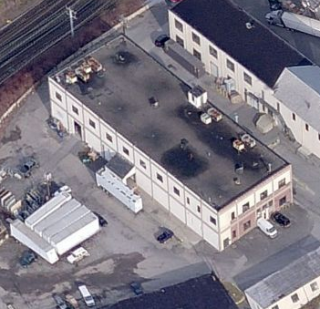
One of nine buildings identified as building 6 in tax assessment records located on a legal parcel of 9.38 acres along the south side of the main New Haven line railroad entered from by a drive from frontage along Fairfield Avenue.
Adjacent To
Exterior Visible from Public Road?
Yes
Parcel ID / Assessor Record Link
- 001/3193 / Link →
Acreage
9.38 overall parcel
Use (Present)
- Sources
-
Form Completed By
Wes Haynes
Date
September 2016
Bibliography
- Sanborn Map Co., 1929-30, 1951.
- Representative View(s)Click on image to view full file
-
Photographer
n/a
Photography Date
September 2016