Mill Record Canaan
RETURN TO ‘FIND MILLS’Disclaimer: Content for these properties was compiled in 2014-2017 from a variety of sources and is subject to change. Updates are occasionally made under Property Information, however the Connecticut Trust for Historic Preservation (dba Preservation Connecticut) makes no representation or warranty that the information is complete or up-to-date.
- Complex Name (Common)
- Falls Village Water Power Co.
- Complex Name (Historic)
-
- Connecticut Power Co.
- Falls Village Water Power Co.
- Address or Location
- 35 Water Street, Falls Village, Canaan
- County
- Litchfield
- Historic Designation
- Associated Mill Community
- n/a
 What can you do at this mill?
- Historic Information
Companies Associated w/Complex
- Connecticut Power Co. 1912-
- Falls Village Water Power Co. 1851-1912
Use (Historic)
- Other: Power generation
Largest Documented Workforce
n/a
Historic Narrative
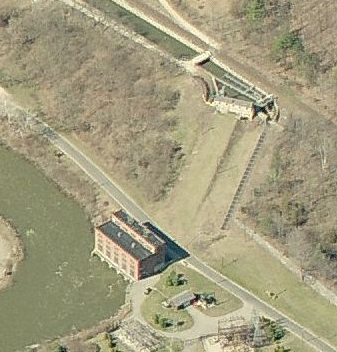
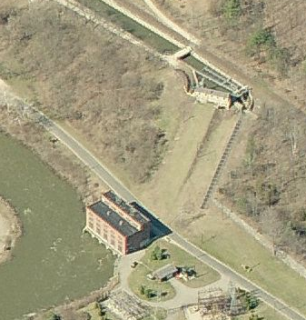
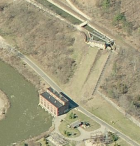
Canfield and Robbins, iron manufacturers, organized the Falls Village Water Power Co. in 1845 to develop the vast potential at the Great Falls of the Housatonic, where the river drops over 100' in less than a mile. Construction of the dam and canal took two years, 1849-1851. A stone and-earth retaining wall supported the canal high on the ridge running along the river's east bank; the water would be used three times on its return to the river, affording about 30' head at each application. The canal itself was made of granite blocks. An impressive structure, sufficiently sound to have survived 130 years, the canal was a resounding failure because, for unknown reasons, the builders did not seal the walls in any way to prevent leakage. The canal did not hold water. In 1859 the owners appealed to local residents to contribute labor to repair the canal, but nothing was accomplished. William Barnum, a competitor in the iron trade, bought Canfield's share in 1859 and paid for extensive repairs in 1865, but water never flowed and industry never came. For the rest of the 19th century business and personal antipathy between Robbins and Barnum paralyzed the project, as each vetoed the other's initiatives. Incompetent engineers and contentious owners prevented realization of one of the more ambitious schemes for industrial development in 19th-century Connecticut. Connecticut Power Co. bought the dam, canal and surrounding land in 1912, and engaged Stone and Webster Engineering Corp. of Boston to design and construct a hydroelectric generating plant. The earth-buttress dam was rebuilt to its present dimensions of 25' wide at the base, 10' wide at the top, 16' high, and masonry facing and cap were added. The canal was widened to 18' and lined with concrete to about 1,900' below the dam, at which point steel penstocks were laid to run 90' down the hill to the brick powerhouse. Generation began in 1914. The original generating equipment has been replaced, but electricity is still produced here. The 1851 canal survives substantially unaltered below the penstocks. (Roth)
- Architectural Information
Number of Existing Buildings
One (1) block.
Dates of Construction
c.1913
Architect
Stone and Webster Engineering Corp., Boston
Builder
Stone and Webster Engineering Corp., Boston
Building Type
Architectural Description
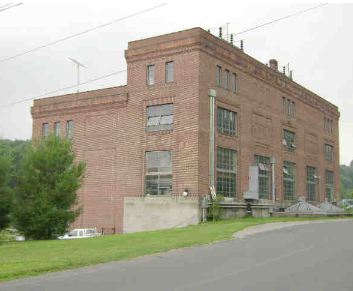
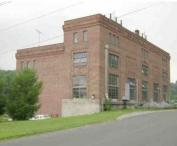
The three-story brick powerhouse, approx. 60 ft by 120 ft, has a five bay east (front) facade with steel frame windows and a decorative brick cornice. The building steps down a story from the front elevation, retaining three stories at a lower grade across the penstock outflow and the same five bay window and cornice configuation on the west facade above the five arched tailrace.
Exterior Material(s)
Structural System(s)
n/a
Roof Form
Roof Material
n/a
Power Source
Condition
n/a
Condition Notes
n/a
- Property Information
-
Specific Location
One 29.06 parcel between the Housatonic River to the west and Water Street to the east
Adjacent To
Exterior Visible from Public Road?
Yes
Parcel ID / Assessor Record Link
- 16/ / 35 / Link →
Acreage
26.06
Use (Present)
- Sources
-
Form Completed By
n/a
Date
n/a
Bibliography
- Roth, Matthew, et al, Connecticut: An Inventory of Historic Engineering and Industrial Sites (Washington DC: SIA, 1981).
- Representative View(s)Click on image to view full file
-
Photographer
n/a
Photography Date
n/a