Mill Record Hartford
RETURN TO ‘FIND MILLS’Disclaimer: Content for these properties was compiled in 2014-2017 from a variety of sources and is subject to change. Updates are occasionally made under Property Information, however the Connecticut Trust for Historic Preservation (dba Preservation Connecticut) makes no representation or warranty that the information is complete or up-to-date.
- Complex Name (Common)
- Hartford Rubber - Pope Tire - U.S. Rubber
- Complex Name (Historic)
-
- Hartford Rubber - Pope Tire - U.S. Rubber
- Address or Location
- 1477 Park Street, Parkville, Hartford
- County
- Hartford
- Historic Designation
- Associated Mill Community
- n/a
 What can you do at this mill?
- Historic Information
Companies Associated w/Complex
- Hartford Rubber Works c.1890-1899
- Rubber Goods Manufacturing Co. 1899-1905
- U. S. Rubber Co. 1905-1929
Use (Historic)
Largest Documented Workforce
n/a
Historic Narrative
see State Register form The Hartford Rubber Works Co. was established by John W. Gray, a Hartford rubber goods merchant, in 1881. The company’s initial plant was built on the south side of Park Street shortly after the firm was organized. The original factory measured just 50’ x 60’ and Gray’s entire workforce numbered just 20 hands. By the early 1890s, however, the firm had expanded to become one of the largest and best equipped manufacturers of rubber goods in the country, positioning itself as the primary supplier of bicycle tires to the Pope Manufacturing Co., also based in Hartford. In 1892, a Hartford Courant article announced Pope’s acquisition of majority control of the Hartford Rubber Works, which at that time employed about 170 employees and operated 24 hours a day. In 1899 the Hartford Rubber Works was absorbed into one of Pope’s various holding companies, the Rubber Goods Manufacturing Co., and then in 1905 was purchased by another conglomerate, the U.S. Rubber Co.. Despite these acquisitions, the firm’s stability and success meant that it was largely allowed to operate without heavy-handed management from the outside entities. The quality of the company’s proprietary products – including its double-tube “Clincher” tires, released in 1903, and anti-skid “Bailey Tread” tires, released in 1905 – resulted in Hartford Rubber Works Co. tires as standard equipment on an array of early automobiles in addition to those built by the Pope Manufacturing Co.. Among these were cars produced by Locomobile, Olds, Baker Electric, Pierce, Racine, Packard, Peerless, Pierce-Arrow, White, Stevens-Duryea, Rambler, Cadillac, and Studebaker. The resultant demand fueled expansion in both the company’s workforce and its physical plant through the 1910s. This growth came at a time when the conglomerate U.S. Rubber Co. – of which the Hartford Rubber Co. was one of four plants – contributed one-third of the 4,500,000 pneumatic tires produced in the country. Although the outbreak of World War One resulted in several instances of slowed productivity due to material shortages, the company quickly retooled in order to support the war effort. By the war’s end the company had contributed over 55,000 gas masks, 5,000 pairs of hip-height rubber boots, 5,000 solid rubber tires, and thousands of pneumatic tires.
The success of the Hartford Rubber Works Co. continued in the post-war period as increasing numbers of Americans became financially capable of acquiring personal automobiles, driving up the national demand for tires. In 1918 the company initiated another massive building program intended to expand its workforce capacity from a 3,000 employees to a total of 7,000. The expansion included construction of a new six-story, 278,000 square-foot factory and a four-story employee building, both located on the south side of Park Street. Although completion of the company’s new buildings allowed the Hartford Rubber Works to begin operating 24 hours a day in three eight-hour shifts, the good times were not to last. Employment peaked at around 4,000 in the early 1920s and began to dwindle throughout the remainder of the decade, as technological advances in machinery allowed for increased production with reduced staffing. In August 1929 it was announced that the U.S. Rubber Co. would close the Hartford plant and move all of its operations to Detroit. Following the shutdown of the Hartford Rubber Works Co. factory, the U.S. Rubber Co. assumed the role of a landlord, eventually leasing the Hartford plant to a variety of commercial and light industrial firms through the 1930s and 1940s. In 1945, the company sold the factory complex to a Hartford real estate syndicate. See also Today in Connecticut History: Pope Manufacturing Co. Debuts Electric Automobile in 1897 at https://todayincthistory.com/2018/05/13/may-13-electric-automobile-1897/- Architectural Information
Number of Existing Buildings
multiple
Dates of Construction
multiple
Architect
n/a
Builder
n/a
Building Type
n/a
Architectural Description
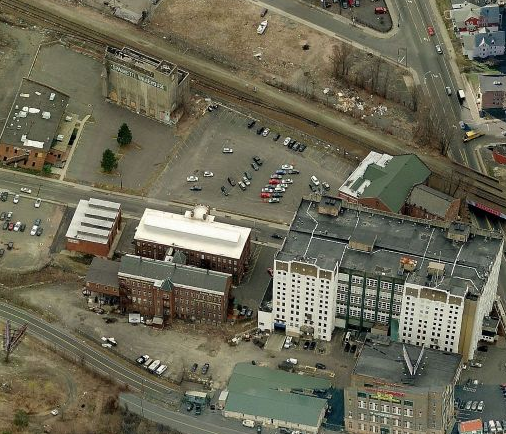
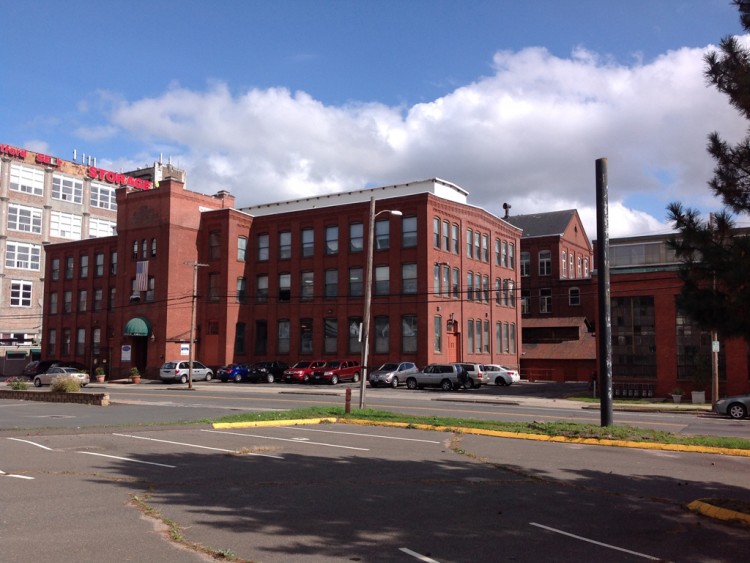
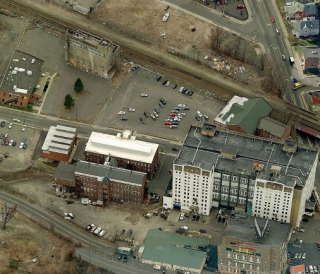
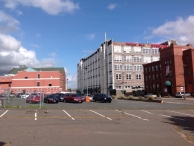
30 Bartholomew Ave: Pope Manufacturing Company. Brick Mill style industrial building, 1903. Fred O’Neil, builder. Three-and-a-half-story red-brick factory complex with flat and side-gabled roofs. 50 Bartholomew Ave: United States Rubber Company. Brick Mill style industrial building, 1922. Two-story red-brick industrial building with flat roof. 45 Bartholomew Ave: Hartford Rubber Works Company. Reinforced concrete boiler house, 1912. Ford, Buck and Sheldon, structural engineers and architects (Hartford). Fred T. Ley, builder. Three-story reinforced concrete power plant with flat roof. 55 Bartholomew Ave: Hartford Rubber Works Company. Brick Mill style industrial building, c. 1912. Two-story red-brick factory building with low-pitch, front-facing gable roof. 69-71 Bartholomew Ave: Pope Manufacturing Company. Brick Mill style industrial building, 1895. W.W. Marvel, builder. Two-and-a-half-story red-brick factory complex with front-facing gable roof. 81-99 Bartholomew Ave: Pope Manufacturing Company. Brick Mill style industrial building, 1893, 1895. A.C. Pattison and Son, builder. Two-story red-brick factory complex with flat roof penetrated by sawtooth monitors. 1409 Park St: United States Rubber Company. Art Deco industrial building, 1920. Lockwood, Greene and Company, architects (Boston, MA). Stone and Webster, builders. Four story, poured concrete and yellow-brick industrial building with flat roof. 1429 Park St: United States Rubber Company. Art Deco industrial building, 1920. Lockwood, Greene and Company, architects (Boston, MA). Stone and Webster, builders. Six-story steel, poured concrete, and yellow-brick industrial building with flat roof. And vernacular industrial building, 1920. Lockwood, Greene and Company, architects (Boston, MA). Stone and Webster, builders. One story, poured concrete industrial building with low-pitch side-gabled roof. 1477 Park St: Hartford Rubber Works Company. Brick mill industrial building, 1895. George Keller, architect (Hartford). Three-story red-brick industrial building with front-facing and side-gabled roof. Northern wing raised from two to three stories in 1910. Latter work completed by George Zunner, architect (Hartford), and A.L. Hills, builder. 55 Pope Park Hwy No.4 (55-61) aka 30rear Bartholomew Ave: Hartford Rubber Works Company. Brick mill industrial building, 1905. Isaac A. Allen, architect (Hartford). Caspar Rauger, builder. Four-story red-brick industrial building with side-gabled roof .
Exterior Material(s)
Structural System(s)
n/a
Roof Form
Roof Material
Power Source
n/a
Condition
Good, Fair, Deteriorated
Condition Notes
n/a
- Property Information
-
Specific Location
Multiple parcels at corner of Park Street and Bartholomew Avenue and along Bartholomew Avenue
Located in Parkville Historic District;
For the buildings at 45-55 Bartholomew Avenue only, see State Register form.Adjacent To
n/a
Exterior Visible from Public Road?
Yes
Parcel ID / Assessor Record Link
- 159/485/62 (for record, use link and type in address or parcel number) / Link →
- 159/485/60 (for record, use link and type in address or parcel number) / Link →
- 159/486/084 (for record, use link and type in address or parcel number) / Link →
- 159/486/079 (for record, use link and type in address or parcel number) / Link →
- 159/486/080 (for record, use link and type in address or parcel number) / Link →
Acreage
n/a
Use (Present)
- Mixed-Use
- Other: Within proposed Parkville Arts & Innovation (improvement) District, in discussion/planning 2023. 30 Bartholomew Ave: commercial mixed use 50 Bartholomew Ave: retail 45 Bartholomew Ave: 2022 to be converted into Girls for Technology workforce and talent development center 55 Bartholomew Ave: Hands On Hartford food pantry/housing/supportive services since 2016 69-71 Bartholomew Ave: commercial 81-99 Bartholomew Ave: commercial 1409 Park St: storage 1429 Park St: mixed use; as of 10/2025 developer Mouta converting mixed use space to 47 apartments on upper floors for 143 res units total 1477 Park St: residential 55 Pope Park Hwy No.4 (55-61) aka 30rear Bartholomew Ave: industrial
- Sources
-
Form Completed By
n/a
Date
n/a
Bibliography
- Karmazinas, Lucas. 2015. Parkville Historic District National Register Nomination. Access draft at:.
- Parkville Industrial Historic District, National Register of Historic Places Registration Form, US Department of the Interior.
- 45-55 Bartholomew Avenue only:.
- Karmazinas, Lucas. 2014. Hartford Rubber Works State Register Nomination. Access at:.
- Hartford Rubber Works Company Boiler House and Tire Storage Building, Registration Form.
- Representative View(s)Click on image to view full file
-




Photographer
n/a
Photography Date
n/a