Mill Record Norwich
RETURN TO ‘FIND MILLS’Disclaimer: Content for these properties was compiled in 2014-2017 from a variety of sources and is subject to change. Updates are occasionally made under Property Information, however the Connecticut Trust for Historic Preservation (dba Preservation Connecticut) makes no representation or warranty that the information is complete or up-to-date.
- Complex Name (Common)
- Hopkins & Allen Fire Arms Co.
- Complex Name (Historic)
-
- Hopkins & Allen Fire Arms Co.
- Address or Location
- 132-176 Franklin Street, Norwich
- County
- New London
- Historic Designation
- Associated Mill Community
- n/a
- Historic Information
Companies Associated w/Complex
- Hopkins & Allen Fire Arms Co. 1900-1917
- J.B. Martin Co. 1921-ca. 1970s
- Marlin-Rockwell Co. 1917-ca. 1918
Use (Historic)
Largest Documented Workforce
2,000 (1917).
Historic Narrative
The Hopkins and Allen Fire Arms Company was organized on June 15, 1868, with $6,000 in capital. The founders included Samuel S. and Charles W. Hopkins, Charles W. Allen, Charles A. Converse, and Horace Briggs. The city of Norwich had an established gun-making industry during the middle of the 19th century and the Hopkins and Allen Fire Arms Company appears to have been formed as a result of the consolidation of two existing firms, the Bacon Manufacturing Company and the Continental Arms Company. Hopkins and Allen produced various lines of pistols, rifles, and shotguns, and originally operated in the Falls section of Norwich. In 1876, the company acquired a plant at the intersection of Franklin Street and Willow Street from the Union Manufacturing Company, which allowed the firm to expand production. The workforce of 25 to 30 hands was increased to 500 during the 1880s, and 600 by 1900, thus making it one of the city’s largest employers. Tragedy struck, however, on February 4, 1900, when a divesting fire destroyed the company’s Franklin Street plant, leaving the entire workforce unemployed. The plant was quickly rebuilt, however, the firm never recovered from the financial burden of rebuilding the factory. The company managed to maintain operations into the 1910s, and in 1915 discontinued all of its consumer lines in order to focus on production of Model 1889, or Mauser, rifles for the Belgian military. Upwards of 2,000 workers were employed during 1916 and 1917. In 1916, the company also began producing a machine gun of French design, known as the Berthier gun, which it modified for use with American ammunition The terms of Hopkins and Allen’s contract with the Belgian government eventually drove the firm into bankruptcy as unforeseen rises in labor costs meant that by 1917 the firm was losing money on every gun manufactured. In 1917, Hopkins and Allen declared bankruptcy and ceased production. The Franklin Street plant was in turn acquired by the Belgian government, which contracted with the Marlin-Rockwell Company to complete its original order. Marlin-Rockwell made significant additions to the former Hopkins and Allen factory and once the Belgian contract was satisfied began production of 25,000 Browning machine guns for the United States Government. Marlin-Rockwell vacated the Franklin Street plant shortly after the conclusion of the war and it was next occupied by the J.B. Martin Company, a high-quality velvet manufacturer with ownership based in Lyon, France. J.B. Martin established its first plant in the Taftville section of Norwich in 1898 and expanded into the former Hopkins and Allen complex in 1921. The firm employed between 100 and 200 there throughout the 1930s. J.B. Martin eventually succumbed to the pressures exerted by Southern textile manufacturers during the late-1950s and sometime after 1970 had relocated all production to South Carolina and closed its plants in Norwich and Montville, Connecticut. Based upon visual information at the site, it would appear that additional occupants have included the Eastern Pants Co., Rose City Dying, Norwich Textile Finishing and SMS Textile (dates unknown, c.late 20th c to early 21st c?).
- Architectural Information
Number of Existing Buildings
Roughly seven (7) primary blocks.
Dates of Construction
1900, ca. 1900, 1917, late-20th c.
Architect
n/a
Builder
n/a
Building Type
Architectural Description
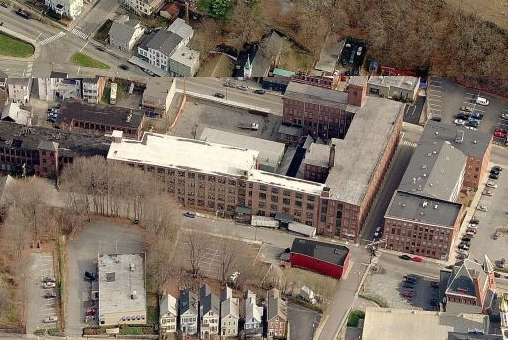
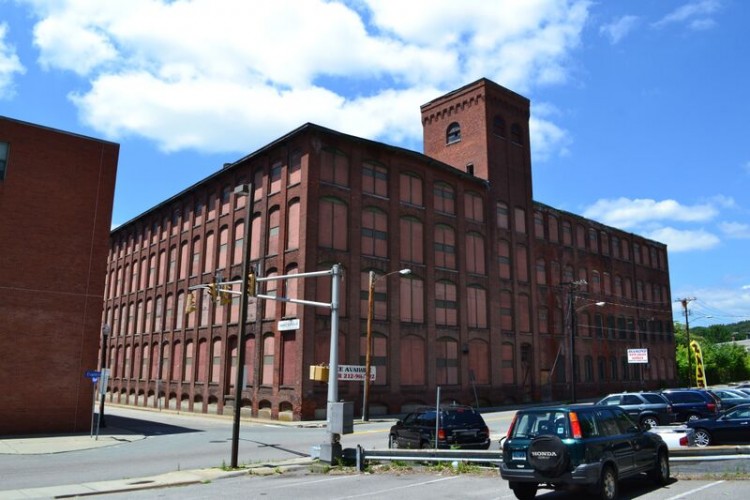
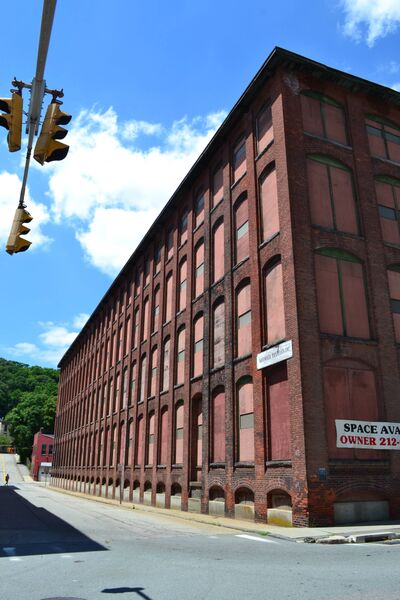
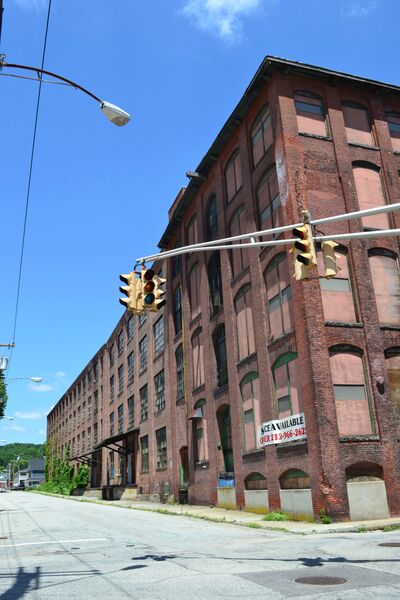
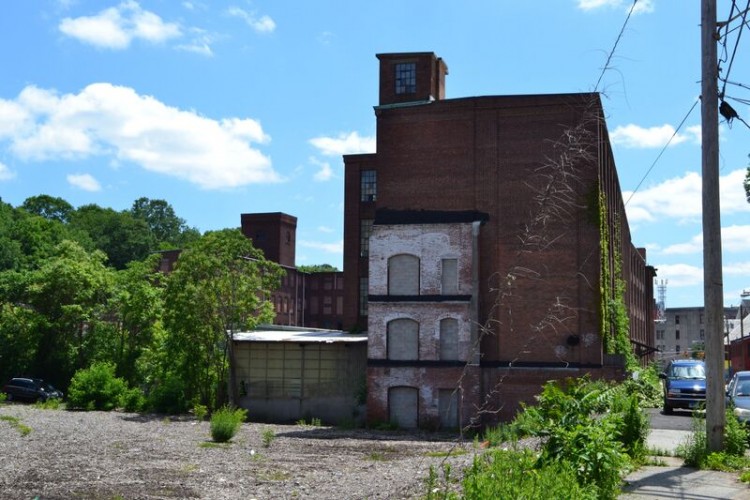
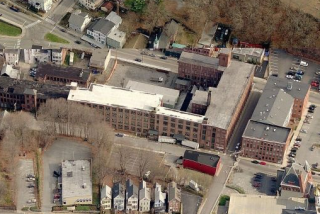
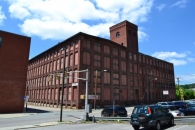
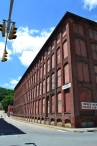
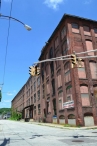
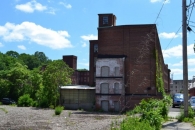
The former Hopkins and Allen Fire Arms Company plant is comprised of approximately seven primary adjoining and freestanding blocks located at the northwest corner of the intersection of Franklin and Willow Streets. The earliest blocks were erected in 1900 and include the four-and-a-half-story red brick manufacturing building lining Franklin Street, and a one-story brick block located in the center of the complex that once housed the plant’s blacksmith shop. The manufacturing building is of standard brick pier construction with large segmental-arched window openings, stone sills, and a low-pitch side-gabled roof with exposed rafter tails. It measures roughly 222’ x 58’ and there is a four-and-a-half-story, 65’ x 44’ cross-gable ell on its north (rear) elevation. The ell abuts the south elevation of the blacksmith shop, which measures 104’ x 58’. The wall details are obscured as the building is surrounded by other blocks, however, a clerestory monitor extends the length of the pitched roof. A four-and-a-half-story addition was completed adjoining the northeast corner of the manufacturing block ca. 1900. It measures 35’ x 100’ overall and is of similar detailing to the main block, yet has slightly smaller window openings. A five-story stair tower is located along Franklin Street between the two blocks. This has recessed window bays that rise the full height of the tower and terminate in round-arched openings with fanlights, a corbelled brick cornice, and a flat roof. Two further additions were made to the west side of the plant, along Chestnut Street, in 1917. These consist of a pair of four-and-a-half-story red brick blocks with large, rectangular window openings, multi-pane metal sash with hopper-style openings, concrete sills, denticulated brick cornices, and flat roofs. The buildings measure roughly 25’ x 108’ and 62’ x 210. Several loading bays are located on their west elevation with access from Chestnut Street. The final building associated with the plant is a one-story, 50’ x 122’ steel-frame storage warehouse erected during the late-20th century.
Exterior Material(s)
Structural System(s)
Roof Form
Roof Material
Power Source
Condition
Fair
Condition Notes
The factory is in fair condition. Although most of the exterior walls of the plant are in need of cleaning and repairs, and a number of the original windows have been removed and the openings boarded up, the majority of the facility appears structurally sound.
- Property Information
-
Specific Location
One legal parcel (132-176 Franklin Street) totaling 1.83-acres at the northwest corner of the intersection of Franklin and Willow Streets.
Adjacent To
Exterior Visible from Public Road?
Yes
Parcel ID / Assessor Record Link
- 102/3/19 / Link →
Acreage
1.83
Use (Present)
- Sources
-
Form Completed By
Lucas A. Karmazinas
Date
06/24/2015
Bibliography
- List of Connecticut Manufacturers, 1922, 1924, 1930, 1932.
- Directory of Connecticut State Manufacturers, 1936, 1939.
- Industrial Directory of Connecticut, 1947.
- Register of War Production Facilities in Connecticut, 1951.
- Map of New London County; Baker, William A., 1854.
- Atlas of New London County, Beers, Ellis & Soule, 1868.
- Birdseye View of Norwich, Connecticut; Vogt, C.H., 1876.
- Aero View of Norwich, Connecticut; Hughes and Bailey, 1912.
- Sanborn Map Company, 1885, 1892, 1897, 1903, 1909, 1914, 1926, 1949.
- Hartford Courant, 1915, 1916, 1917.
- Norwich, Connecticut; Norwich Board of Trade, 1888.
- Norwich, The Rose of New England; Norwich Evening Record, 1894.
- Norwich, Century of Growth; Society of the Founders of Norwich, CT, 1978.
- Norwich; Plummer, Dale, 2003.
- Roth, Matthew, et al, Connecticut: An Inventory of Historic Engineering and Industrial Sites (Washington DC: SIA, 1981).
- Representative View(s)Click on image to view full file
-
Photographer
Lucas A. Karmazinas
Photography Date
06/24/2015