Mill Record Wallingford
RETURN TO ‘FIND MILLS’Disclaimer: Content for these properties was compiled in 2014-2017 from a variety of sources and is subject to change. Updates are occasionally made under Property Information, however the Connecticut Trust for Historic Preservation (dba Preservation Connecticut) makes no representation or warranty that the information is complete or up-to-date.
- Complex Name (Common)
- International Silver Co. (Factory A)
- Complex Name (Historic)
-
- International Silver Co. (Factory A)
- Address or Location
- 718 North Colony Road, Wallingford
- County
- New Haven
- Historic Designation
- Associated Mill Community
- n/a
- Historic Information
Companies Associated w/Complex
- Eyelet Specialty Co., Inc. 1973-ca. 1988
- International Silver Co. 1950-1973
Use (Historic)
Largest Documented Workforce
Unknown.
Historic Narrative
The International Silver Company was organized under the laws of the State of New Jersey on November 19, 1898. Essentially a holding company, the firm acquired control of 17 of the most significant manufacturers of silver products in the United States and Canada within its first year of existence. Among these were the Barbour Silver Company of Hartford, Connecticut; the Holmes and Edwards Silver Company of Bridgeport, Connecticut; Manhattan Silver Plate of Lyons, New York; the Meriden Britannia Company of Meriden, Connecticut; Norwich Cutlery of Norwich, Connecticut; the William Rogers Manufacturing Company of Hartford, Connecticut; Rogers Cutlery of Hartford, Connecticut; Rogers and Brothers of Waterbury, Connecticut; Rogers and Hamilton of Waterbury, Connecticut; Wilcox Silver Plate of Meriden, Connecticut; the Watrous Manufacturing Company of Wallingford, Connecticut; and the Standard Silver Company, Ltd. of Toronto, Canada. Within the course of its first five years five more of the most notable names in the silverware and silverplating industry were acquired by International Silver. The Derby Silver Company of Derby, Connecticut; the Middletown Plate Company of Middletown, Connecticut; and the Simpson, Hall, Miller and Company and the Simpson Nickel Company, both of Wallingford, Connecticut, were added in 1899; and control of the United States Silver Corporation – and thus C. Rogers and Brothers of Meriden, Connecticut – was purchased in 1903. The result was a massive industrial concern valued at $20,000,000. The International Silver Company grew to become the largest producer of silver products in the United States. The company’s operations were based in Meriden, Connecticut, although it maintained numerous plants throughout the state and the country. Several were located in Wallingford, Connecticut, among them being complexes on Center Street (Factory L), South Cherry Street (Factory M), and Hall Avenue (Factory P). In 1949, the company moved to construct a new plant for the production of its lines of low-priced silverplated wares, which had formerly taken place in a Meriden factory acquired from the Colt Firearms Company. The new 112,000 square-foot Factory A was built off of North Colony Road in Wallingford, Connecticut, and was the most modern flatware plant in the world at the time of its completion in 1950. Metal shortages during the Korean War forced International Silver to seek out military contracts in order to keeps its plants operational and in 1950 Factory A was retooled for the production of blades for jet engines. A 150,000 square foot addition was constructed in order to keep up with demand and the work continued there until March 1958. Blade manufacturing was replaced with the production of metal lipstick cases and other eyelet machine products after the firm acquired the Eyelet Specialty Company of Waterbury, Connecticut early in 1958. This work continued until 1973 when International Silver deemed the division insignificantly profitable and both it and Factory A were sold. The Eyelet Specialty Company was purchased by the United Communities Corporation, which maintained operations at the Wallingford plant. The Eyelet Specialty Company continued to operate in the Wallingford plant until 1988.
- Architectural Information
Number of Existing Buildings
Roughly five (5) primary blocks.
Dates of Construction
1950, 1958, late-20th c.
Architect
n/a
Builder
n/a
Building Type
Architectural Description
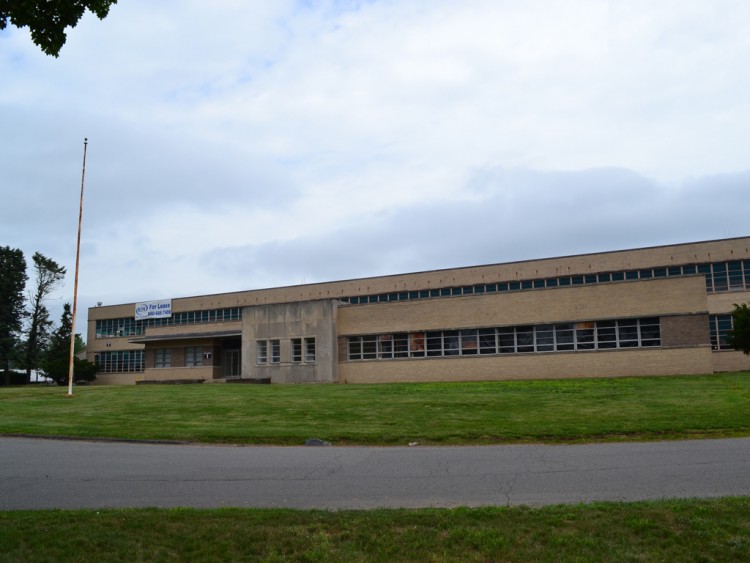
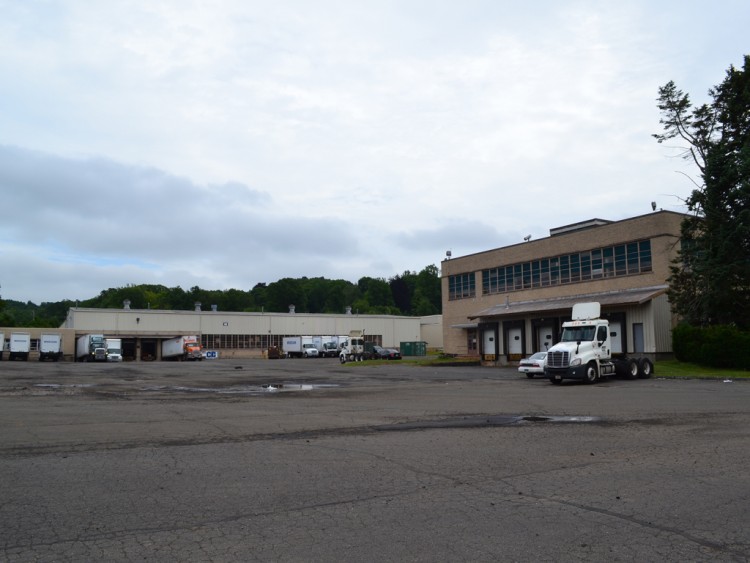
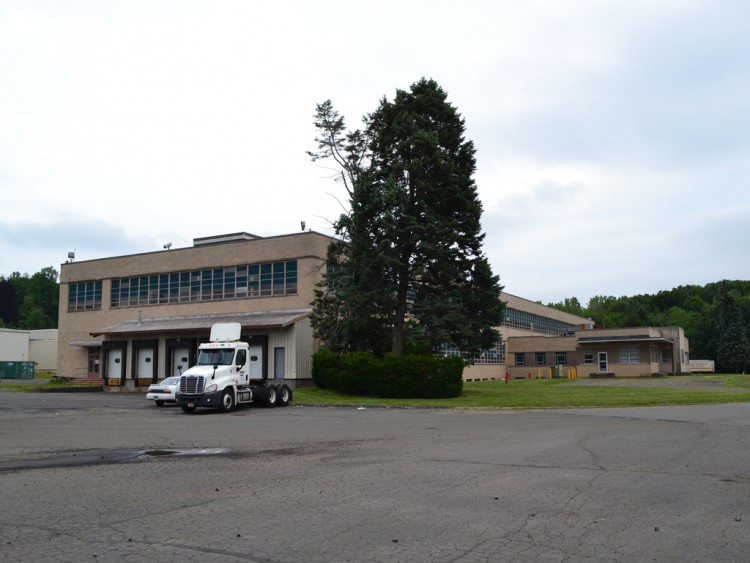
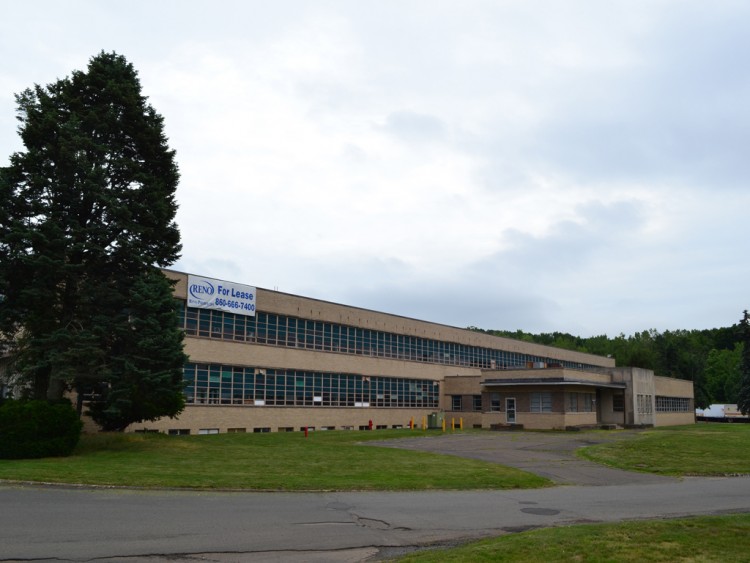
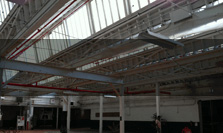
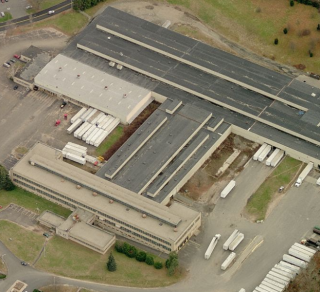
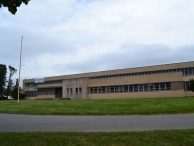
The former International Silver Company Factory A is comprised of five primary adjoining blocks located on the east side of Old Colony Road, and south side of Beaumont Road. The original section of the complex consists of the three westernmost blocks, which were built in 1950. They include the one-story, 164’ x 43’ office building; a two-story, 398’ x 105’ manufacturing block; and a two-story, 160’ x 300’ warehouse. The office and manufacturing building are both of an International Style design and have yellow brick curtain walls, wide ribbon windows, and metal sash with hopper-style openings. Both buildings have flat roofs, however, a clerestory monitor runs the length of the manufacturing building. The warehouse is of a utilitarian design and has sheet metal wall sheathing and a flat roof with multiple clerestory monitors (these have been boarded over). A substantial addition was erected on the east side of the plant in 1958. This is a two-story, 770’ x 205’ steel-frame manufacturing block with metal wall cladding and a flat roof with multiple clerestory monitors (these have been boarded over). Numerous loading bays are located on the south side of its west elevation, which allow trucks to back right up to the building. A two-story, 242’ x 104’ steel-frame addition was erected adjoining the northern end of the 1958 building’s west elevation during the late-20th century. This houses shipping and receiving facilities and has both ribbon windows and loading bays spanning its west elevation. The block has metal wall cladding and a flat roof.
Exterior Material(s)
Structural System(s)
Roof Form
Roof Material
Power Source
Condition
Fair
Condition Notes
The factory is in overall fair condition. Most of the original windows have been retained and the majority of the plant appears structurally sound and reasonably well maintained.
- Property Information
-
Specific Location
One 34.36-acre parcel (718 North Colony Road) on the east side of Old Colony Road, and south side of Beaumont Road.
Adjacent To
n/a
Exterior Visible from Public Road?
Yes
Parcel ID / Assessor Record Link
Acreage
34.36
Use (Present)
- Sources
-
Form Completed By
Lucas A. Karmazinas
Date
06/16/2015
Bibliography
- List of Connecticut Manufacturers, 1922, 1924, 1930, 1932.
- Directory of Connecticut State Manufacturers, 1936, 1939.
- Industrial Directory of Connecticut, 1947.
- Register of War Production Facilities in Connecticut, 1951.
- Map of New Haven County, H & C.T. Smith, 1856.
- Atlas of New Haven County, Beers, Ellis & Soule, 1868.
- Birdseye View of Wallingford, Connecticut, O.H. Bailey & Co., 1881.
- Birdseye View of Meriden, Connecticut, Hughes and Bailey, 1905.
- Sanborn Map Company, 1885, 1892, 1897, 1904, 1911, 1919, 1925, 1948.
- Hartford Courant, 1957, 1973.
- An American Heritage; Hogan, Edmund P.
- History of Wallingford, Connecticut; Davis, Charles H.S., 1870.
- History of New Haven County, Connecticut; Rockey, John L., 1892.
- A Modern History of New Haven and Eastern New Haven County; Hill, Everett G., 1918.
- See the International Silver Company Records at the Thomas J. Dodd Research Center at UConn
- Representative View(s)Click on image to view full file
-
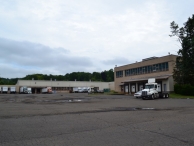


Photographer
Lucas A. Karmazinas
Photography Date
06/16/2015