Mill Record New Haven
RETURN TO ‘FIND MILLS’Disclaimer: Content for these properties was compiled in 2014-2017 from a variety of sources and is subject to change. Updates are occasionally made under Property Information, however the Connecticut Trust for Historic Preservation (dba Preservation Connecticut) makes no representation or warranty that the information is complete or up-to-date.
- Complex Name (Common)
- James F. Molloy & Co.
- Complex Name (Historic)
-
- James F. Molloy & Co.
- Address or Location
- 48-62 Grant Street, Hill, New Haven
- County
- New Haven
- Historic Designation
- Associated Mill Community
- n/a
- Historic Information
Companies Associated w/Complex
- Atlas-Ansonia Co. 1928-ca. 1945
- James F. Molloy & Co. 1895-1914
- James F. Molloy Co. 1914-1927
Use (Historic)
Largest Documented Workforce
50-100 (1927).
Historic Narrative
The firm of James F. Molloy and Company was organized in New Haven, Connecticut by West Haven resident James F. Molloy in 1889. The shop specialized in the manufacture of metal suspender trimmings and buckles and initially occupied a small plant on Oak Street in New Haven. In 1895, Molloy erected a new and larger plant on Grant Street, this after taking on a partner, Ludwig Harke. James F. Molloy and Company was granted dozens of new patents for metal buckles and other suspender hardware during the late-19th and early-20th centuries, and in 1906 began to manufacture silver and gold plated buckles in addition to those of brass and nickel plating as had previously taken place. After James F. Molloy’s death in 1912, the business passed to his wife and son, Lillian and Thomas F. Molloy, who sold the firm the following year. James F. Molloy and Company was acquired by three Norwich, Connecticut investors, John Campbell, Philip Henault, and J.J. Desmond, who incorporated the business as the James F. Molloy Company on January 1, 1914. The firm was valued at $150,000 at the time of its incorporation and continued to be led by one of Molloy’s sons, Leon M. Molloy. The James F. Molloy Company remained in operation until 1927. In 1928, the former James F. Molloy Company plant was acquired by the New Haven-based Atlas Manufacturing Company. The Atlas Manufacturing was organized by the Bradley family in 1895, and its principal products consisted of shelf brackets, coat and hat hooks. The business occupied a factory on Water Street in New Haven from its inception until 1928, when a fire destroyed the plant. Before moving to Grant Street, Atlas Manufacturing merged with the Ansonia Novelty Company, a manufacturer of clocks, scissors, and other metal items incorporated in Ansonia, Connecticut in 1899. The resultant Atlas-Ansonia Company manufactured a variety of metal products including light hardware, sewing thimbles, and pencil sharpeners. The business was managed by H.L. Wittstein, president and treasurer; E. O’Brien, vice-president; and George H. Adams, secretary. By the late-1930s, the Atlas-Ansonia Company had shifted into the production of wire goods, and during the Second World War the firm applied this experience in securing several significant contracts to manufacture bomb fuses for the United States Government. The Atlas-Ansonia Company remained on Grant Street until around 1945, whereupon the firm moved to North Haven and the New Haven plant was bought by a real estate investor, Manufacturers Properties, Inc. The factory has since been occupied by a variety of short-term industrial and commercial tenants.
- Architectural Information
Number of Existing Buildings
Five (5) primary adjoining blocks.
Dates of Construction
1895, ca. 1905, ca. 1960.
Architect
n/a
Builder
n/a
Building Type
Architectural Description
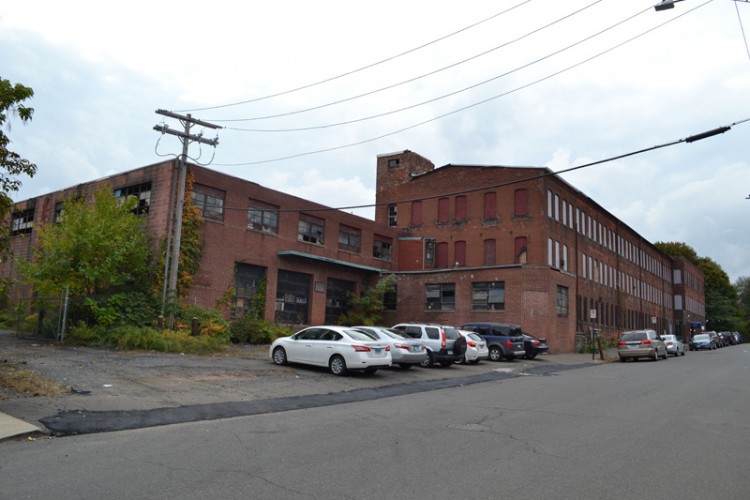
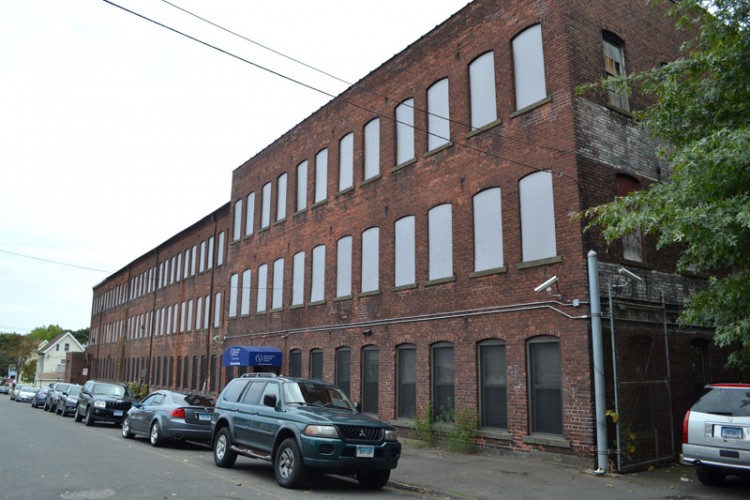
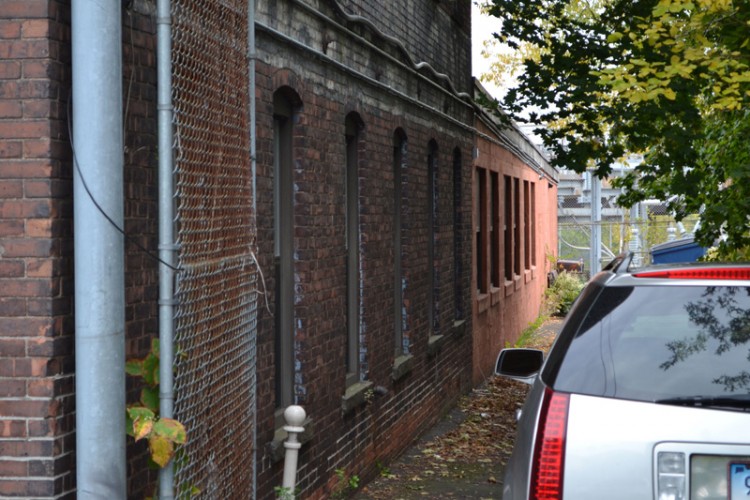
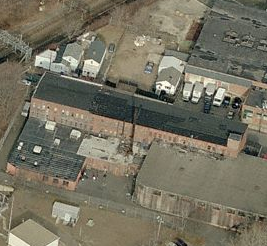
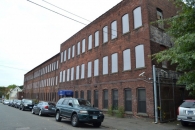
The former James F. Molloy and Company plant consists of five primary adjoining blocks located on the south side of Grant Street, at the western terminous of Grant Street roughly 200’ west of Grant Street’s intersection with Plymouth Street. The oldest block associated with the facility is the factory’s main manufacturing building, this erected in 1895. It is a three-story, 152’ x 46’ red brick building with segmental-arched window openings, stone window sills, a corbelled and denticulated brick cornice, and a low-pitch side-gabled roof. The main entry to the building is located at the eastern end of its north (façade) elevation, this consisting of a single pass-through door located within a brick portico with a corbelled round-arched opening, brownstone keystone, and a front-facing gable roof with cornice returns. A four-story engaged brick stairtower is located at the southeast corner of the building, however, this is not an original feature and was added ca. 1930. The plant was expanded ca. 1905 through the construction of a three-story, 62’ x 48’ red brick block adjoining the western elevation of the original factory. The details of the addition are similar to the main block, however, it has round masonry anchors scattered across the second and third floors and lacks a cornice, the walls instead being topped by tile coping. The three remaining blocks were all erected ca. 1960. These consist of a one-story, 18’ x 22’ red brick addition adjoining the northeast corner of the main block; a two-story, 152’ x 88’ red brick and concrete block addition adjoining the southeast corner of the main block; and a one-story, 74’ x 82’ concrete block addition adjoining the south elevation of the ca. 1905 building. All of the ca. 1960 additions have rectangular window openings with concrete sills. The two additions on the east side of the factory have flat roofs, while the western addition has a shed roof.
Exterior Material(s)
Structural System(s)
Roof Form
Roof Material
Power Source
Condition
Fair, Deteriorated
Condition Notes
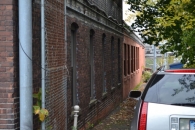
The complex is in fair to deteriorated condition. Many of the original windows in the 1895 and ca. 1905 block have been removed and/or boarded up, while those in the later additions are missing much of their glazing. The masonry throughout the facility is in need of cleaning and repairs, and the roofs show signs of failure.
- Property Information
-
Specific Location
One legal parcel (48 Grant Street) located on the south side of Grant Street, at the western terminus of Grant Street roughly 200’ west of Grant Street’s intersection with Plymouth Street.
Adjacent To
n/a
Exterior Visible from Public Road?
Yes
Parcel ID / Assessor Record Link
- 273/0019/01002. / Link →
Acreage
Unlisted.
Use (Present)
- Commercial
- Other: Grant Street Partnership Cornell Scott Hill Health Center (substance abuse rehab) in western block 62 Grant St. 10/2022 proposed sale of 48 Grant Street to Allen McCollum for redev to apartments.
- Vacant
- Sources
-
Form Completed By
Lucas A. Karmazinas
Date
08/13/2015
Bibliography
- List of Connecticut Manufacturers, 1922, 1924, 1930, 1932.
- Directory of Connecticut State Manufacturers, 1936, 1939.
- Industrial Directory of Connecticut, 1947.
- Register of War Production Facilities in Connecticut, 1951.
- Map of New Haven County; Clark, Richard, 1859.
- Atlas of New Haven County, Beers, Ellis & Soule, 1868.
- Aerial Survey of Connecticut, 1934, 1965.
- Sanborn Map Company, 1901, 1911, 1923, 1950.
- New Haven City Directory; Various editions.
- History of the City of New Haven to the Present Time, 1887.
- Leading Business Men of New Haven County; Mercantile Publishing Co., 1887.
- A Modern History of New Haven and Eastern New Haven County, 1920.
- Carriages & Clocks, Corsets & Locks; New Haven Preservation Trust, 2004.
- Hartford Courant, 1930.
- Representative View(s)Click on image to view full file
-


Photographer
Lucas A. Karmazinas
Photography Date
08/13/2015