Mill Record Kent
RETURN TO ‘FIND MILLS’Disclaimer: Content for these properties was compiled in 2014-2017 from a variety of sources and is subject to change. Updates are occasionally made under Property Information, however the Connecticut Trust for Historic Preservation (dba Preservation Connecticut) makes no representation or warranty that the information is complete or up-to-date.
- Complex Name (Common)
- Kent Iron Furnace
- Complex Name (Historic)
-
- Kent Iron Furnace
- Address or Location
- U.S. Route 7, N of Kent, Kent
- County
- Litchfield
- Historic Designation
- Associated Mill Community
- n/a
 What can you do at this mill?
- Historic Information
Companies Associated w/Complex
Use (Historic)
Largest Documented Workforce
n/a
Historic Narrative
For historical significance see National Register nomination: http://pdfhost.focus.nps.gov/docs/NRHP/Text/77001401.pdf
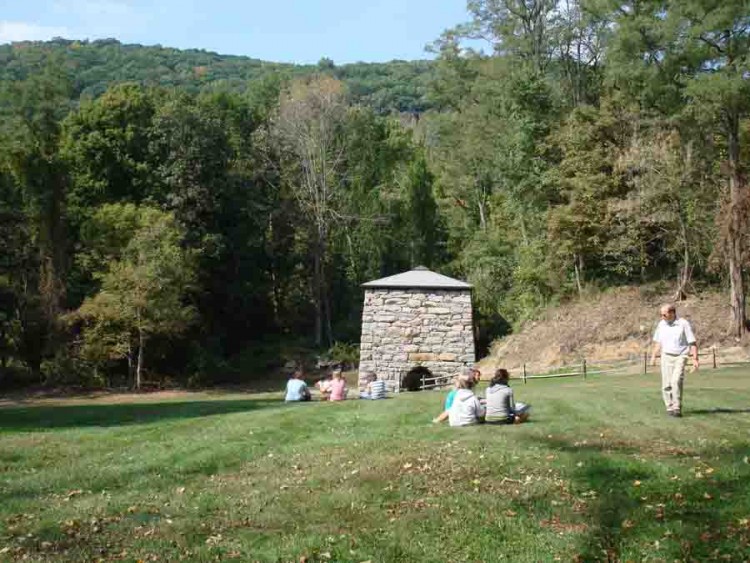
Stuart, Hopson and Co. built the first blast furnace here in 1826. It was 28' high, charcoal-fired and used cold blast. The ore, a hematite yielding 60% iron, was dug from a mountainside in South Kent; charcoal and lime were also produced locally. In 1864, with additional investors, Kent Iron Co. was formed and a slightly larger, hot blast furnace replaced the earlier stack. Charcoal supply was a problem by this time, as the 1864 furnace was fired by a mixture of charcoal and anthracite. Kent Iron Co. rebuilt the stack to its present dimensions in 1870. Its battered walls, made of rough granite blocks in random ashlar, were 32' high in 1870, but erosion and vandalism have destroyed the upper 8'. Iron tie-rods reinforced against expansion. Arched openings break three of the walls, with the 14'-high hearth opening on the south side. Inside, bosh diameter is 9'; two layers of fire brick are partially intact and a great deal of brick and other debris has accumulated at the bottom of the furnace. None of the blast system remains except for a vague depression that was once the power canal which carried water from the dam (across the Housatonic River) to the wheelhouse, where a breast wheel drove the blowing tub. The sheds that stored charging materials are gone, as are the frame structures that surrounded the operating furnace: the charging house atop the stack and casting house below. Foundations are all that remain of the saw and grist mills run by the iron company. Depletion of local charcoal and surface ore at South Kent caused the operation to slow to a halt in 1892.
Today the stack is on the grounds of the Sloane-Stanley Museum, which features a section-view model of the furnace, a diorama depicting the site in the 19th century, and iron-making artifacts including a slag fork and a cooling coil for a tuyere. (Roth)- Architectural Information
Number of Existing Buildings
1
Dates of Construction
1870
Architect
n/a
Builder
n/a
Building Type
Architectural Description
For description see National Register nomination: http://pdfhost.focus.nps.gov/docs/NRHP/Text/77001401.pdf
Exterior Material(s)
Structural System(s)
Roof Form
n/a
Roof Material
n/a
Power Source
n/a
Condition
Good
Condition Notes
n/a
- Property Information
- Sources
-
Form Completed By
n/a
Date
n/a
Bibliography
- Clouette, Bruce. 1977. Kent Iron Furnace National Register Nomination No. 77001401. National Park Service.
- Kent Furnace National Register of Historic Places State Archaeological Preserve. Record on file at SHP office, Hartford, CT.
- Eric Sloane Museum & Kent Iron Furnace web site. Access.
- Representative View(s)Click on image to view full file