Mill Record Middletown
RETURN TO ‘FIND MILLS’Disclaimer: Content for these properties was compiled in 2014-2017 from a variety of sources and is subject to change. Updates are occasionally made under Property Information, however the Connecticut Trust for Historic Preservation (dba Preservation Connecticut) makes no representation or warranty that the information is complete or up-to-date.
- Complex Name (Common)
- L. D. Brown & Sons
- Complex Name (Historic)
-
- Burns Lace Manufacturing Co.
- L. D. Brown & Sons
- Address or Location
- 10 Cooley Ave, Middletown
- County
- Middlesex
- Historic Designation
- Associated Mill Community
 What can you do at this mill?
- Historic Information
Companies Associated w/Complex
- Burns Lace Manufacturing Company 1917-ca.1935
- Formatron Corporation 1960-late 20th c.
- L. D. Brown & Sons 1871-1903
Use (Historic)
Largest Documented Workforce
150 (1884)
Historic Narrative
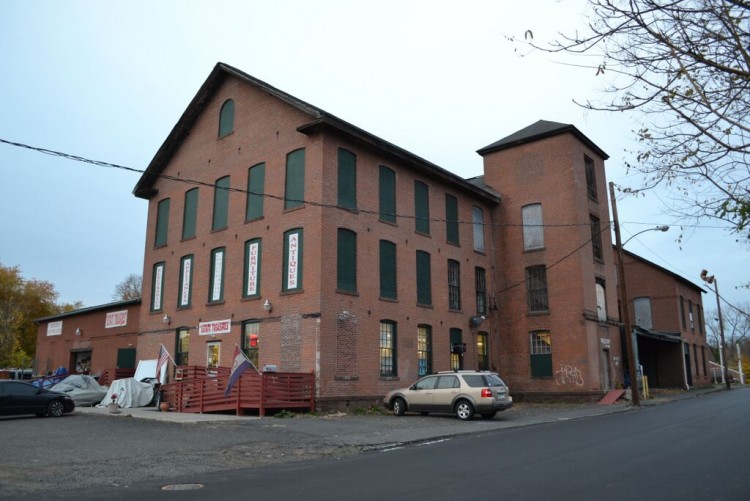
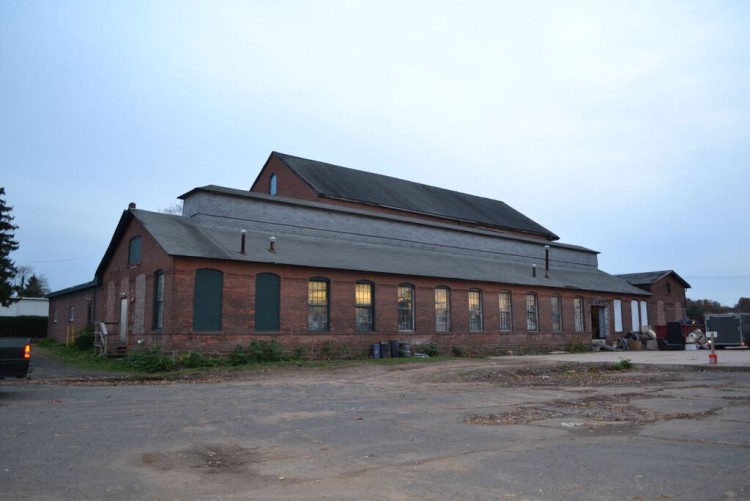
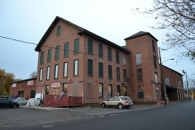
The firm that would become the L.D. Brown and Sons silk manufactory was established by L.D. Brown in the Gurleyville section of Mansfield, Connecticut in 1850. The company moved to the village of Atwoodville around 1860 when Brown’s son Henry L. Brown joined the firm. In 1871, Henry L. Brown again uprooted the company and transferred its operations to the South Farms section of Middletown, a formerly undeveloped area that experienced a significant industrial boom in the period following the Civil War. L.D. Brown and Sons erected their Middletown factory on Cooley Avenue starting with the three-story brick block that today forms the core of the plant, built in 1871, and a dye house and boiler plant following in 1872. The factory was initially powered by a 50-horsepower steam engine and staffed by a workforce of 150 employees, the latter capable of processing 35,000 pounds of raw material annually. L.D. Brown and Sons’ product line included a diverse array of machine twist and sewing silk, this taken through various reeling, spinning, doubling, twisting, and dyeing processes in house and then marketed and sold via offices in Boston and New York. L.D. Brown and Sons continued to expand through the late 1890s. A two-story office block was erected at the southwest corner of the main block ca. 1890, and a large, one-story manufacturing block with sawtooth roof built just west of the original plant ca. 1900 (the latter was demolished in 2011, however, the earlier blocks remain intact). The ca. 1900 block housed new warping and weaving machinery, illustrating the company’s diversification into the production of broad silk fabrics. Despite this expanded product line, the L.D. Brown and Sons silk manufactory fell into receivership in 1903. The company’s plant was sold at auction in 1904 and then passed through the control of several broad silk manufacturers – including the Merchants Silk Company and Poidebard Silk Company – between 1904 and 1917. In 1917, the factory complex was acquired by the Burns Lace Manufacturing Company, producers of lace goods, nets, and bleached fabrics. By 1924, the Burns Lace Manufacturing Company’s operations had been consolidated in the sawtooth block and the Russell Manufacturing Company had acquired the eastern portion of the complex for the production of braided goods. The Burns Lace Manufacturing Company was supplanted by the Colonial Lace Manufacturing Company by 1935, which was in turn replaced by the Wilcox Lace Corporation by 1950. By the latter year, the Russell Manufacturing Company had also been replaced, in this case by the Middlesex Bag and Paper Company, Inc. The Formatron Corporation, manufacturers of beauty and barbershop equipment, acquired the plant in 1960 and maintained operations there into the late-20th century.
- Architectural Information
Number of Existing Buildings
Five (5) blocks.
Dates of Construction
1871-1874, ca. 1890, ca. 1960
Architect
n/a
Builder
n/a
Building Type
Architectural Description
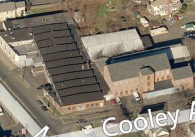
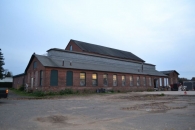
The former L.D. Brown and Sons factory is comprised of an adjoining complex of five blocks located on the north side of Cooley Avenue between Main Street Ext. and East Main Street. The factory’s original block was erected in 1871 and consists of a three-and-a-half-story red brick structure with rectangular footprint, circular masonry anchors, plain wood cornice, cornice returns, and a side gabled roof. The building measures roughly 106’ x 48’ feet and there is a four-story, 20’ x 20’ stair tower with pyramidal roof centered on its façade (south elevation). The window openings throughout the primary block and stair tower have segmental-arched brick openings, brownstone sills, and twelve-over-twelve double-hung wood sash. Many of the windows have been boarded up. North of the stair tower there is a loading dock with roll-up garage-style door opening and a shed roof. Notable additions to the plant include a 26’ x 40’ boiler house and 36’ x 134’ dye house erected on the north side of the block in 1872, and a 34’ x 34’ office block built adjoining the southeast corner of the main block ca. 1890. These three blocks stand one-and-a-half-story, one-story, and two-stories tall, respectively, and share similar detailing including red brick walls, brick beltcourses, segmental-arched window openings, brownstone sills, twelve-over-twelve double-hung wood sash, and pitched roofs. The dye house is notable for the hipped-roof monitor running the length of the building, however, the monitor’s original openings have been covered with asphalt shingles. A one-story addition connects the dye house and office building, this built ca. 1960. A large sawtooth roof production shed on the west side of the complex along Main Street Extension was demolished c.2014. 5/2021 Tower stairs and elevator are intact; staircase has curved beadboard banister, wood newel post and railing (later railing was installed on outer wall). Brick walls were stuccoed and some remains in place. Timber framing and open factory floor space can be experienced on second floor. Windows are replacements.
Exterior Material(s)
Structural System(s)
Roof Form
Roof Material
Power Source
Condition
Good, Fair, Deteriorated
Condition Notes
All portions of the building are in generally good condition, however, the original windows are either deteriorated or have been boarded up. A large sawtooth roof production shed on the west side of the complex along Main Street Extension was demolished c.2014.
- Property Information
-
Specific Location
One legal parcel (listed in the Middletown Assessor’s Records as Cooley Avenue, MBLU #34/0102) totaling 0.5 acres just east of the northeast corner of the intersection of Cooley Avenue and Main Street Ext.
Adjacent To
Exterior Visible from Public Road?
Yes
Parcel ID / Assessor Record Link
- 34/ / 0102 / Link →
Acreage
0.5
Use (Present)
- Commercial
- Other: Estate Treasures
- Sources
-
Form Completed By
Lucas A. Karmazinas
Date
11/5/2014
Bibliography
- List of Connecticut Manufacturers, 1922, 1924, 1930, 1932.
- Directory of Connecticut State Manufacturers, 1936, 1939.
- Atlas of Middlesex County, F.W. Beers & Co., 1874.
- Middletown Bird’s Eye View, 1877, 1915.
- Industrial Directory of Connecticut, 1947.
- Register of War Production Facilities in Connecticut, 1951.
- Sanborn Map Company, 1889, 1895, 1901, 1913, 1924, 1950.
- Aerial Survey of Connecticut, 1934, 1965.
- History of Middlesex County, Connecticut, 1884.
- Roth, Matthew, et al, Connecticut: An Inventory of Historic Engineering and Industrial Sites (Washington DC: SIA, 1981).
- Representative View(s)Click on image to view full file
-

Photographer
Lucas A. Karmazinas
Photography Date
11/5/2014