Mill Record New Britain
RETURN TO ‘FIND MILLS’Disclaimer: Content for these properties was compiled in 2014-2017 from a variety of sources and is subject to change. Updates are occasionally made under Property Information, however the Connecticut Trust for Historic Preservation (dba Preservation Connecticut) makes no representation or warranty that the information is complete or up-to-date.
- Complex Name (Common)
- Landers, Frary and Clark
- Complex Name (Historic)
-
- Landers, Frary and Clark
- Address or Location
- 321 and 322 Ellis Street, New Britain
- County
- Hartford
- Historic Designation
- Associated Mill Community
- n/a

- Historic Information
Companies Associated w/Complex
- General Electric 1965-1969
- Landers, Frary and Clark Co. 1908-1965
Use (Historic)
Largest Documented Workforce
Over 1000 (1939)
Historic Narrative
See 2021 National Register nomination. The origins of Landers, Frary and Clark date to 1842, when George M. Landers and Josiah Dewey established a small manufactory for the production of furniture casters, window springs, hat and coat hooks, and other small hardware items. Around 1852, Levi O. Smith joined the firm and it was reorganized as the Landers and Smith Manufacturing Company. This occupied a substantial plant on East Main Street, which was continually enlarged as the company’s business expanded. A significant move towards this end came in 1862, when the firm purchased Frary, Carey and Company of Meriden, Connecticut. Smith retired from the company at this point in time and James D. Frary was brought into the newly formed Landers, Frary and Clark Manufacturing Company. In 1866, the Landers, Frary and Clark erected a second plant, known as the Aetna Works, for the production of table cutlery. This was destroyed in 1874, but quickly rebuilt on a larger scale and with the most modern machinery. By the late 1880s the company and its two plants boasted $500,000 in capital and was led by J.A. Pickett, president; George M. Landers, vice-president; C.S. Landers, treasurer; and J.C. Atwood, secretary. In 1898, the company added home appliances to its line of hardware and cutlery with the introduction of the “Universal” food chopper, which spurred the construction of a third manufacturing plant on Ellis Street by 1908. A whole line of appliances followed the Universal food chopper, an increasing number of these being electrified by the early 1900s as access to the utility reached a greater number of American homes. By 1913, electric appliances produced by Landers, Frary and Clark included irons, coffee pots, electric ranges, vacuum cleaners, bread mixers, cake makers, electric heaters, and dishwashers. The demand for these goods was spurred by the prosperity Americans experienced during the 1910s and 1920s, and the firm’s Ellis Street plant was continually expanded during this period. Significant contributions were also made by the company during the World Wars. During the First World War alone Landers, Frary and Clark produced approximately 3,000,000 canteens, 5,000,000 trench knives, millions of mess kits, bacon cans, canteen cups, and similar metalware, as well as practically all of the sabers required by the United States Cavalry. Landers, Frary and Clark continued to produce appliances at their Ellis Street plant through the 1960s. In 1965, the majority of the firm was taken over by the J.B. Williams Company of New York, with the food chopper division having been acquired by the Union Manufacturing Company, and the electrical appliance operations purchased by General Electric. While the J.B. Williams Company shut down production in New Britain shortly after completing the transaction, it was hoped at the time that some of the jobs at the Ellis Street plant might be preserved by General Electric. While work did continue for a short period of time, Landers, Frary and Clark’s production fell silent in 1969 after General Electric left New Britain. The plant was subsequently occupied by a mix of small industrial and office uses. On the other hand, the company’s East Main Street and Aetna plants were demolished for highway construction during the 1960s.
- Architectural Information
Number of Existing Buildings
Roughly sixteen (16) primary blocks.
Dates of Construction
1908, 1912, 1916, 1917, 1919, 1920, 1923, 1924, 1928, 1936, ca. 1940, 1945, ca. 1945.
Architect
n/a
Builder
n/a
Building Type
Architectural Description
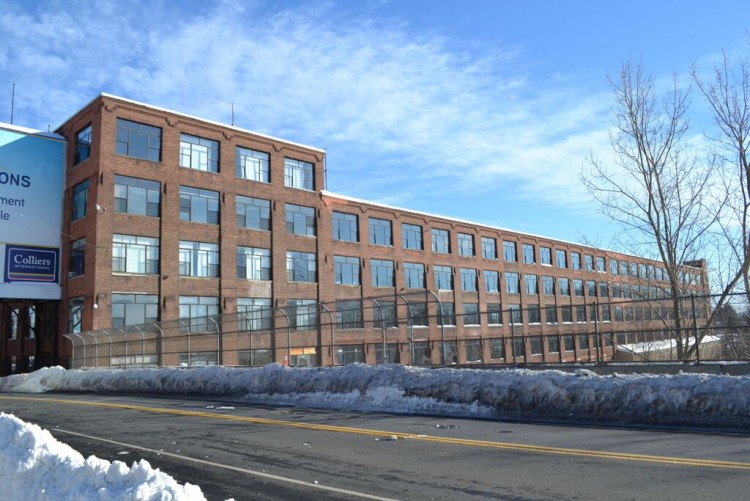
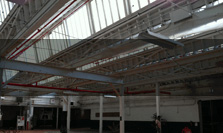
The former Landers, Frary and Clark plant is comprised of approximately sixteen primary buildings in two separate groups of adjoining blocks located on the north and south sides of Ellis Street between Stanley Street and the New York, New Haven, and Hartford Railroad. The oldest structure associated with the complex is a one-story, 135’ x 104’ red brick manufacturing building with a sawtooth roof erected in 1908. This is situated at the northwestern corner of the plant and has since been incorporated into the sprawling complex on the north side of Ellis Street through the addition of numerous primary and support buildings. Among the former are a one-story, 124’ x 104’ red brick boiler house built in 1912 (later raised to two stories); a four-story, 120’ x 50’ red brick manufacturing block built in 1917; a six-story, 154’ x 80’ red brick manufacturing block built in 1920; a four-story, 145’ x 55’ red brick manufacturing block built in 1923; a one-story, 123’ x 200’ reinforced concrete manufacturing block built in 1928; a one-story, 123’ x 104’ reinforced concrete and brick manufacturing block built ca. 1940; a one-story, 123’ x 105’ reinforced concrete and brick manufacturing block built ca. 1940; a five-story, 123’ x 80’ red brick manufacturing block built ca. 1940; a one-story, 76’ x 236’ steel frame and concrete block manufacturing block built ca. 1945; a 1-story, 238’ x 140’ reinforced concrete storage building erected in 1945; and a one-story, 200’ x 54’ concrete block storage building erected ca. 1945. Those buildings constructed before 1925 are notable for their brick pier and timber frame construction, full-height window bays rising to corbelled brick cornices, segmental-arched window openings with concrete sills and multi-pane steel sash, and flat roofs. The majority of the remaining manufacturing blocks are dominated by the broad window openings allowed by their reinforced concrete construction, with a number also possessing clerestory monitors extending the length of their flat roofs. Landers, Frary and Clark began work on a second complex of manufacturing buildings located on the south side of Ellis Street starting in 1916. This was initiated with the construction of a five-story, 230’ x 60’ red brick manufacturing block at the core of the present group, and continued through the addition of a one-story, 230’ x 60’ red brick forge shop erected in 1919; a six-story, 161’ x 67’ red brick manufacturing block built along Ellis Street in 1924; and a five-story, 190’ x 60’ red brick manufacturing block erected at the southern end of the plant in 1936. The buildings on the south side of Ellis Street are slightly different in their design to those to the north. Although likewise of brick pier construction, the windows are set in wide rectangular openings and the corbelled brick cornices are uninterrupted by the stepped piers that rise the height of the buildings. The 1924 block is particularly notable among the southern cluster as a shallow pavilion with stepped parapet projects from the center of its northern (front) elevation. This contains the building’s primary entrance, which is set in a recessed opening with a flat-arched concrete surround. A pair of wood and glass doors provide access to the building, above which is an arched multi-pane transom.
Exterior Material(s)
Structural System(s)
Roof Form
Roof Material
Power Source
Condition
Fair
Condition Notes
The factory complex is in fair condition. The majority of the exterior walls and roofs appear to be in good condition, although some of the buildings show areas where brick cleaning and repointing are needed. Several of the buildings retain their original metal sash, however, all of those located south of, as well as the first four blocks looking north from Ellis Street, have had their windows replaced with modern units.
- Property Information
-
Specific Location
Two legal parcels (321 and 322 Ellis Street) totaling 22.38 acres on the north and south sides of Ellis Street between Stanley Street and the New York, New Haven, and Hartford Railroad line.
Adjacent To
Exterior Visible from Public Road?
Yes
Parcel ID / Assessor Record Link
Acreage
10.21; 12.17
Use (Present)
- Industrial
- Other: Winn Development redeveloped the southern complex at 321 Ellis Street. Project announced 8/2021. Groundbreaking 7/2023. $85million project: $7.9 million from the state Department of Housing, 11/2022 DECD $995k loan to Winn for abatement and remediation, tax credits for historic preservation and tax credits through the Connecticut Housing Finance Authority, and a phase-in of property taxes that’s projected to save the developer hundreds of thousands of dollars over 20 years.154 apartments -- 79 one-bedroom, 59 two-bedroom and 16 three-bedroom. Leasing 12/2024 as The Ellis Block for February 2025 occupancy. Ribbon cutting 7/8/25!
- Residential
- Vacant
- Sources
-
Form Completed By
Lucas A. Karmazinas
Date
02/12/2015
Bibliography
- List of Connecticut Manufacturers, 1922, 1924, 1930, 1932.
- Directory of Connecticut State Manufacturers, 1936, 1939.
- Map of Hartford County, H & C.T. Smith, 1855.
- Atlas of Hartford County, Beers, Baker & Tilden, 1869.
- Industrial Directory of Connecticut, 1947.
- Register of War Production Facilities in Connecticut, 1951.
- Sanborn Map Company, 1884, 1890, 1895, 1909, 1950, 1954.
- Aerial Survey of Connecticut, 1934, 1965.
- Birdseye View of New Britain, 1875.
- New Britain City Directory, 1860-1960.
- Hartford Courant, 1919, 1965, 1969.
- History of New Britain, With Sketches of Farmington and Berlin, Camp, David, N., 1889.
- Roth, Matthew, et al, Connecticut: An Inventory of Historic Engineering and Industrial Sites (Washington DC: SIA, 1981).
- Representative View(s)Click on image to view full file
-


Photographer
Lucas A. Karmazinas
Photography Date
02/12/2015