Mill Record Norwalk
RETURN TO ‘FIND MILLS’Disclaimer: Content for these properties was compiled in 2014-2017 from a variety of sources and is subject to change. Updates are occasionally made under Property Information, however the Connecticut Trust for Historic Preservation (dba Preservation Connecticut) makes no representation or warranty that the information is complete or up-to-date.
- Complex Name (Common)
- Nash Engineering Co.
- Complex Name (Historic)
-
- Nash Engineering Co.
- Address or Location
- 310 Wilson Avenue , South Norwalk, Norwalk
- County
- Fairfield
- Historic Designation
- Associated Mill Community
- n/a
 What can you do at this mill?
- Historic Information
Companies Associated w/Complex
- Nash Engineering Co. ca. 1930-1995
Use (Historic)
Largest Documented Workforce
300-499 (1939).
Historic Narrative
The Nash Engineering Company was formed in Brooklyn, New York by Lewis H. Nash in 1905. A native of Norwalk, Connecticut, Nash moved the firm to his home town in 1908, where it manufactured air pumps in a small shop on Water Street in South Norwalk. In 1910, Nash patented his first designs for several vacuum pumps and compressors used in steam heating and sewage systems, and the following year a new facility was established on Wilson Avenue in South Norwalk. In 1914, Nash was awarded the patent for his ‘Pump and Air Compressor,’ which was the first liquid ring vacuum pump and compressor patent awarded in the United States. Work and facilities at the Nash Engineering Company expanded significantly in order to support production of liquid ring vacuum pumps and compressors. Harold L. Nash, Lewis J. Nash’s son, joined the business in 1914; the original one-story plant was raised to three-stories in 1918; and the firm established divisions in Canada and Great Britain in 1924 and 1931, respectively. This work continued into the early 1960s, whereupon the firm shifted away from the fields of commercial heating and sewage towards a focus on industrial machinery, such as vacuum pumps, for paper, power, petrochemical, and food producers. The Nash Engineering Company established additional production facilities in Brazil, Sweden, and Belgium during the 1960s; new offices and manufacturing plants throughout the United States, Canada, and Brazil during the 1970s; and a new Korean office in 1987. Work at the Norwalk plant and office continued until 1995, whereupon this was closed in favor of a new location in Trumbull, Connecticut. The Nash Engineering Company merged with Elmo Vacuum Technology, a division of the Siemens Corporation, to form Nash Elmo in 2002; and then was acquired by the Wayne, Pennsylvania-based industrial equipment manufacturer Gardner Denver, Inc. in 2012. The latter transaction resulted in Gardner Denver Nash, a division of the parent company that continued to produce vacuum products, albeit no longer in Connecticut. The surviving sections of the former Norwalk plant presently house an indoor ice rink and a variety of small commercial tenants.
- Architectural Information
Number of Existing Buildings
Fourteen (14) primary blocks.
Dates of Construction
ca. 1930, ca. 1950, 1956, ca. 1960, 1980.
Architect
n/a
Builder
n/a
Building Type
Architectural Description
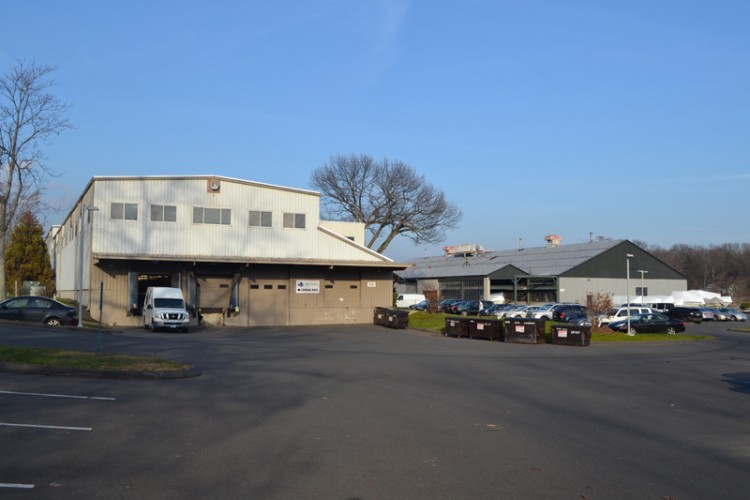
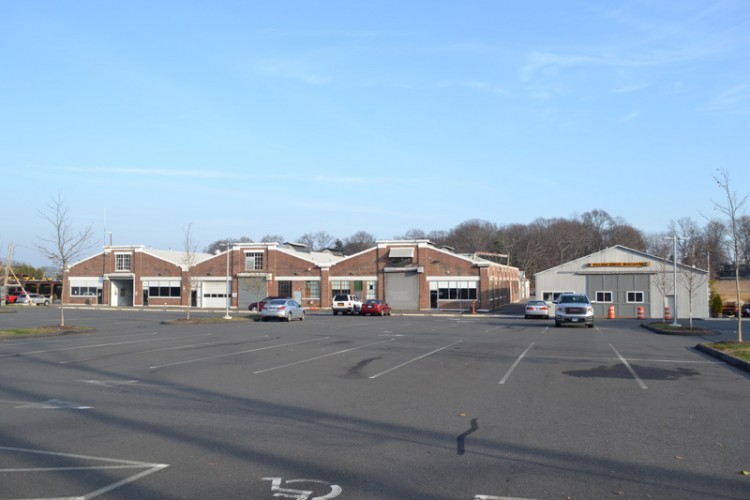
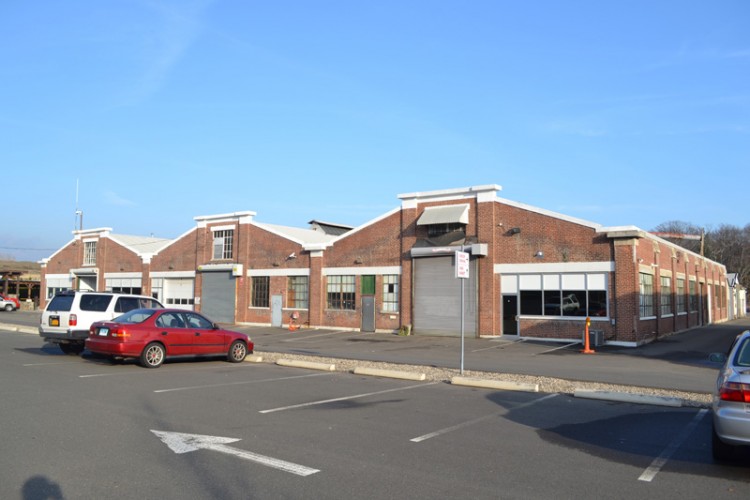
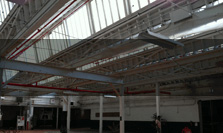
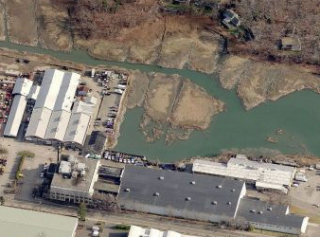
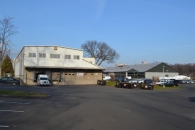
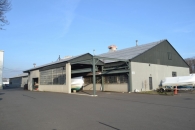
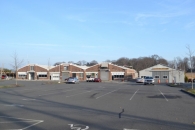
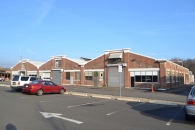
The former Nash Engineering Company facility is comprised of fourteen primary adjoining and freestanding buildings located on the east side of Wilson Avenue, just south of Wilson Avenue’s northern intersection with Grey Rock Road. The company’s original manufacturing plant at this location was demolished in 2012, however, several historic buildings have been preserved. The oldest consist of three red brick buildings erected ca. 1930 that are now included in a cluster of adjoining blocks set back roughly 275’ west of Wilson Avenue at the northeast corner of the property. The ca. 1930 blocks stand one story in height and each measures 62’ x 132’. They are of brick pier construction and have concrete foundations, large rectangular window openings with concrete sills and lintels and multipane metal sash, concrete pier caps and coping, and front-facing gable roofs. All three blocks have a mix of loading bay and window openings on their west (front) elevations, while the central and southern blocks each have two gabled skylights running along their ridgelines. Numerous one-story metal-frame and concrete block additions were erected adjoining the ca. 1930 blocks during the 1950s and 1960s. Two adjoining one-story blocks were erected south of the ca. 1930 buildings in 1956. These are of reinforced concrete and steel-frame construction and measure 106’ x 50’ and 200’ x 80’. The exterior walls are dominated by large, nearly floor-to-ceiling multipane metal windows with concrete sills. Both blocks have side-gabled roofs. A one-story port-cochere is located adjoining the west elevation of the southern block. This is identical in design to the adjoining block and it has a large steel hoist beam running its full length. Two large, two-story steel-frame blocks replaced a number of preexisting manufacturing blocks located south of the original plant and west of the 1956 buildings in 1980. These measure 370’ x 160’ and 208’ x 98’ and have concrete foundations, corrugated metal sheathing, and low-pitch side-gabled roofs. Small rectangular windows run along the rooflines of both blocks.
Exterior Material(s)
Structural System(s)
Roof Form
Roof Material
Power Source
Condition
Fair
Condition Notes
The complex is in fair condition. Although the original plant has been demolished and alterations have impacted a number of the surviving blocks, the plant retains much of its historic character.
- Property Information
-
Specific Location
One legal parcel (310 Wilson Avenue) totaling 14.31 acres located on the east side of Wilson Avenue, just south of Wilson Avenue’s northern intersection with Grey Rock Road.
Adjacent To
Exterior Visible from Public Road?
Yes
Parcel ID / Assessor Record Link
- 5/84/53/0. / Link →
Acreage
14.31
Use (Present)
- Commercial
- Other: redev as SoNo Ice House by Spinnaker 2012-14
- Sources
-
Form Completed By
Lucas A. Karmazinas
Date
11/06/2015
Bibliography
- List of Connecticut Manufacturers, 1922, 1924, 1930, 1932.
- Directory of Connecticut State Manufacturers, 1936, 1939.
- Industrial Directory of Connecticut, 1947.
- Register of War Production Facilities in Connecticut, 1951.
- Map of New Haven County; Clark, Richard, 1859.
- Atlas of New Haven County, Beers, Ellis & Soule, 1868.
- Aerial Survey of Connecticut, 1934, 1951, 1965, 1970, 1985.
- Sanborn Map Company, 1891, 1896, 1901, 1906, 1922, 1950, 1958.
- Norwalk Directory; Various editions.
- Hartford Courant, 1925.
- New York Times, 1975.
- Nash by Gardner Denver website, About Us.
- Norwalk; Grant, Lisa Wilson, 2014.
- Representative View(s)Click on image to view full file
-
Photographer
Lucas A. Karmazinas
Photography Date
11/06/2015