Mill Record Shelton
RETURN TO ‘FIND MILLS’Disclaimer: Content for these properties was compiled in 2014-2017 from a variety of sources and is subject to change. Updates are occasionally made under Property Information, however the Connecticut Trust for Historic Preservation (dba Preservation Connecticut) makes no representation or warranty that the information is complete or up-to-date.
- Complex Name (Common)
- Naugatuck Valley Crucible Co.
- Complex Name (Historic)
-
- Naugatuck Valley Crucible Co.
- Address or Location
- 281 Canal Street, Shelton
- County
- Fairfield
- Historic Designation
- Associated Mill Community
- n/a
- Historic Information
Companies Associated w/Complex
- American Crucible Co. ca. 1932-ca. 1950
- Naugatuck Valley Co. ca. 1930-ca. 1932
- Naugatuck Valley Crucible Co. 1917-ca.1930
- Wilkinson Brothers Paper Mill ca. 1878-ca. 1917
Use (Historic)
- Paper & Wood Products
- Other: Stone, Clay, and Glass Products
Largest Documented Workforce
51-200 (1947)
Historic Narrative
The first manufactory on this site was the Wilkinson Brothers Paper Mill, which was established by William Wilkinson, an English immigrant, during the early 1860s. Originally founded in New York City, Wilkinson’s first plant in Shelton consisted of a wooden structure erected at the northern end of the Ousatonic Water Company’s recently completed canal in 1871. Wilkinson’s wooden plant was destroyed by fire in 1878 and slowly replaced by the sprawling brick complex visible between the canal and the Housatonic River today. Locally known as the 'Derby Mills,' the Wilkinson Brothers Paper Mill produced manila paper and packing twine, and by the mid-1880s was credited with over $5 million of annual income. In 1906, a two-story building at the southern end of the plant was acquired by the Star Pin Company, and around the same time another housed the fledgling Driscoll Wire Company. Just over ten years later, in 1917, Wilkinson Brothers ceased production and the northern half of the mill was purchased by the Naugatuck Valley Crucible Company, and the southern part was occupied by Driscoll Wire. The Naugatuck Valley Crucible Company was organized by David N. Clark in 1917. Clark was a prominent businessman in Shelton having established a notable local hardware firm in 1882, and founding the Shelton Metallic Filler Company in 1890. Incorporated with $250,000 in capital, the Naugatuck Valley Crucible Company specialized in the production of crucibles used by metalworking firms, particularly the thriving local brass industry. A 1922 advertisement lists a variety of the company’s products, including graphite crucibles, phosphorizers, and stirrers, to which were added black lead crucibles by 1930 whereupon the company had changed its name to the Naugatuck Valley Company. By 1932, the company had merged with the Chicago Crucible Company and again changed its name. The subsequent American Crucible Company was one of the largest crucible manufacturing companies in the United States and its catalog included crucibles for oil or coke fuel furnaces, brass rolling mills, and steel melting. The company occupied the plant into the second half of the 20th century, yet by 1951 is identified as operating on Washington Avenue in North Haven, Connecticut, rather than Shelton.
- Architectural Information
Number of Existing Buildings
Roughly ten (10) blocks.
Dates of Construction
ca. 1878 - ca. 1898
Architect
n/a
Builder
n/a
Building Type
Architectural Description
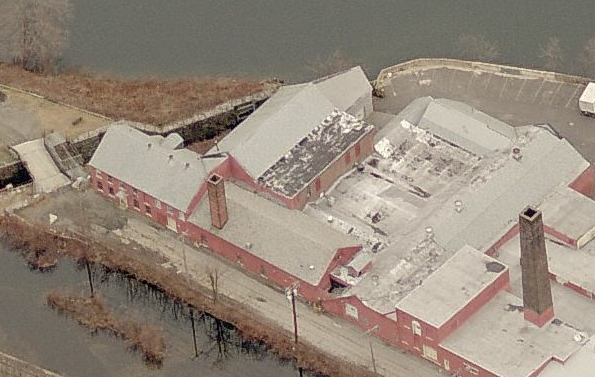
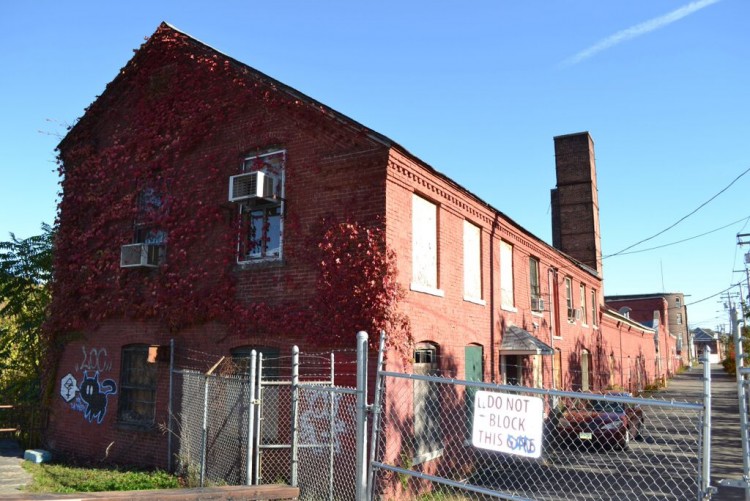
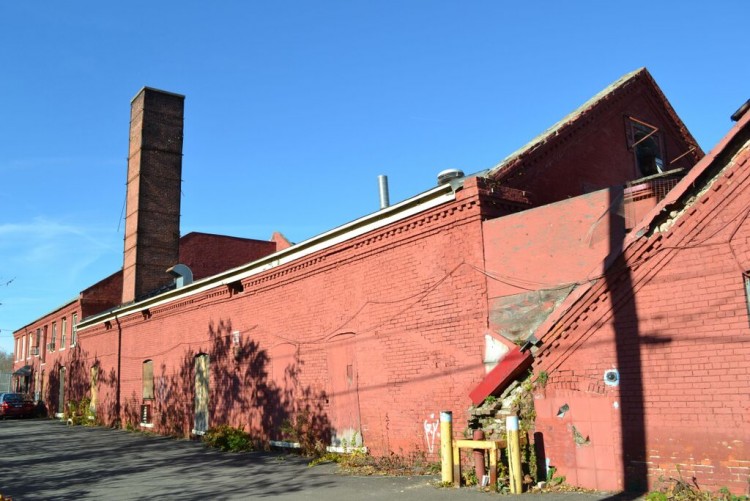
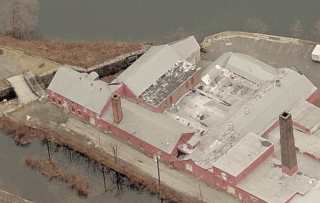
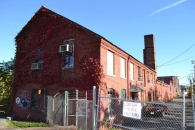
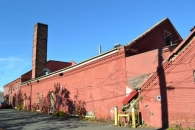
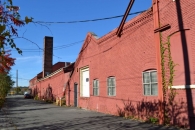
The former Naugatuck Valley Crucible Company plant is comprised of an adjoining complex of approximately ten identifiable red brick blocks with a frontage of roughly 220 feet on the east side of Canal Street. Originally built as part of a large complex by the Wilkinson Brothers Paper Mill between ca. 1878 and ca. 1898, the northern half of the plant was acquired by the Naugatuck Valley Crucible Company in 1917. The blocks comprising the Naugatuck Valley Crucible Company factory range between one and two stories in height and have a mix of pitched and flat roofs. The majority of the exterior walls are painted and they rise to a denticulated brick cornice. The first-floor door and window openings throughout the complex have segmental-arched openings, while the second-story fenestration either shares this detail or intersects the cornice detailing. Many of the plant’s irregularly-spaced door and window openings have been boarded up, however, a number of the original windows remain intact. These primarily consist of a mix of two-over-two and eight-over-eight double-hung wood sash. A particularly notable section of the former Naugatuck Valley Crucible Company plant is the block forming the southern terminus of the complex adjoining the northernmost buildings once occupied by the Driscoll Wire Company factory. The former is a one-story block measuring roughly 34 feet wide and 150 feet long. This red brick building has a front-gabled, long-slope roof descending almost to ground level before it intersects the building on its northern side. The denticulated cornice visible throughout the majority of the complex is present along this uniquely designed roofline and although frame infill is visible along the west (front) elevation of the block, the steep pitch of the roof is maintained the entire length of the building.
Exterior Material(s)
Structural System(s)
Roof Form
Roof Material
Power Source
Condition
Fair, Deteriorated
Condition Notes
All portions of the building are in generally fair condition, however deterioration is present in many locations throughout the complex. This is particularly true of many of the windows, cornices, and roofs.
- Property Information
-
Specific Location
One legal parcel totaling 0.77 acres on the east side of Canal Street.
Adjacent To
Exterior Visible from Public Road?
Yes
Parcel ID / Assessor Record Link
- 139.-3 (for record, use link and type in address or parcel number) / Link →
Acreage
0.77
Use (Present)
- Sources
-
Form Completed By
Lucas A. Karmazinas
Date
10/27/2014
Bibliography
- List of Connecticut Manufacturers, 1922, 1924, 1930, 1932.
- Atlas of New Haven County, Beers, Ellis & Soule Co., 1868.
- Derby and Shelton Bird’s Eye View, 1898.
- Shelton Bird’s Eye View, 1919.
- Industrial Directory of Connecticut, 1947.
- Register of War Production Facilities in Connecticut, 1951.
- Sanborn Map Company, 1924, 1949.
- Aerial Survey of Connecticut, 1934, 1965.
- Tercentenary Pictorial and History of the Lower Naugatuck Valley, Malloy, Leo T., 1935.
- Roth, Matthew, et al, Connecticut: An Inventory of Historic Engineering and Industrial Sites (Washington DC: SIA, 1981).
- Representative View(s)Click on image to view full file
-

Photographer
Lucas A. Karmazinas
Photography Date
10/27/2014