Mill Record Winchester
RETURN TO ‘FIND MILLS’Disclaimer: Content for these properties was compiled in 2014-2017 from a variety of sources and is subject to change. Updates are occasionally made under Property Information, however the Connecticut Trust for Historic Preservation (dba Preservation Connecticut) makes no representation or warranty that the information is complete or up-to-date.
- Complex Name (Common)
- New England Pin Co.
- Complex Name (Historic)
-
- New England Pin Co.
- Address or Location
- 10 Bridge St, Winsted, Winchester
- County
- Litchfield
- Historic Designation
- Associated Mill Community
- n/a
- Historic Information
Companies Associated w/Complex
- New England Flexible Door Co. 1928-1929
- New England Knitting Co. 1887-1955
- New England Pin Co. ca. 1880-1926
Use (Historic)
Largest Documented Workforce
130 (1926).
Historic Narrative
IN 2023 BY SHPO. The New England Pin Company was organized in the Winsted section of Winchester, Connecticut in 1854. The firm was established by John G. Wetmore, a prolific industrialist and inventor, and by his management it expanded considerably during the second half of the 19th century. In 1880, the company added a paper box department to the business, which manufactured all of the boxes used by the firm in addition to supplying product to many other concerns throughout Winsted and the surrounding area. By the early 1890s, the company’s plant was the largest pin factory in the United States, and in 1892, the firm employed 60 hands capable of producing an average of 7,000,000 pins per day. At the same time, the box department employed 30 hands, most of these being young women. Much of the New England Pin Company’s market growth came through acquisitions. By the turn of the century, the company had acquired a number of competitors, among them being the Diamond Pin Company of Boston, Massachusetts; the Empire Pin Company of Cohoes, New York; and the Pyramid Pin Company of New Haven, Connecticut. The firm made considerable additions to its Winsted plant between 1900 and 1905, and by 1906 the workforce had increased to 125 hands. Total output averaged between 12,000,000 and 15,000,000 pins per day at the time, this requiring roughly one ton of raw material daily. The company’s product consisted of a wide variety of needle-pointed pins. These ranged between one-half of an inch and four inches in length and included office, bank, shawl, book, blocking, and hair pins sold under such brands as ‘Crown,’ ‘Victoria,’ ‘No Plus Ultra,’ and many others. The New England Pin Company continued to operate until 1926 when the firm merged with the Star Pin Company of Shelton, Connecticut and the National Pin Company of Detroit, Michigan. All of the business of the Winsted company was moved to Shelton following the merger and the plant remained vacant until 1928 when it was occupied by the newly-organized New England Flexible Door Company. This business remained in Winsted for just one year, however, before relocating to Hartford, Connecticut. In 1930, the mill was in turn acquired by the New England Knitting Company, a woolen underwear manufacturer that had occupied an adjoining factory complex on the west side of the New England Pin Company mill since 1887. The New England Knitting Company remained in business until 1955, whereupon the former New England Pin Company plant passed to a series of real estate developers who rented the space to small industrial firms or other assorted occupants. Note: 3/2023 SHPO determined complex to be eligible for listing as part of a small historic industrial district (10 Bridge St incl'g rear; 9 Willow, 35 Willow and possible 119 Willow).
- Architectural Information
Number of Existing Buildings
Roughly five (5) adjoining primary blocks.
Dates of Construction
ca. 1880, ca. 1895, ca. 1900, 1902, 1905.
Architect
n/a
Builder
n/a
Building Type
Architectural Description
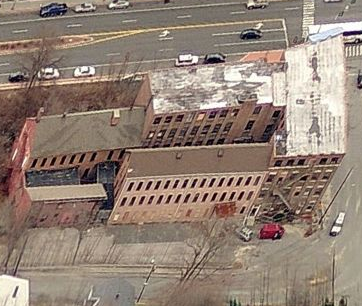
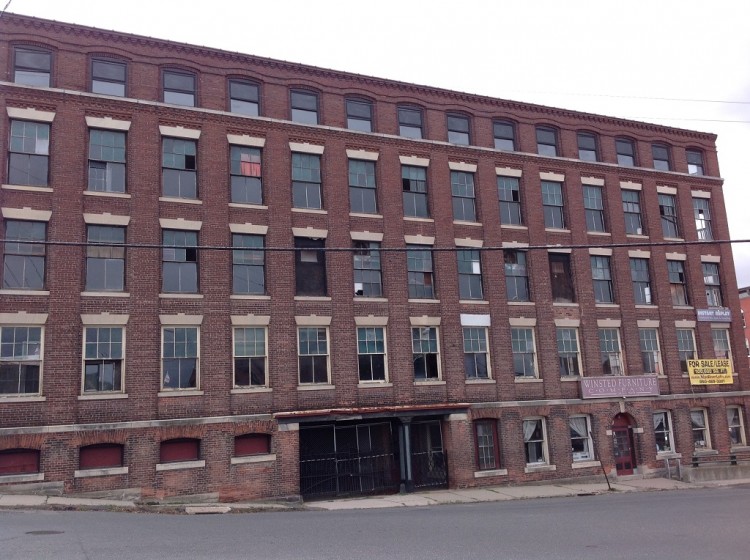
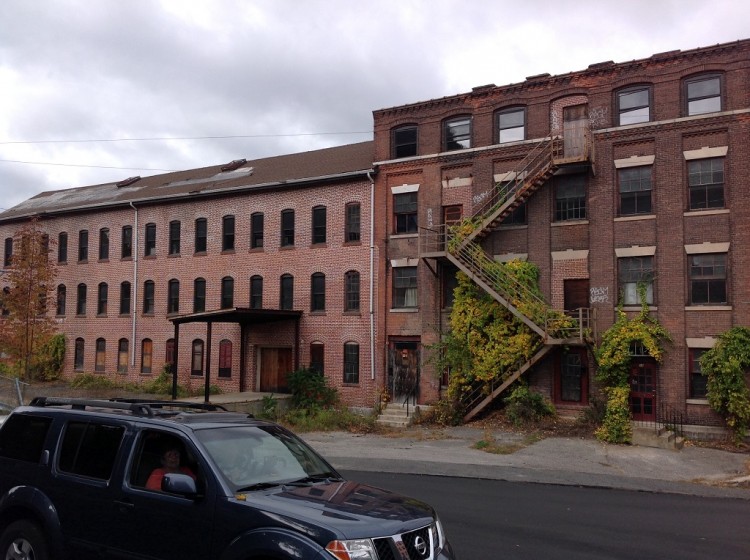
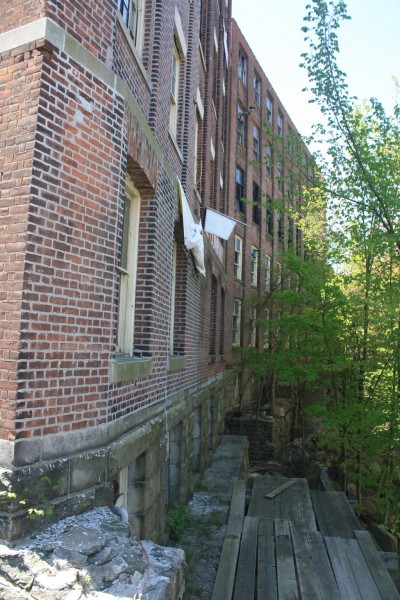
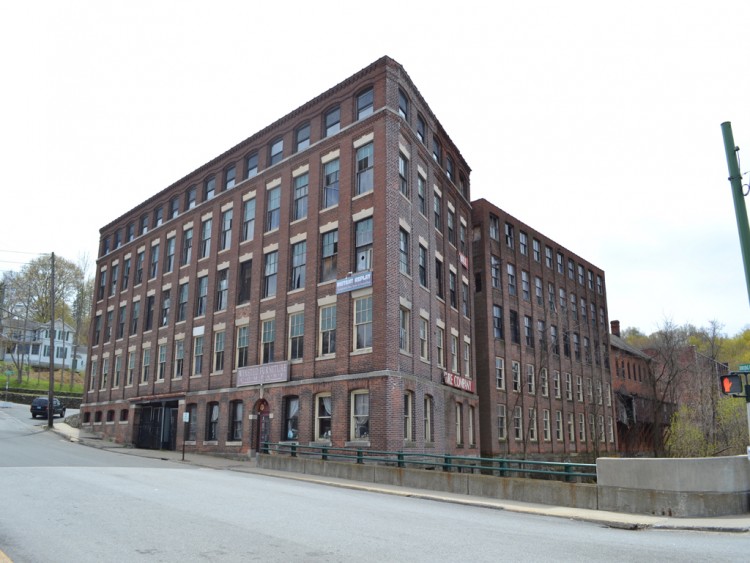
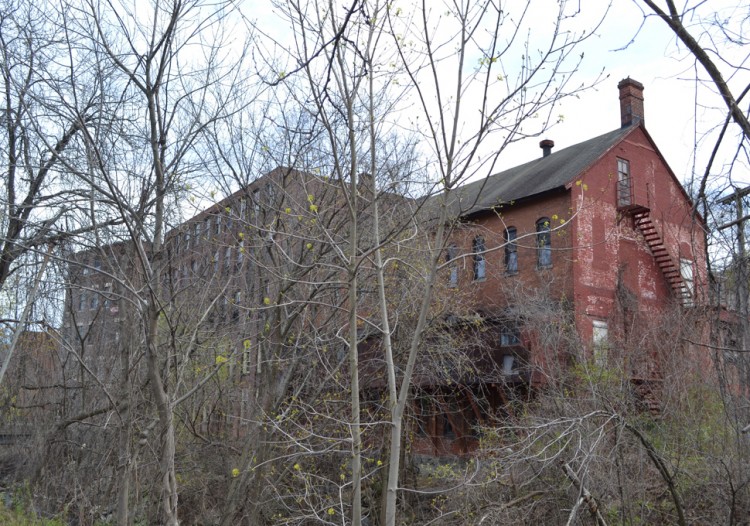
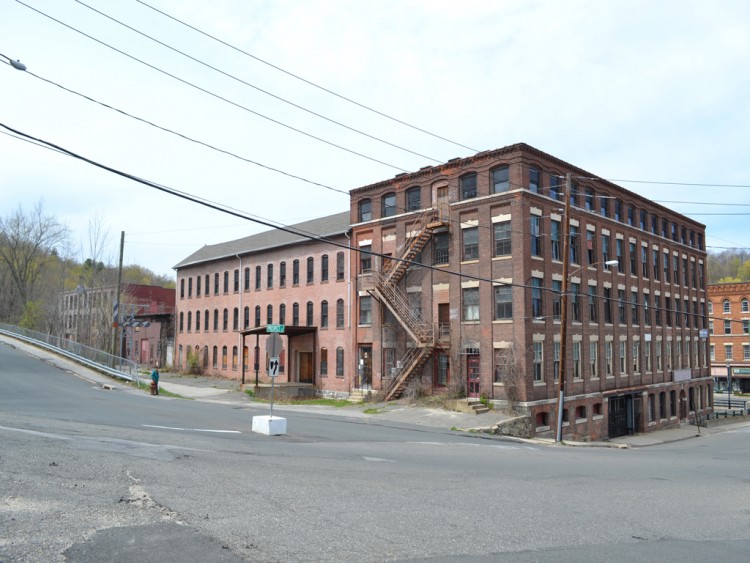
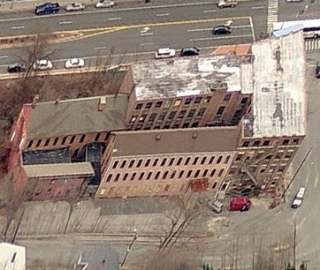
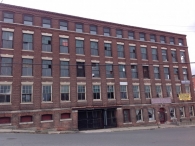
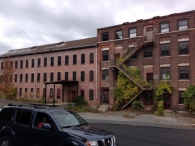
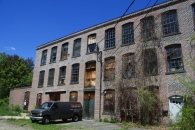
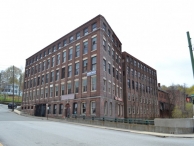
The former New England Pin Company mill consists of roughly five adjoining primary blocks located on the west side of Bridge Street, at the northwest corner of Bridge Street’s intersection with Prospect Street and along the south bank of the Mad River. The plant’s most prominent block fronts on Bridge Street and was erected in 1901. It originally housed offices on the first floor and a machine shop and paper box manufacturing on the upper levels. The red brick building measures 116’ x 45’ and stands five stories tall. It has a heavy ashlar stone foundation, brick pier walls, stone watertables delineating the first and second and fourth and fifth floors, a corbelled and denticulated brick cornice at the fourth floor level, red brick corbelling along the roofline cornice, tile coping, and a flat roof. The first floor window openings have flat-arched brick lintels, heavy stone stills, and a mix of one-over-one and six-over-six double-hung wood sash. The second-, third-, and fourth-floor window openings are rectangular and have splayed stone lintels, stone sills, and either six-over-two or six-over-six double-hung wood sash. The fifth floor has short segmental-arched window openings unified by arcaded brick headers and the stone watertable. The fenestration consists of one-over-one double-hung wood sash. A three-story, 28’ x 112’ red brick block adjoins the southern end of the office/manufacturing building’s west (rear) elevation. The ell was originally erected as a two-story block ca. 1880, yet was raised to its present height in 1902. The building housed packing, shipping, and pin sticking operations, and has a rough-cut stone foundation, segmental-arched window openings with brownstone sills and brick lintels, six-over-six double-hung wood sash, and a front-facing gable roof. A two-story, 23’ x 62’ red brick and wood-frame block adjoins the west elevation of the packing/shipping/pin sticking building. This was erected for storage use ca. 1895. It has a rough-cut stone foundation, rectangular window openings with six-over-six double-hung wood sash, and a flat roof. A three-story, 42’ x 100’ red brick block adjoins the northern end of the office/manufacturing building’s west (rear) elevation. This was built in 1905 to house both pin and paper box production. The building has a heavy ashlar stone foundation; brick pier walls; rectangular window openings with stone sills, brick lintels, and two-over-two-over-two triple-hung wood windows; tile coping, and a flat roof. A three-story, 40’ x 80’ red brick block adjoins the 1905 block’s west elevation. The former was built by the New England Pin Company ca. 1880, yet was occupied by the New England Knitting Company from 1887 to 1955. The building has a rough-cut stone foundation, segmental-arched window openings with stone sills and brick lintels, one-over-one double-hung windows, and an overhanging front-facing gable roof.
Exterior Material(s)
Structural System(s)
Roof Form
Roof Material
Power Source
Condition
Fair
Condition Notes
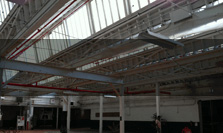
The plant is in fair condition. Most of the original windows appear to have been retained, however, many are in need of repair. The various blocks appear structurally sound.
- Property Information
-
Specific Location
One 0.78-acre parcel (10 Bridge St.) located on the west side of Bridge Street, at the northwest corner of Bridge Street’s intersection with Prospect Street and along the south bank of the Mad River.
Adjacent To
Exterior Visible from Public Road?
Yes
Parcel ID / Assessor Record Link
- 110/054/003A. / Link →
Acreage
0.78
Use (Present)
- Other: 3/2023 SHPO determined complex to be eligible for listing as part of a small NR historic industrial district (10 Bridge St incl'g rear; 9 Willow, 35 Willow and possible 119 Willow) in advance of proposed rehab. 6/2023 DECD awarded $128,500 grant to remediate and abate the 0.78-acre property of the former Winsted Centerless Company factory located at 10 Bridge Street to potentially enable adaptive reuse for mixed-use development.
- Vacant
- Sources
-
Form Completed By
Lucas A. Karmazinas
Date
04/28/2016
Bibliography
- List of Connecticut Manufacturers, 1922, 1924, 1930, 1932.
- Directory of Connecticut State Manufacturers, 1936, 1939.
- Industrial Directory of Connecticut, 1947.
- Register of War Production Facilities in Connecticut, 1951.
- Sanborn Map Company, 1887, 1892, 1897, 1904, 1909, 1919, 1931, 1947.
- Aerial Survey of Connecticut, 1934, 1951, 1965, 1970, 1985.
- Fairfield City Directories, Various editions.
- Hartford Courant, 1892, 1905, 1926, 1928, 1930.
- Winsted: The Development of an Ideal Town; Hulburt, Robert S., 1906.
- Roth, Matthew, et al, Connecticut: An Inventory of Historic Engineering and Industrial Sites (Washington DC: SIA, 1981).
- Representative View(s)Click on image to view full file
-



Photographer
Lucas A. Karmazinas
Photography Date
04/28/2016