Mill Record Norwich
RETURN TO ‘FIND MILLS’Disclaimer: Content for these properties was compiled in 2014-2017 from a variety of sources and is subject to change. Updates are occasionally made under Property Information, however the Connecticut Trust for Historic Preservation (dba Preservation Connecticut) makes no representation or warranty that the information is complete or up-to-date.
- Complex Name (Common)
- Ponemah Mills
- Complex Name (Historic)
-
- Ponemah Mills
- Address or Location
- 607; 607 #1; 611 #A Norwich Avenue, Norwich
- County
- New London
- Historic Designation
- Associated Mill Community
 What can you do at this mill?
- Historic Information
Companies Associated w/Complex
- Ponemah Mills
- Ponemah Mills
Use (Historic)
Largest Documented Workforce
1550 c.1880s
Historic Narrative
In 1865 Edward Taft of Providence began the cotton-textile manufacturing village that would bear his name. He bought 600 acres of land and a previously undeveloped water privilege (30' head) on the Shetucket River above Norwich. Construction of the mills, power system and village took five years. F. P. Sheldon and Son designed the brick-pier main mill. Ponemah first produced fine cottons such as percales, lawns and cambrics. English tradesmen and experienced Rhode Islanders filled many of the skilled and supervisory positions, while Irish comprised a majority of the initial 1,000-member workforce. After a strike in 1875, caused in part by the workers' demand for an adjustment in piece rates to correspond with the coarser goods being introduced, many people left the village for good. The turnover from Irish to French-Canadian millhands began at this time. In 1884 the company built Mill #2 for its weaving operations. In 1902 the weaving was again moved to a new building. Last in the line of mill structures is the 3-story brick storage building, started in 1900 and enlarged several times to its present size. The residential component of the village was enlarged around 1895 with 32 brick dwellings built south of the mills. These houses do not reflect growth in the number of people working in the mills, for even though the number of spindles increased from 108,000 in 1882 to 120,000 in 1890 and 265,000 in 1924, employment remained at about 1,500 from the 1880s. The new dwellings became necessary only after state laws prohibited child labor in the mills, thus requiring more families to provide the same number of millhands. The increase in number of spindles was achieved almost entirely through the adoption of new machinery and by increasing the number of machines each worker tended. After financial reverses in the 1930s the houses were sold. The mills were sold one at a time until 1970, when the last looms ran. (Roth)
- Architectural Information
Number of Existing Buildings
n/a
Dates of Construction
1865, 1884, 1900
Architect
F. P. Sheldon and Son
Builder
n/a
Building Type
Architectural Description
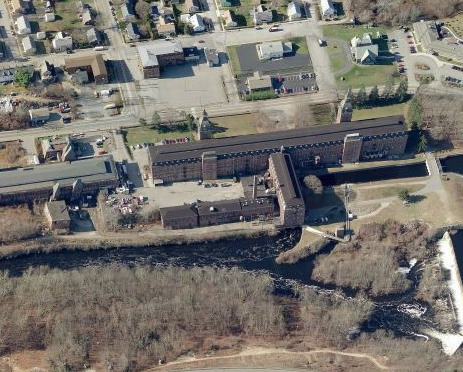
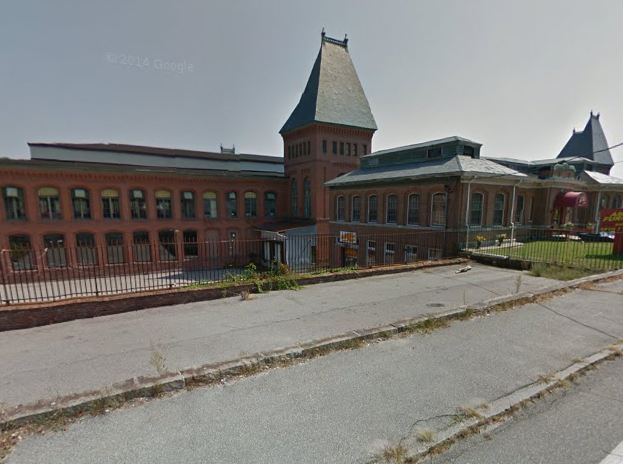
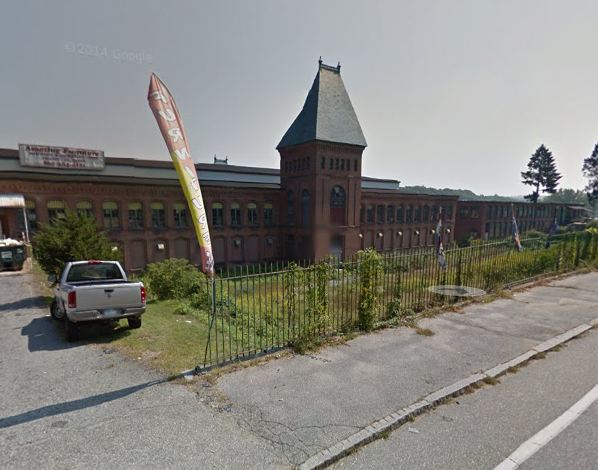
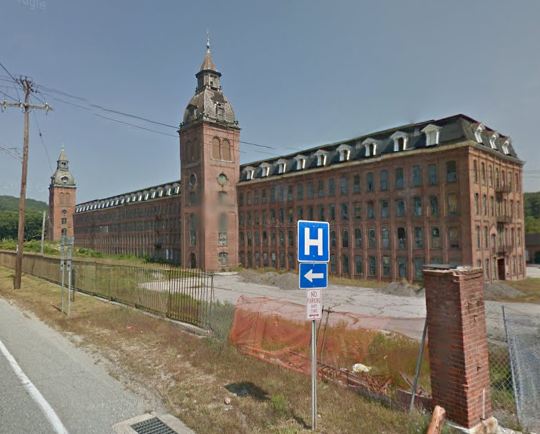
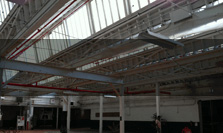
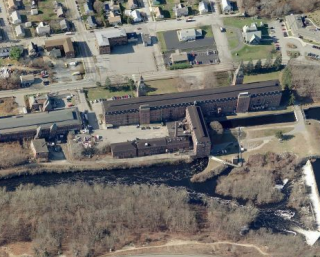
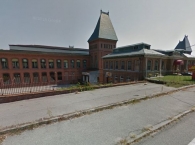
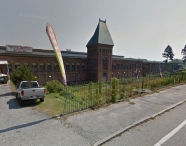
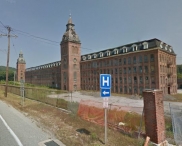
F. P. Sheldon and Son designed the brick-pier main mill, 5-story and 750' x 74' with a 5-story, 228' x 61' wing. It is highly elaborate, even grandiose, depicting the textile economy at the height of its power in eastern Connecticut, but fumbling for an architectural style. The mansard roof with monitor and gabled dormers at alternate bays, corbeled drops and arches at the cornice and corbeled belt courses contribute to the mill's handsome appearance, but most striking are the two main stair towers, 150' in from each end on the village-facing (west) side. They have four-sided domed roofs topped with octagonal cupolas and feature a variety of window treatments, decorative parapets and finials. Inside the mill, timber posts and beams carry the hardwood floors, which are laid over two plank subfloors. The fourth floor, which housed the large spinning mules, has no posts; its ceiling hangs from the roof trusses on iron rods. Traces of the rubble-stone dam remain, but most of it was rebuilt in concrete in the 1930s. The original coursed-granite bulkhead and rubble-walled headrace still feed water into the wheelpit under the wing, where modern turbines generate electricity. Behind the mill stand a boiler house, machine shop and gas-holder house, all of brick. The village consists of 11 blocks, each with 10 houses around its perimeter and open space in its center. The dwellings are 1 1/2-story and 2 1/2-story frame duplexes. The 2-story and about 700' x 90' brick mill #2 has a low, hip roof and a more prominent monitor than the first mill. It has no piers and much simpler corbeling. Stylistic intent was concentrated on the elaborate, chateauesque west stair towers; these feature different window treatments for each floor, and roofs that have two hipped sections, copper cresting and finials. The 2-story brick mill, about 250' x 150' with a near-flat roof, is the first in Taftville to have iron posts. Last in the line of mill structures is the 3-story brick storage building, about 300' x 100'. It was started in 1900 and enlarged several times to its present size. The residential component of the village was enlarged around 1895 with 32 brick dwellings built south of the mills. Unlike the earlier houses in their spacious block setting, these are tightly spaced in two long rows. (Roth)
Exterior Material(s)
Structural System(s)
n/a
Roof Form
Roof Material
n/a
Power Source
n/a
Condition
n/a
Condition Notes
n/a
- Property Information
-
Specific Location
condos
Located in the Taftville National Historic District (1978).
http://npgallery.nps.gov/nrhp/GetAsset?assetID=9d867937-ee3d-4e13-9177-13027a624489Adjacent To
Exterior Visible from Public Road?
Yes
Parcel ID / Assessor Record Link
Acreage
n/a
Use (Present)
- Commercial
- Other: Residential rehab in the works 2016 for the northern building - completed 2021. DECD awarded $200,000 grant in 2018 for environmental assessment at south end of site, 555-559 Norwich Ave. DECD awarded $795k brownfields grant 6/2021 for remediation/renovation of 555 & 575 Norwich Ave for mixed use residential (141 units)/commercial. 1/2022, Norwich City Plan Commission approved $40 million plan by New Jersey developer OneKey Inc. to create 146 apartments and a 3,879-square-foot restaurant or café in the south mill complex following an online public hearing on the project
- Sources
-
Form Completed By
n/a
Date
n/a
Bibliography
- Roth, Matthew, et al, Connecticut: An Inventory of Historic Engineering and Industrial Sites (Washington DC: SIA, 1981).
- Representative View(s)Click on image to view full file
-
Photographer
n/a
Photography Date
n/a