Mill Record Middletown
RETURN TO ‘FIND MILLS’Disclaimer: Content for these properties was compiled in 2014-2017 from a variety of sources and is subject to change. Updates are occasionally made under Property Information, however the Connecticut Trust for Historic Preservation (dba Preservation Connecticut) makes no representation or warranty that the information is complete or up-to-date.
- Complex Name (Common)
- Remington Rand Corp.
- Complex Name (Historic)
-
- Keating Wheel Co.
- Address or Location
- 180 Johnson Street, Middletown
- County
- Middlesex
- Historic Designation
- Associated Mill Community
- n/a
 What can you do at this mill?
- Historic Information
Companies Associated w/Complex
- Eisenhuth Horseless Vehicle Co. 1901-1907
- Keating Wheel and Automobile Co. 1899-1901
- Keating Wheel Co. 1897-1899
- Noiseless Typewriter Co. 1909-1924
- Remington Rand Corp. 1927-1955
- Remington-Noiseless Typewriter Corp. 1924-1927
- Sperry Rand Corp. 1955-ca. 1970
Use (Historic)
Largest Documented Workforce
1200 (1936)
Historic Narrative
The majority of the former Remington Rand plant was built between 1896 and 1897 for the Keating Wheel Company. The Keating Wheel Company was established by Robert M. Keating in Holyoke, Massachusetts in 1892 and moved to Middletown after its early success necessitated greater production space. A brochure published by the company following the completion of its new factory noted that it was 1000’ long, 50’ wide, stood two stories tall, and had six ells, in all totaling 168,000 square feet of floor space. The main building was also accompanied by an office building and boiler house, these located to the west and north of the main plant, respectively. The Keating Wheel Company limited its production to bicycles until 1899, when a lines of motorized horseless carriages was developed. The firm subsequently changed its name to the Keating Wheel and Automobile Company and began manufacturing a mix of vehicles, its specialty being an electric-powered delivery wagon. Unfortunately, the product did not spell success for the company. Despite rebounding from this failure with the country’s first production gasoline-powered motorcycle, the firm was forced to close its doors in 1901. The Keating Wheel Company factory was soon purchased by the Eisenhuth Horseless Vehicle Company, which produced a gasoline-powered automobile designed by John W. Eisenhuth. Despite making constant improvements to its products, which possessed qualities including comparatively high power and efficiency, poor business practices and managment conflicts forced the firm into bankruptcy in February 1907. Consequently, the factory complex remained unoccupied until 1909 when the company’s office furniture was sold and the building purchased by the Noiseless Typewriter Company. The Noiseless Typewriter Company was incorporated in January 1909 and the firm began production in their newly occupied plant in November of that same year. By redesigning how their machine’s action transferred ink to a page (by applying controlled pressure rather than striking) the company sought to address the issue of noise, one of the largest complaints regarding typewriter designs at the time. The most modern equipment available was employed by the firm and production estimates were placed at 12,000 machines per year, with potential expansion predicted to push the number to 36,000 annually. Like the firms that preceded it, the Noiseless Typewriter Company was plagued by financial issues and after numerous attempts at reorganization merged with the Remington Company, one of the most prominent typewriter companies in the world at the time, in 1924. The resultant Remington-Noiseless Typewriter Company then merged with office equipment company Rand Kardex in 1927, thus forming the Remington Rand Company. Remington Rand produced a variety of typewriters and other office machines through the 1930s and 1940s, including the first business computer, the Remington Rand 409, in 1949. In 1955, Remington Rand merged with the Sperry Corporation to form Sperry Rand, which continued production in Middletown through the early 1970s. Following Sperry Rand’s closure the factory complex was occupied by a variety of light industrial and other tenants, yet never again saw the peak employment of 1,200 workers retained by Remington Rand during the late 1930s and 1940s.
- Architectural Information
Number of Existing Buildings
Roughly ten (10) blocks and quonset hut.
Dates of Construction
1896-1897, ca. 1925, 1926, 1934, 1935, ca. 1940, 1948
Architect
n/a
Builder
n/a
Building Type
Architectural Description
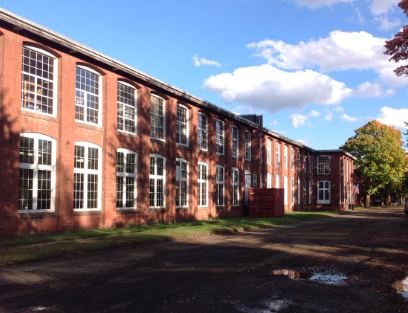
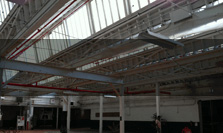
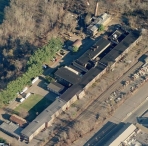
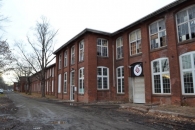
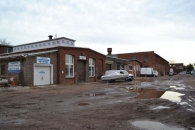
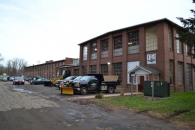
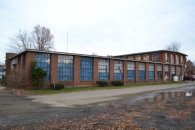
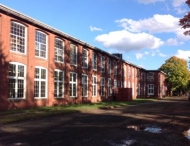
The former Remington Rand plant consists of a sprawling complex of approximately ten adjoining buildings and a detached Quonset hut located at the northern terminus of Johnson Street. The primary manufacturing building was built between 1896 and 1897 and is a 50’ x 905’ factory with brownstone and concrete foundation, red brick walls, and a widely overhanging flat roof with simple wood cornice. The building stands two stories tall and its façade (south elevation) is interrupted by three projecting pavilions, each with an entry door and interior stair. The factory’s exterior walls are divided into bays by full-height brick piers, these framing broad window openings with brownstone sills and brick segmental arches above. Many of the windows have been replaced with modern aluminum sash, however, the surviving original fenestration is a mix of multi-pane casement or hopper windows, these with wood sash. Four one-story ells original to the factory’s construction project from the north elevation of the main block. These are all two stories in height and from west to east measure 50’ x 102’, 50’ x 102’, 50’ x 75’, and 44’ x 74’, respectively. They are similar in construction and detailing to the main block yet originally had monitor roofs, these surviving in all cases except that of the westernmost ell, this having been recently removed and the roof replaced. When occupied by the Remington Rand Corporation, the ells housed grinding and polishing, pressing, plating, and Japanning operations. Five additional ells were constructed on the north side of the main block in ca. 1925, 1926, 1934, 1934, and 1935. These consisted of a one-story storage building, a two-story combined shipping and manufacturing block, a one-story carbon coating building, a one-story storage structure, and a two-story office and maintenance building. All but the ca. 1925 storage building – which is of frame construction and has aluminum siding – have red brick walls and flat or low-pitch gable roofs. Like the original blocks, their exterior walls are divided into bays by full-height brick piers. Their original fenestration, however, consisted of steel hopper-style sash set in rectangular openings, which remains in place.
Exterior Material(s)
Structural System(s)
Roof Form
Roof Material
Power Source
Condition
Good
Condition Notes
Overall the complex is in good condition. Sections of the plant have recently been rehabilitated, while others are currently undergoing repairs and adaptive reuse. Overall the exterior walls and structure are sound, while any original windows that remain range in condition from good to slightly deteriorated.
- Property Information
-
Specific Location
One legal parcel (180 Johnson Street) totaling 10.48 acres at the northern terminus of Johnson Street, along the New York, New Haven & Housatonic Railroad.
Adjacent To
Exterior Visible from Public Road?
Yes
Parcel ID / Assessor Record Link
- 20/ / 0223 / Link →
Acreage
10.48
Use (Present)
- Sources
-
Form Completed By
Lucas A. Karmazinas
Date
11/25/2014
Bibliography
- List of Connecticut Manufacturers, 1922, 1924, 1930, 1932.
- Directory of Connecticut State Manufacturers, 1936, 1939.
- Atlas of Middlesex County, F.W. Beers & Co., 1874.
- Middletown Bird’s Eye View, 1877, 1915.
- Industrial Directory of Connecticut, 1947.
- Register of War Production Facilities in Connecticut, 1951.
- Sanborn Map Company, 1889, 1895, 1901, 1913, 1924, 1950.
- Aerial Survey of Connecticut, 1934, 1965.
- Middletown City Directory, 1887-1960.
- Mitigation Documentation for the Remington Rand Facility, 2010.
- Representative View(s)Click on image to view full file
-
Photographer
Lucas A. Karmazinas
Photography Date
11/25/2014