Mill Record New Haven
RETURN TO ‘FIND MILLS’Disclaimer: Content for these properties was compiled in 2014-2017 from a variety of sources and is subject to change. Updates are occasionally made under Property Information, however the Connecticut Trust for Historic Preservation (dba Preservation Connecticut) makes no representation or warranty that the information is complete or up-to-date.
- Complex Name (Common)
- Seamless Rubber Co
- Complex Name (Historic)
-
- Seamless Rubber Co
- Address or Location
- 69 Daggett Street, The Hill, New Haven
- County
- New Haven
- Historic Designation
- Associated Mill Community
- n/a

- Historic Information
Companies Associated w/Complex
- Goodyear Rubber Sundries Co. 1920-1955
- Seamless Rubber Co. 1877-1920
Use (Historic)
Largest Documented Workforce
60 (1886).
Historic Narrative
The Seamless Rubber Company was organized in New Haven, Connecticut in 1877. The company manufactured soft rubber articles for the drug, dental, surgical, and stationary trades and its first factory was built on Daggett Street at a cost of $10,000. By the mid-1880s, the Seamless Rubber Company employed 60 hands, however, this number undoubtedly increased during the 1890s after several substantial additions to the plant were completed. The company’s capital value was increased several times during the early 1900s, including from $130,000 to $250,000 in 1903, and again from $250,000 to $300,000 in 1905. By the 1910s, the Seamless Rubber Company produced a broad range of rubber medical products including bottle nipples, hot water bottles, rubber tubing, surgical gloves, and crutch tips, and rubber sporting goods such as balls and hockey pucks. The firm was incorporated with $1,500,000 in capital in 1917, and in 1919 a massive new factory was built for the company on Hallock Street, where employment numbered over 1,000 workers. The Daggett Street plant subsequently passed to several small manufacturers, principal among them being Goodyear Rubber Sundries, Inc., which was organized in 1920 by James A. Murray and James A. Murray Jr. Other tenants in the plant included Allen and Company, Inc., tool manufacturers; the A and V Powder Puff Company; the C and K Manufacturing Company, another producer of powder puffs; and the New England Fabrics Manufacturing Company, an automobile accessory firm. Goodyear Rubber Sundries eventually secured sole control of the Daggett Street factory and continued to occupy it until the 1950s. In 1955, Goodyear Rubber Sundries was sold to the Bridgeport-based Connecticut Chemical Research Corporation, which closed the New Haven factory and moved production of its primary product, a plastic film called Plasti-cleer, to Bridgeport. The plant returned to use by a mix of small tenants during the second half of the 20th century, and during the late 20th century the complex was converted for use as live-work space for local artists. This lasted until March 2015 when the program was terminated by the City of New Haven.
- Architectural Information
Number of Existing Buildings
Roughly twelve (12) primary blocks.
Dates of Construction
1877, ca. 1895, 1903, ca. 1910.
Architect
Roy W. Foote (1919 building on Hallock St)
Builder
Alberthaw Constuction Co. (1919 building on Hallock St)
Building Type
Architectural Description
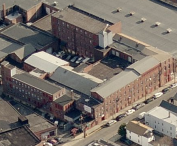
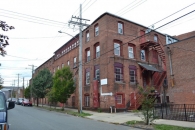
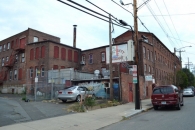
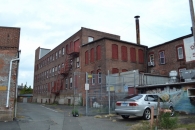
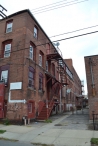
The former Seamless Rubber Company plant consists of approximately twelve primary adjoining and freestanding blocks located on the east side of Daggett Street, roughly 200’ south of Daggett Street’s intersection with Congress Street. The oldest and original portion of the plant consists of a three-and-a-half-story, 40’ x 76’ red brick block erected in 1877. This is located at the core of the plant and has subsequently been surrounded by later additions, thus obscuring the majority of its original details with the exception of its front-facing gable roof. The additions are all of red brick construction and generally stand between three and four stories tall. The most prominent is the three-and-a-half-story, 76’ x 28’ block that adjoins the west elevation of the original mill and extends along Daggett Street. This was erected ca. 1895. It has segmental-arched window openings with stone sills on the first through third floors, small rectangular window openings with stone sills and heavy stone lintels on the attic level, a denticulated brick cornice, and a side-gabled roof. A similar 41’ x 28’ block adjoins the south elevation of the aforementioned ca. 1895 addition, this built shortly after its neighbor. The latter originally stood three-stories tall, yet was raised to three-and-a-half stories through the construction of a frame addition to the top of the building at an unknown date. An additional block erected at the southwest corner of the plant ca. 1895 was originally constructed as a three-story, 26’ x 98’ building, yet was later raised to four stories. Additions to the southeast and north sides of the plant were completed in 1903 and ca. 1910, respectively. All are of red brick construction with segmental-arched window openings, stone window sills, and flat roofs.
Exterior Material(s)
Structural System(s)
Roof Form
Roof Material
Power Source
Condition
Fair
Condition Notes
The complex is in fair condition. The exterior walls are in need of minor repairs and maintenance and most of the window openings throughout the remainder of the plant have been reduced in size and the sash replaced, however, overall, the factory appears to be structurally sound.
- Property Information
-
Specific Location
One legal parcel (69 Daggett Street) totaling 1.06 acres located on the east side of Daggett Street, roughly 200’ south of Daggett Street’s intersection with Congress Street.
Adjacent To
Exterior Visible from Public Road?
Yes
Parcel ID / Assessor Record Link
- 277/99/1900 / Link →
Acreage
1.06
Use (Present)
- Sources
-
Form Completed By
Lucas A. Karmazinas
Date
10/13/2015
Bibliography
- List of Connecticut Manufacturers, 1922, 1924, 1930, 1932.
- Directory of Connecticut State Manufacturers, 1936, 1939.
- Industrial Directory of Connecticut, 1947.
- Register of War Production Facilities in Connecticut, 1951.
- Map of New Haven County; Clark, Richard, 1859.
- Atlas of New Haven County, Beers, Ellis & Soule, 1868.
- Aerial Survey of Connecticut, 1934, 1965.
- Sanborn Map Company, 1901, 1911, 1923, 1950.
- New Haven City Directory; Various editions.
- History of the City of New Haven to the Present Time, 1887.
- Leading Business Men of New Haven County; Mercantile Publishing Co., 1887.
- A Modern History of New Haven and Eastern New Haven County, 1920.
- Carriages & Clocks, Corsets & Locks; New Haven Preservation Trust, 2004.
- Hartford Courant, 1903, 1927, 1929, 1955.
- Representative View(s)Click on image to view full file
-
Photographer
Lucas A. Karmazinas
Photography Date
10/13/2015