Mill Record Sharon
RETURN TO ‘FIND MILLS’Disclaimer: Content for these properties was compiled in 2014-2017 from a variety of sources and is subject to change. Updates are occasionally made under Property Information, however the Connecticut Trust for Historic Preservation (dba Preservation Connecticut) makes no representation or warranty that the information is complete or up-to-date.
- Complex Name (Common)
- Sharon Valley Historic District
- Complex Name (Historic)
-
- Sharon Valley Historic District
- Address or Location
- Jct. of Sharon Valley and Sharon Station Rds., Sharon
- County
- Litchfield
- Historic Designation
- Associated Mill Community
- n/a
- Historic Information
Companies Associated w/Complex
Use (Historic)
n/a
Largest Documented Workforce
n/a
Historic Narrative
For historical significance see National Register application: http://pdfhost.focus.nps.gov/docs/NRHP/Text/82004478.pdf
HD includes two industrial sites:
Primary iron production in Sharon Valley began in 1825 when Lyman Bradley built a charcoal-fired, cold-blast furnace (8' bosh diameter) by the Webatuck River. The remains on the site date from the rebuilding of 1863, when the furnace was enlarged to 12' bosh diameter and fitted with hot blast; use of charcoal fuel continued. After Bradley the furnace was operated by Horace Landon until c .1873, then by the Sharon Valley Iron Co., which sold out in 1898 to Barnum-Richardson and Co., the dominant Connecticut iron producer. Barnum-Richardson apparently had an interest in the furnace at least 20 years before purchasing it, as three c.1880 iron-workers' dwellings, on Sharon Station Rd. adjacent to the houses noted above, are nearly identical to houses built by Barnum-Richardson at the firm's ironworks in East Canaan: L-shaped plan with entrance in the ell, open porch with curved, overhanging roof, corner brackets, carved rafter ends. Barnum-Richardson closed the furnace at Sharon Valley soon after buying it in 1898. (Roth)
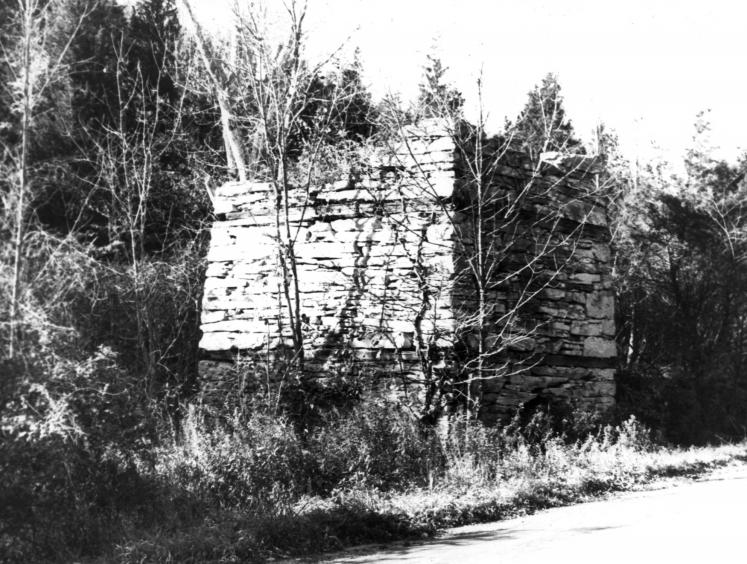
This kiln stands on land owned during the 19th century by sheepraiser Chauncey Moorehouse and his family. The Moorehouses leased this land, along with several nearby limestone quarries, to Sharon Valley Ironworks. Processed lime from the kiln could have been used in ironmaking, but it probably was not, because raw, crushed limestone worked just as well, as it was turned to lime as part of the reaction inside the blast furnace. The ironmakers probably
built the kiln to profit from their excess limestone by selling processed lime to farmers. In the 19th century, commercial quarrying and burning of limestone took place throughout the northwest part of the state. This kiln is one of the few remnants of that once-important industry. (Roth)- Architectural Information
Number of Existing Buildings
n/a
Dates of Construction
n/a
Architect
n/a
Builder
n/a
Building Type
n/a
Architectural Description
For description see National Register application: http://pdfhost.focus.nps.gov/docs/NRHP/Text/82004478.pdf
The furnace has almost completely disappeared: only some limestone rubble, iron tie-rods, and fire-brick arches remain above ground. Other visible remains include some limestone foundations or retaining walls, the wheelpit foundation with arched tailrace opening, and mounds of slag. The race leads upstream, between earthen embankments, about 1500' to the remains of the dam, which is rubble with iron tie-rods. Also around 1863, worker housing and a company office were built. The two extant dwellings are small, 1 1/2-story houses with two small attic windows on the long side, side entrances and low lean-to's across the rear. The office is a Gothic Revival cottage with quatrefoil peak ornaments and jig-sawn trim along the open porch. (Roth)
The kiln is 15' square and 17' high, with two courses of timber reinforcement around all four sides. There are two arched openings, one each on the east and west sides, and a rectangular opening (now blocked in) on the south side. Heavy brush obstructs access to the interior, but preliminary inspection reveals that the arched openings held fires to heat the kiln and the lime was drawn off through the other opening. (Roth)Exterior Material(s)
n/a
Structural System(s)
n/a
Roof Form
n/a
Roof Material
n/a
Power Source
n/a
Condition
n/a
Condition Notes
n/a
- Property Information
-
Specific Location
n/a
Adjacent To
n/a
Exterior Visible from Public Road?
Yes
Parcel ID / Assessor Record Link
n/a
Acreage
n/a
Use (Present)
n/a
- Sources
-
Form Completed By
n/a
Date
n/a
Bibliography
n/a
- Representative View(s)Click on image to view full file