Mill Record Torrington
RETURN TO ‘FIND MILLS’Disclaimer: Content for these properties was compiled in 2014-2017 from a variety of sources and is subject to change. Updates are occasionally made under Property Information, however the Connecticut Trust for Historic Preservation (dba Preservation Connecticut) makes no representation or warranty that the information is complete or up-to-date.
- Complex Name (Common)
- Torrington Co., Standard Plant DEMO IN PROCESS 2023
- Complex Name (Historic)
-
- Torrington Co., Standard Plant
- Address or Location
- 70 North Street, Torrington
- County
- Litchfield
- Historic Designation
- Associated Mill Community
- n/a
- Historic Information
Companies Associated w/Complex
- The Torrington Co., Standard Co. Division 1906-1917
- The Torrington Co., Standard Plant 1917-1968
Use (Historic)
- Fabricated Metal Products
- Paper & Wood Products
- Other: Plastic Packaging Products
Largest Documented Workforce
1001 to 1,500 (1947)
Historic Narrative
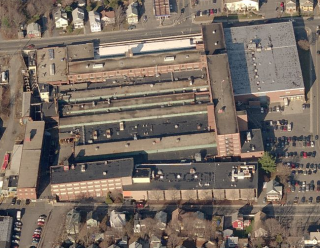
The origins of the Standard Company can be traced to the Excelsior Needle Company, which established a department for the production of bicycle spokes and nipples during the early 1890s. Initially organized as the Torrington Swaging Company, it was renamed the Standard Spoke and Nipple Company in 1898 when the Excelsior Needle Company was absorbed into the newly established Torrington Company of Maine, a holding company organized by executives associated with Kidder, Peabody and Company of Boston, Massachusetts, Excelsior’s majority stockholder. Despite the acquisition, the Excelsior Needle Company retained its corporate existence and the Standard Spoke and Nipple Company continued to be operated by local managers. In 1906 an independent factory was built for the Torrington Company’s spoke and nipple division, which by this time had been shortened to the ‘Standard Company.’ The plant was located on the north side of North Street and consisted of a pair of one-story manufacturing buildings each measuring 365’ x 72’. The factory was further enlarged ca. 1910 and ca. 1920 when additional buildings were erected to the north, east, south, and west of the original plant. The newly expanded factory allowed the Standard Company to expand its catalog to eventually include a diverse range of products including needles, bicycle spokes and nipples, handlebars, metal tubing, machine screws, carpet sweepers, piano hardware, and spark plugs. By the late 1920s the company had also begun to produce a line of ball bearings, this supplanted by the manufacture of needle bearings during the 1940s. The latter would develop into a market that continued to drive the company’s success into the second half of the 20th century and at its peak supported a workforce of over 1,000 employees. The Torrington Company’s Standard Plant – by which it was known after 1917 when the former was reorganized as the Torrington Company of Connecticut – continued to experience success through the 1960s, as evidenced by the construction of additional manufacturing and research and development buildings at the North Street plant. In 1968, the Torrington Company was purchased by the Ingersoll-Rand Corporation, which continued operations in Torrington through the early 2000s. Various mergers and corporate buyouts impacted the former Standard Plant throughout the second half of the 20th century, and although the factory complex stands largely vacant today, limited manufacturing work continues under the Albea Corporation, a manufacturer of beauty and personal care packaging.
- Architectural Information
Number of Existing Buildings
Roughly eleven (11) primary buildings/blocks.
Dates of Construction
1906, ca. 1910, 1919, ca. 1920, ca. 1940, 1963, 1970, 1974, ca. 1980.
Architect
Charles S. Palmer (1906 one story production sheds); Leo F. Caproni (1963 addition)
Builder
Torrington Building Co (1906 one story production sheds); C. H. Nickerson & Co., Torrington (1963 addition)
Building Type
Architectural Description
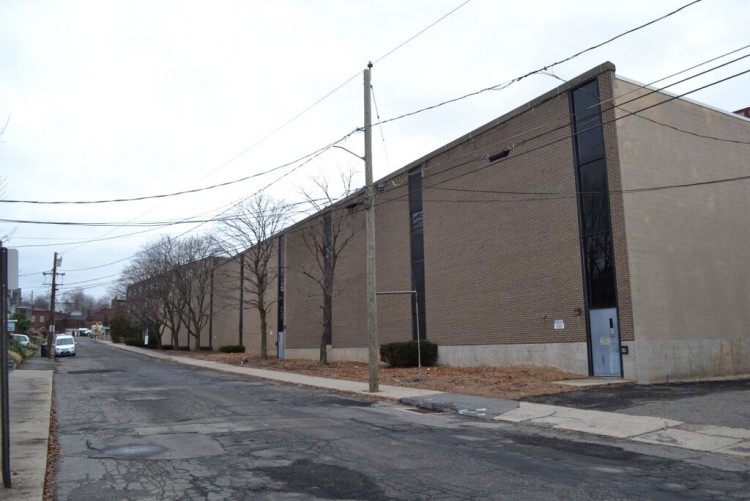
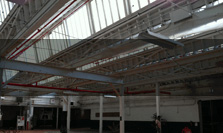
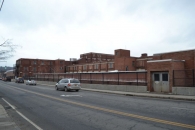
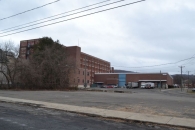
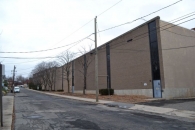
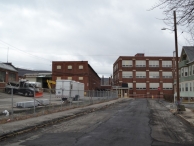
The former Torrington Company Standard Plant consists of a sprawling complex of roughly eleven primary buildings/blocks located south of North Elm Street (CT Rte 4), west of Prospect Street, and north of North Street. The factory has gone through numerous expansions over the course of its history and many of the oldest blocks have been absorbed into the overall footprint of the complex, thus obscuring their original details. The earliest portions of the factory were a pair of one-story red brick manufacturing buildings with flat roofs and clerestory monitors erected in 1906. These are located at the core of the present complex and by 1915 were integrated into a one-story manufacturing block measuring roughly 375’ x 330’. A three-story red brick storage building was erected to the southwest of these blocks during the same period, this measuring 46’ x 240’. The storage building is of brick pier construction and has stone sills, a mix of rectangular and segmental-arched window openings (these presently have board or fiberglass panel infill), and a low-pitch shed roof that extends over its eastern (side) elevation. Two additional manufacturing buildings were constructed for the Standard Plant ca. 1920. These were erected on the north and east sides of the original plant and consist of two- and six-story blocks, respectively. The northern of the two buildings measures 342’ x 54’ and is of brick pier construction. The block’s stepped piers have concrete caps and its roof is flat. Stone sills extend the full width of the exterior bays directly below the windows while concrete lintels do the same above. The original fenestration consists of multi-pane steel sash with hopper style openings. The six-story building measures 50’ x 304’ and was completed in 1919. It is of similar detailing to its northwestern neighbor include its concrete sills and the lack of concrete caps on the piers The block was enlarged to 50’ x 460’ overall through the construction of a three-story addition ca. 1940. Numerous additional blocks were constructed throughout the Standard Plant ca. 1940. These include a cluster of adjoining one- and one-and-a-half-story red brick manufacturing blocks located along North Elm Street, a 64’ x 192’ three-story red brick manufacturing and storage block at the western end of North Street, and a 55’ x 114’ one-story red brick storage building that stands roughly 100’ southwest of the plant along Field Street. Further additions to the plant include several two-story blocks erected in phases during the 1960s, 1970s, and 1980s. These are located on the south and east sides of the Standard Plant complex and are of steel frame construction with brick or concrete block curtain walls and flat roofs. A 1963 addition, fronting (and exactly parallel to) North Street at the south side of the complex, was designed by Leo F. Caproni (Hartford Courant, 7/10/1963); it was later added onto.
Exterior Material(s)
Structural System(s)
Roof Form
Roof Material
Power Source
Condition
Fair, Deteriorated
Condition Notes
The complex is in generally fair condition, however, some of the exterior walls and windows of the northern portions of the plant show signs of deterioration. Much of the original fenestration in the older sections of the complex have been boarded up, infilled, or have had their historic sash replaced with modern units.
- Property Information
-
Specific Location
One 11.52 acre parcel comprising the entire block between Rte 4 to the north, Prospect Street to the east, and North Street to the south.
Adjacent To
Exterior Visible from Public Road?
Yes
Parcel ID / Assessor Record Link
- 119/010/004 / Link →
Acreage
11.52
Use (Present)
- Industrial
- Other: Actual demolition beginning fall 2023. Phase 1 demolition plans (6-story concrete loft w/ brick curtain walls on east side of complex parallel to Prospect St) submitted to Torrington Building Dept January 2021, Phase 2 demolition (the remainder of the core complex from North St north to Elm St) plans June 2021. Surviving buildings at that point will include separate smaller group parallel to the rail siding on the west side of the property). Jan 2020 DECD Brownfield award: $2,000,000 for the abatement and partial demolition of structures at the Torrington Business Park (Standard Plant Site) located at 70 North Street, the former home of the Torrington/Excelsior Needle Company. 2026: brick storage bldg & 20thc part of factory bldg 3 both along tracks are all that's left
- Vacant
- Sources
-
Form Completed By
Lucas A. Karmazinas
Date
12/22/2014
Bibliography
- List of Connecticut Manufacturers, 1922, 1924, 1930, 1932.
- Directory of Connecticut State Manufacturers, 1936, 1939.
- Atlas of Litchfield County, F.W. Beers & Co., 1874.
- Industrial Directory of Connecticut, 1947.
- Register of War Production Facilities in Connecticut, 1951.
- Sanborn Map Company, 1884, 1891, 1901, 1909, 1915, 1924, 1931, 1949.
- Aerial Survey of Connecticut, 1934, 1965.
- The Hartford Courant, 1919, 1970, 1974.
- The History of Waterbury and the Naugatuck Valley, 1918.
- Torrington Register Souvenir Edition, 1897.
- Information, historic photographs and sources for Leo Caproni courtesy Gregg Bateman (2018).
- Representative View(s)Click on image to view full file
-
Photographer
Lucas A. Karmazinas
Photography Date
12/22/2014