Mill Record Southington
RETURN TO ‘FIND MILLS’Disclaimer: Content for these properties was compiled in 2014-2017 from a variety of sources and is subject to change. Updates are occasionally made under Property Information, however the Connecticut Trust for Historic Preservation (dba Preservation Connecticut) makes no representation or warranty that the information is complete or up-to-date.
- Complex Name (Common)
- United Aircraft (Pratt and Whitney Div.)
- Complex Name (Historic)
-
- United Aircraft (Pratt and Whitney Div.)
- Address or Location
- 75 Aircraft Road, Southington
- County
- Hartford
- Historic Designation
- Associated Mill Community
- n/a

- Historic Information
Companies Associated w/Complex
- United Aircraft (Pratt and Whitney Div.) 1942-1995
Use (Historic)
Largest Documented Workforce
4,000 (1968).
Historic Narrative
The Pratt and Whitney Aircraft Company was the brainchild of Frederick B. Rentschler, an Ohio-born, ex- United States Signal Corps captain, who arrived in Hartford, Connecticut in 1925 with the hope of raising enough money to produce a radial air-cooled aircraft engine of his own theoretical design. Rentschler’s technological background came from years of practical experience as an engineer, machinist, and United States Army aircraft inspector, as well as having been employed as an executive at the Wright Aeronautical Corporation, and it was not long after he approached officials at the Niles-Bement-Pond Corporation – which controlled the Pratt and Whitney Machine Tool Company – that he had secured a contract. The Pratt and Whitney Aircraft Company was incorporated on July 26, 1925, and work on Rentschler’s engine began just over a week later on August 3. Rentschler gathered a talented team of engineers and mechanics around him and set an aggressive deadline of December 25, 1925 to complete production of a prototype of what would be Pratt and Whitney’s Wasp engine. The first Wasp was completed on December 24, 1925 and was met with unbridled success. The 425-horsepower engine far surpassed even the company’s own expectations and easily passed the United States Navy’s strict qualification tests. A Hartford Courant article celebrating the 25th anniversary of the company noted that, “Within a year, the Wasp shattered its first world record and went on to smash existing standards for both landplanes and seaplanes for the next seven years, carrying airframes and pilots higher, farther and faster than they had ever gone before.” Full-scale production of the Wasp began in Pratt and Whitney’s Hartford plant in 1926 after the company secured a United States Navy contract for 200 units. In 1929, Pratt and Whitney Aircraft joined with the Chance Vought and Boeing Airplane and Transport Corporations to form the United Aircraft and Transport Corporation. In need of vastly enlarged plants for both its Pratt and Whitney Aircraft and Chance Vought divisions, the United Aircraft and Transport Corporation purchased a large swath of former tobacco farmland in East Hartford, where expansive offices and factories were erected for each company. Pratt and Whitney experienced financial difficulties during the 1930s, however, the firm resumed its prominent place in the field of American aeronautics with the outbreak of the Second World War. The company was called upon to produce a significant percentage of the engines powering Allied aircraft, with output increasing from 1,000,000 horsepower per month in 1940, to 4,500,000 horsepower per month in 1943. Much of this increase was accomplished by the construction of a new plant in Southington, which was initiated in 1942 and operational by May 1943. Wartime work at Pratt and Whitney’s Southington plant included the manufacturing and repair of Double Wasp engines and production of components used in the Republic P-47 Thunderbolt fighter and Consolidated B-24 Liberator bomber. Despite reductions in the number of military contracts in the post-war period, Pratt and Whitney continued to thrive throughout the second half of the 20th century and work at the Southington plant peaked around 4,000 in 1968. In 1994, Pratt and Whitney’s parent company, the United Technologies Corporation, announced that due to cost-cutting measures the Southington plant would be closed and its workforce of 800 either laid off or transferred to its Middletown, Connecticut plant. This move was completed in the spring of 1995 and the expansive plant was unoccupied until early 2017 when a fulfillment center leased the space.
- Architectural Information
Number of Existing Buildings
Roughly seven (7) primary blocks.
Dates of Construction
1942, 1976, 1986.
Architect
n/a
Builder
n/a
Building Type
Architectural Description
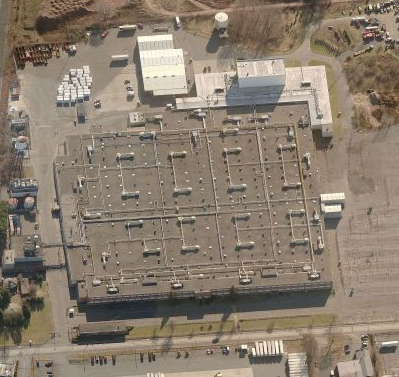
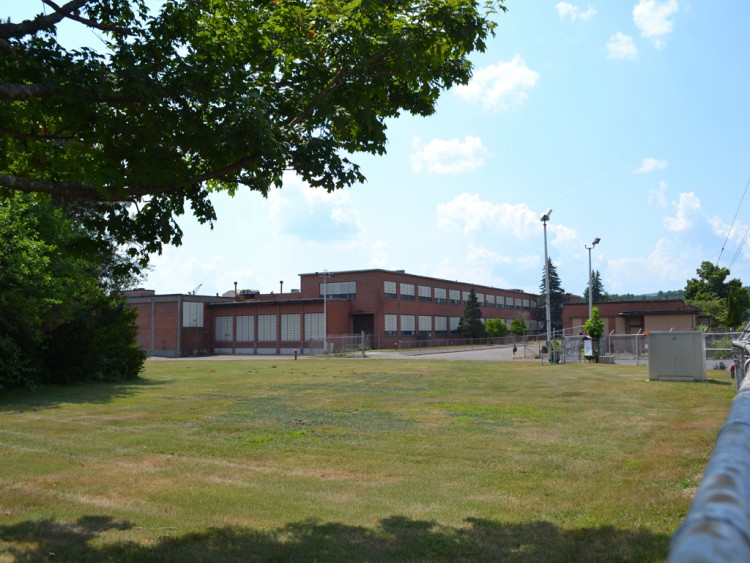
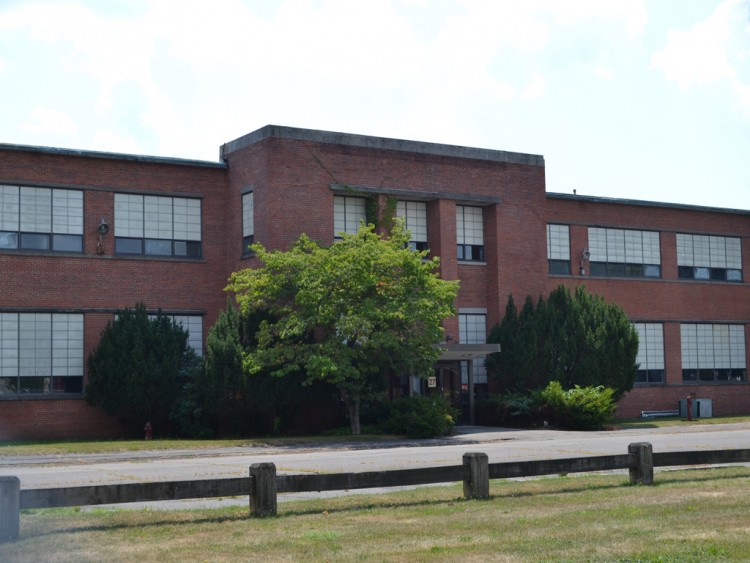
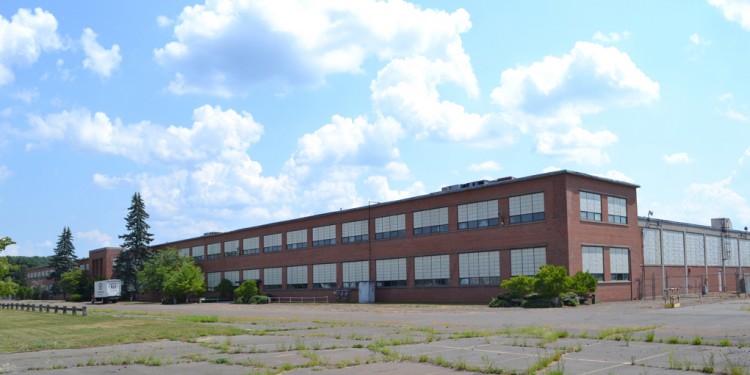
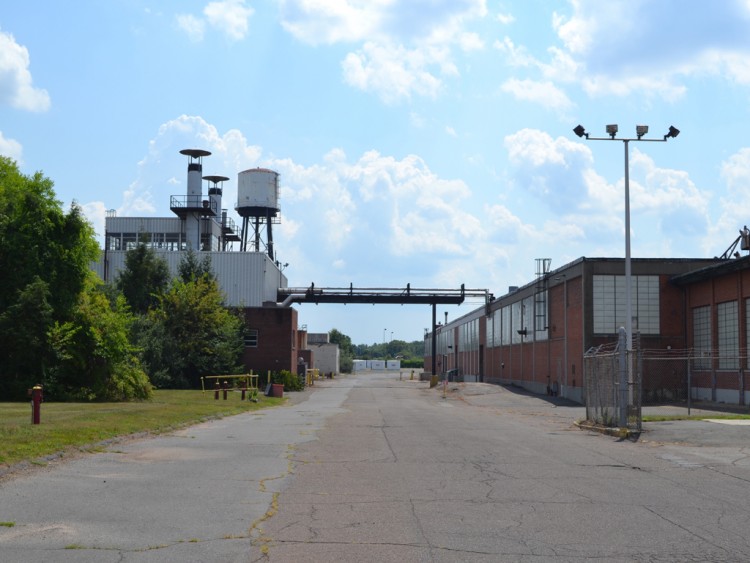
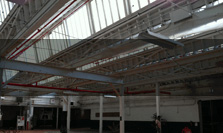
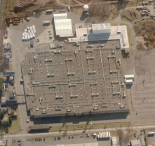
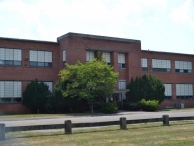
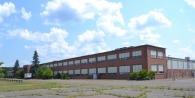
The former Pratt and Whitney Aircraft Company plant is comprised of roughly seven adjoining and freestanding blocks located on the south side of Aircraft Road, roughly 800’ west of Aircraft Road’s intersection with Queen Street. The core of the complex was built in 1942 and consists of four reinforced concrete, steel-frame, and red brick blocks. A two-story, 728’ x 42’ office building stands approximately 160’ south of Aircraft Road. The building is comprised of a central entry pavilion flanked by ells extending to the east and west. It has a concrete foundation, red brick walls, large window openings with concrete sills and lintels extending the width of each ell, a plain cornice, and a flat roof. A one-story, 775’ x 640’ manufacturing block adjoins the south elevation of the office building. This is of reinforced concrete and steel-frame construction and has a concrete foundation, concrete piers, red brick apron walls, large window openings set in concrete frames, a plain cornice, and flat roof. The two freestanding support buildings built in 1942 are located to the north and east of the office and manufacturing blocks. A one-story, 136’ x 36’ red brick security building stands roughly 90’ north of the office’s northeast corner. This is similar in detail to the office building yet consists of a single rectangular block. An enclosed entry porch with a flat roof is located on the building’s north elevation. A two-story, 134’ x 112’ steel-frame powerplant is located approximately 60’ east of the manufacturing block. This has red brick apron walls, narrow ribbon windows, corrugated sheet metal siding, and a flat roof. Three additions to the plant were completed in the second half of the 20th century. A one-story, 72’ x 54’ steel-frame and brick powerplant was built 180’ south of the 1942 powerhouse in 1976; a one-story, 445’ x 140’ steel-frame and brick manufacturing block was erected adjoining the southwest corner of the 1942 manufacturing building in 1986; and a one-story, 130’ x 226’ steel-frame and sheet metal storage building was built 76’ south of the 1942 manufacturing building in 1986.
Exterior Material(s)
Structural System(s)
Roof Form
Roof Material
Power Source
Condition
Fair
Condition Notes
The complex is in fair condition. The exterior walls of the various blocks associated with the plant are in general need of minor repairs and cleaning, however, most of the complex appears to be well maintained overall.
- Property Information
-
Specific Location
One legal parcel (75 Aircraft Road) totaling 40.0 acres located on the south side of Aircraft Road, roughly 800’ west of Aircraft Road’s intersection with Queen Street.
Adjacent To
Exterior Visible from Public Road?
Yes
Parcel ID / Assessor Record Link
- 12928. / Link →
Acreage
40.0
Use (Present)
- Commercial
- Other: Conversion to distributio
- Sources
-
Form Completed By
Lucas A. Karmazinas
Date
08/17/2015
Bibliography
- List of Connecticut Manufacturers, 1922, 1924, 1930, 1932.
- Directory of Connecticut State Manufacturers, 1936, 1939.
- Industrial Directory of Connecticut, 1947.
- Register of War Production Facilities in Connecticut, 1951.
- Atlas of Hartford County, Beers, Baker & Tilden, 1869.
- Sanborn Map Company, 1890, 1895, 1901, 1911, 1923, 1947.
- Aerial Survey of Connecticut, 1934, 1965.
- The Hartford Courant, 1929, 1939, 1950, 1993, 1994.
- Southington: The War Years; Kopec, Liz Campbell, 2012.
- Representative View(s)Click on image to view full file
-


Photographer
Lucas A. Karmazinas
Photography Date
08/17/2015