Mill Record Waterbury
RETURN TO ‘FIND MILLS’Disclaimer: Content for these properties was compiled in 2014-2017 from a variety of sources and is subject to change. Updates are occasionally made under Property Information, however the Connecticut Trust for Historic Preservation (dba Preservation Connecticut) makes no representation or warranty that the information is complete or up-to-date.
- Complex Name (Common)
- Waterbury Watch Co.
- Complex Name (Historic)
-
- New England Watch Co.
- Address or Location
- 117 Benedict Street, Waterbury
- County
- New Haven
- Historic Designation
- Associated Mill Community
- n/a
- Historic Information
Companies Associated w/Complex
- New England Watch Co. 1898-c.1912
- Robert H. Ingersol and Bros. 1914-c.1922
- Waterbury Watch Co. (div. of Benedict and Burnham Mfg.) c.1880-1898
Use (Historic)
Largest Documented Workforce
n/a
Historic Narrative
The well established Waterbury firm of Benedict and Burnham Mfg. Co. produced brass sheet, wire and bar for other manufacturers. It also developed consumer products, establishing several subsidiary companies for their production over the years, including the Waterbury Watch Co. After introducing a successful prototype pocket watch made of punched sheet brass in 1877, the company incorporated the Waterbury Watch Co. in 1880 with its own facility on Benedict Street by 1890. The firm apparently employed hundreds of women for their nimble fingers. The watches were not only sold cheaply but often given away as premium items by clothing manufacturers and the like, ultimately leading to their perception as inferior products and to financial loss for the company. It was reorganized as the New England Watch Company in 1898, making higher end watches, but had stopped production by 1912. Robert H. Ingersoll and Bro. bought the Waterbury plant and began manufacturing Ingersoll watches there in 1914. Examples of Waterbury watches can be seen at the Mattatuck Museum: http://mattatuckcollections.org/category/unknown/watches-waterbury-watch-co/ By 1950, the surviving block was occupied by a plumbing supplier.
- Architectural Information
Number of Existing Buildings
Two (2) blocks.
Dates of Construction
c.1890 with 1901 third story and modern additions
Architect
n/a
Builder
n/a
Building Type
Architectural Description
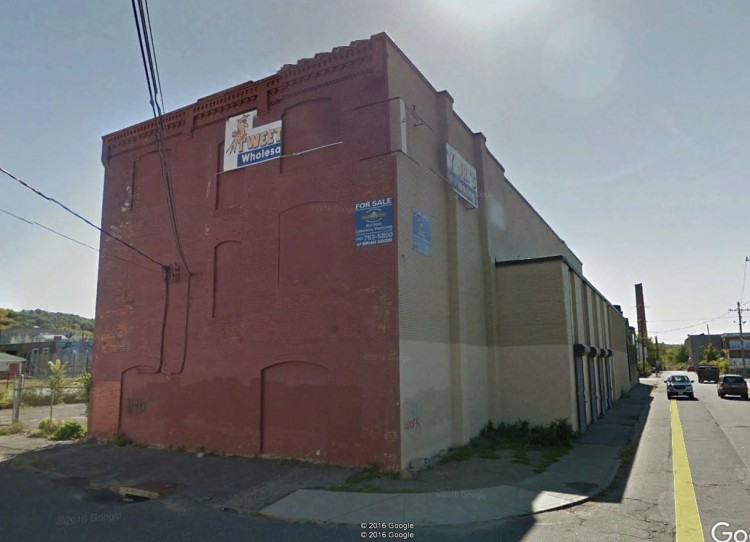
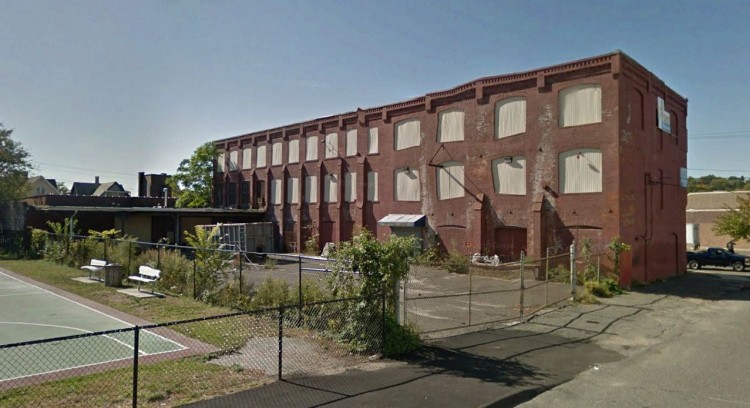
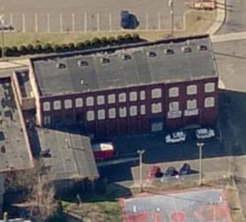
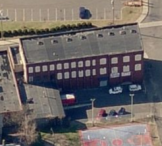
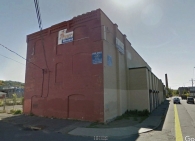
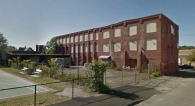
The Waterbury Watch Company factory, built by 1890, was originally centered on the west side of Benedict Street between West Liberty and West Clay Streets; at the time West Dover Street did not extend all the way to Benedict Street. The factory was largely demolished by 1950, leaving only the building now on the southeast corner of Dover and Benedict Streets. Originally a c.1890 two-story brick pier building (approx. 45 ft. by 100 ft.), a third story was added by 1901. Segmental-arch window openings have stone sills; the cornice is highly decorative with three courses of brick dentils of varying designs. The west side of the building appears to have been rebuilt with a one-story addition along Benedict Street; no window openings remain. A one-story addition has been added to the southeast corner. Window openings on the north, east and south sides have been boarded up.
Exterior Material(s)
Structural System(s)
Roof Form
Roof Material
n/a
Power Source
Condition
n/a
Condition Notes
n/a
- Property Information
- Sources
-
Form Completed By
Renée Tribert
Date
October 2016
Bibliography
- Sanborn Insurance Atlases.
- 'Timex Group USA,' Wikipedia, 12 October 2016. Web; accessed October 2016.
- Matthew Roth et al, Connecticut: An Inventory of Historic Engineering and Industrial Sites (Washington DC: SIA, 1981).
- Representative View(s)Click on image to view full file
-
Photographer
n/a
Photography Date
October 2016