Mill Record Plainfield
RETURN TO ‘FIND MILLS’Disclaimer: Content for these properties was compiled in 2014-2017 from a variety of sources and is subject to change. Updates are occasionally made under Property Information, however the Connecticut Trust for Historic Preservation (dba Preservation Connecticut) makes no representation or warranty that the information is complete or up-to-date.
- Complex Name (Common)
- Wauregan Mills
- Complex Name (Historic)
-
- Wauregan Mills
- Address or Location
- 51 South Walnut Street, Wauregan, Plainfield
- County
- Windham
- Historic Designation
- Associated Mill Community
- Historic Information
Companies Associated w/Complex
- Wauregan Mills c.1853-1957
- Wauregan-Quinebaug Mills Inc. c.1945
Use (Historic)
Largest Documented Workforce
800
Historic Narrative
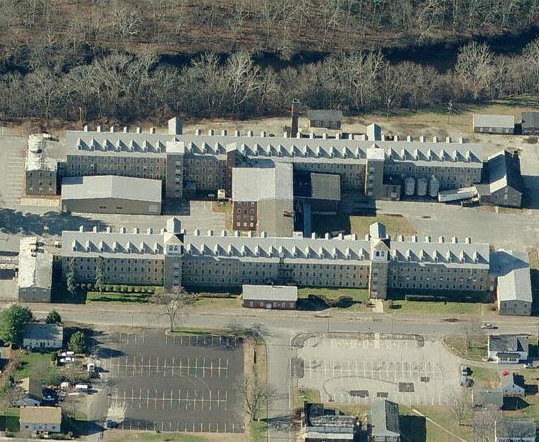
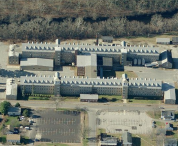
In 1850 a partnership headed by Amos D. Lockwood purchased land and water privileges along the Quinebaug River in Plainfield. Most of the partners were Rhode Island-based textile entrepreneurs, including Orray Taft, whose firm later built Ponemah Mills. They began in 1853 to construct the first mill. In 1858 the mill doubled in length with an addition to the south which repeated all features of the first portion. In 1867-68 the firm built a second mill parallel to the first, on the opposite side of the power canal, so that from above the complex resembles a large H. This final form of the mill matched the original Lockwood plans, even though he had sold his interest in Wauregan in 1858 and James S. Atwood, another Rhode Islander, had assumed operating control. (Lockwood went on to form the influential mill engineering firm of Lockwood, Greene and Co.) After all the mills were built between 700 and 800 people worked here on more than 55,000 spindles and 1,400 looms. After James S. Atwood's death in 1885 his sons James A. and John W. managed the plant. By the early 20th century they had changed to production of finer cottons, such as shirtings, rather than the sheetings which had been the principal output before. Unlike most of Connecticut's textile firms in the 20th century, Wauregan promptly adapted their processes to synthetic materials. In the late 1930s Wauregan Mills collaborated with DuPont in developing technology to produce suitings from a blend of wool and rayon. The firm never recovered from a post-World War II decline in sales and closed in 1957. A cable manufacturer now owns the mills and occupies much of the space while renting the rest to other firms. (Roth) Some workers may have been recruited from Quebec. (check Wauregan Company records)
- Architectural Information
Number of Existing Buildings
n/a
Dates of Construction
1853, 1858, 1867-1868
Architect
n/a
Builder
n/a
Building Type
Architectural Description
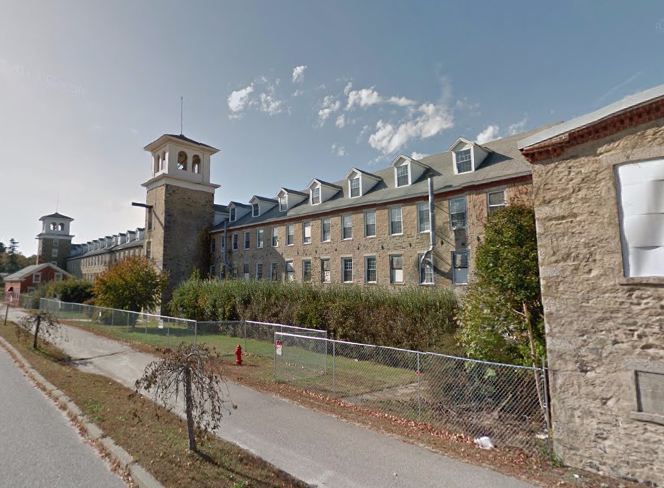
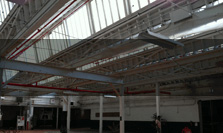
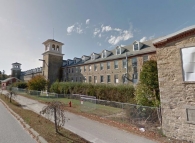
Construction began on the first mill in 1853, 4 1/2-story and 250' x 50' with dormered gable roof, stuccoed fieldstone walls, granite quoins, and brick cornice in dentil pattern. The central stair tower has a peaked roof and two round-arched windows in each wall of the belfry. Inside, the unjoisted, double-ply floors are carried on turned chestnut posts and chestnut beams; the latter are anchored to the walls with wrought iron tie rods bearing against cast-iron plates. The third story is free of posts because the top floor, just above, hangs from the queenpost roof trusses. In 1858 the mill doubled in length with an addition to the south which repeated all features of the first portion. In 1867-68 the firm built a second mill parallel to the first, on the opposite side of the power canal. This 500'-long structure also continued the features of the original mill. A 4-story, 250'-long wing spanned the canal and connected the two mills, so that from above the complex resembles a large H. Wheelpits are below the connecting wing. This final form of the mill matched the original Lockwood plans. Auxiliary structures include picker houses at the ends of the long mills, the 1866 boiler house, the stuccoed-stone waste house, several storehouses of brick or stone, and the 1853 office. Remains of the second Wauregan dam, built in 1876 after the first dam washed away, are found 1,100' upstream from the mill. The second dam was 350' long, 36' wide at the base, 4' wide at the top, and rose 16' above the riverbed. It consisted of log crib-work filled with stone and sheathed with oak and chestnut planks. An apron of oak planks extended 23' down-stream to prevent undercutting. The east abutment, a massive masonry structure, continues to stand, as does a portion of the crib-work next to it. About 100' east of the dam is the granite bulkhead containing the sluice gates. The canal, now dry and partially filled in, was 50' wide and 8' deep. In the wheelpits are two turbines installed in the 1870s (inaccessible), and three double-runner horizontal turbines (maker unknown) from the early 20th century which were connected to electrical generators. Up the slope east of the mills are some 80 frame houses in which the Wauregan millworkers lived. Most are duplexes. The village also includes two boarding houses for unmarried workers, the company store, and, further up the hill, eight duplexes where supervisory personnel lived. (Roth)
Exterior Material(s)
n/a
Structural System(s)
n/a
Roof Form
n/a
Roof Material
n/a
Power Source
n/a
Condition
n/a
Condition Notes
n/a
- Property Information
-
Specific Location
West side of South Walnut Street on east bank of Quinebaug River south of Wauregan Road
Located in Wauregan National Register District (1979).
http://npgallery.nps.gov/nrhp/GetAsset?assetID=d744ce3b-b3f8-4c83-9d35-9ff667231bc4Adjacent To
Exterior Visible from Public Road?
Yes
Parcel ID / Assessor Record Link
- 01W/ 00WM/ 0001 / Link →
Acreage
23.55
Use (Present)
- Other: For sale as of October 2021; redevelopment opportunity. Still on market 11/2023. 351k sq ft. 2025. Aug 2025: owner put complex up for auction after apparently rejecting $1.5 million purchase offer. 2026: Michael Guidicelli, Regions Commercial out of Glastonbury, purchased the complex for $1.96m from DMSB Real Estate Management LLC, w $1.36m mortgage from seller. Initial plans are for repairs/improvements to market the property for commercial/industrial leases with potential long-term redev for residential or mixed use.
- Vacant
- Sources
-
Form Completed By
n/a
Date
n/a
Bibliography
- Roth, Matthew, et al, Connecticut: An Inventory of Historic Engineering and Industrial Sites (Washington DC: SIA, 1981).
- Representative View(s)Click on image to view full file
-
Photographer
n/a
Photography Date
n/a