Mill Community Record New Hartford
FIND ‘MILL COMMUNITIES’- Community Name (Common)
- Pine Meadow Historic District
- Address or Location
- 1-99 Church St., New Hartford
- Specific Location
- Roughly bounded by the Farmington River, Wicket, N. Ten, Church and Main Sts., Village of Pine Meadow
- County
- Litchfield
- Historic Designation
- Associated Mill Complexes
- Architectural and Historical Information
Number of Existing Buildings
Sixteen.
Dates of Construction
Mid 19th c.
Housing Types
Brief Description
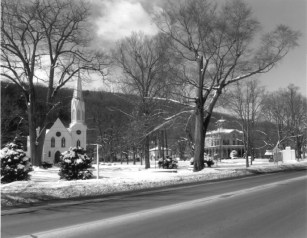
The Pine Meadow Historic District , situated in the Farmington Valley in the northeast corner of the Town of New Hartford, encompasses the historic nineteenth century village of Pine Meadow. Since natural barriers left little room for expansion or modern development, Pine Meadow appears much as it did in the late nineteenth century. From the historic maps of 1874 and 1878 it is apparent that less than a dozen historic houses have been lost, with a number on the east side of the district due to periodic flooding of the river. Except for a group of modern houses and the 1951 Pine Meadow School built on Wicket Street (outside the district), most of the remaining open land was in a floodplain and never developed. Some changes are related to the industrial development and decline of the village. For example, all that is left of the railroad that once ran along the base of the hills on the west is the abandoned track bed that terminates in a brownstone abutment for a bridge that once crossed Main Street on the north, before continuing across the river to New Hartford Center. The railroad depots at either end of the district also are gone. Of the two other historic bridges that once spanned the Farmington River, one was a covered wooden bridge at the east end of Black Bridge Road; its replacement is now closed. The other, which once provided direct access to the factory complex at the southeast corner of the village, is no longer extant. Chapin Park, which is slightly more than an acre in size, occupies an elongated triangle near the center of the Pine Meadow Historic District between Main Street on the east and Church Street on the west. Although today its mature trees, a few possibly survivors of the original plantings, are randomly distributed, the park was originally landscaped more formally with regular rows of trees, especially along its bordering streets. There is a flagpole and a World War II memorial at its north corner. [NR]
The district is associated with and includes the Chapin-Stephens Co. mill (#3055). It consists of a compact village of single- and multi-family residences located in the vicinity of the mill. Sixteen vernacular Greek Revival-style single-family residences were built by the company, these located on Church Street, Main Street, North Ten Street, and Wickett Street.