Mill Record Waterbury
RETURN TO ‘FIND MILLS’Disclaimer: Content for these properties was compiled in 2014-2017 from a variety of sources and is subject to change. Updates are occasionally made under Property Information, however the Connecticut Trust for Historic Preservation (dba Preservation Connecticut) makes no representation or warranty that the information is complete or up-to-date.
- Complex Name (Common)
- American Brass Company DEMO of eastern parcel 130 Freight 2/2020
- Complex Name (Historic)
-
- American Brass Company
- Address or Location
- 130 & 170 Freight Street, Waterbury
- County
- New Haven
- Historic Designation
- Associated Mill Community

- Historic Information
Companies Associated w/Complex
- American Brass Co. c.1922-1970
- Waterbury Brass Co. c.1884-c.1922
Use (Historic)
Largest Documented Workforce
n/a
Historic Narrative
This site was occupied by a Waterbury Brass Co. factory complex from at least 1884. Waterbury Brass was one of five Naugatuck Valley brass firms consolidated under the American Brass Company, a holding company, beginning in 1893. The other companies that initially made up the American Brass holding company were the Benedict and Burnham Manufacturing Company of Waterbury, Coe Brass Manufacturing Company of Torrington, Plume and Atwood Manufacturing Company of Thomaston and Waterbury, and Scovill Manufacturing Company of Waterbury; Holmes, Booth, and Haydens Company of Waterbury declined to join. Charles Brooker of Ansonia brokered agreements among Coe Brass, the Ansonia Brass and Copper Company, and the Waterbury Brass Company resulting in establishment of the American Brass Company in 1899. Over the next two years, America Brass acquired both the Benedict and Burnham and Holmes, Booth, and Haydens, two of Waterbury’s largest brass firms. A merger of the companies was not legally allowed under the Sherman Anti-Trust laws in effect as of 1890; American Brass was found guilty of violating the Act in the early 20th century, and was forced to reorganize into branches. In the first years of the twentieth century, American Brass added to its holdings with the purchase of firms as far away as Wisconsin. Within ten years of the company’s birth, American Brass Company had grown to be the largest brass company in the world. During World War I, it was reported that the American Brass Company controlled nearly 40% of the industry. In 1922, American Brass was purchased by the Anaconda Copper Mining Company—perhaps most famous today for creating the largest free-standing masonry structure in the world, a smelter stack in Anaconda, Montana. The purchase consolidated the supply and processing of copper under a single entity. The Anaconda-American Brass Company continued to operate in the Naugatuck Valley until the 1950s, when labor disputes occurred in many of the factories and the 1955 Naugatuck River flood damaged many company buildings. With corporate expansion on the Pacific coast beginning in 1955, the company began shuttering factories along the Naugatuck Valley throughout the 1950s, 1960s, and 1970s. The American Brass complex on Freight Street was abandoned by the 1970s. Despite fire damage, much of the complex has survived and today houses some light manufacturing operations as well as other businesses, although much of the building remains unoccupied. The Freight Street facility may have been the largest rolling mill in the American Brass conglomerate. There is evidence to suggest that it served as a kind of maintenance facility for the other brass mills, where machines and tools were repaired and made.
- Architectural Information
Number of Existing Buildings
Roughly seven (7) primary blocks.
Dates of Construction
c.1910-1920, c.1940
Architect
Trowbridge and Livingston (office)
Builder
n/a
Building Type
Architectural Description
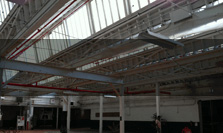
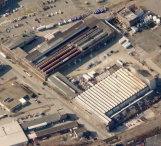
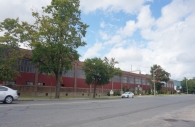
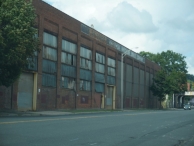
All pre-1910 buildings associated with Waterbury Brass Co. have been demolished. All but one of the seven surviving buildings in the complex were built c.1910-1920. They include the easternmost brick building at the southwest corner of Crane Street and the railroad; approximately 100 by 250 ft. it is two- and three-story with a monitor roof identified as the Mechanical Building housing drafters, storage, and one of the complex’s machine shops. The monitor appears to have been added when the block was extended south sometime after 1950. Immediately south along the west side of the tracks are several two- and one-story connected blocks used as woodshop and storage. The large, single-story structural steel frame brick rolling mill at the northwest corner of Freight Street and the railroad has saw tooth skylights, and measures approximately 270 ft. wide and 600 ft. long. A secondary brick and metal siding rolling mill to the west dates to c.1940 and has ribbon windows along Freight Street. Further west on Freight Street is a one-story saw tooth roof casting shop and metal storage (230 by 600 ft) and coal storage (170 ft long) behind a unified brick curtain wall façade with large steel frame windows. The two-story brick power house stands north of this latter section amid post-1950 infill. The four story brick office with terra cotta ornament at 414-436 Meadow Street was built in 1913 and designed by Trowbridge and Livingston.
Exterior Material(s)
Structural System(s)
Roof Form
Roof Material
Power Source
Condition
Fair
Condition Notes
n/a
- Property Information
-
Specific Location
Two parcels totaling 16.79 north of Freight Street, west of Judd Street, and east of the Naugatuck River; note that the administration building is at 414-436 Meadow Street (NEC with Grand Street) and in Downtown Waterbury HD (see pg 9 at http://focus.nps.gov/pdfhost/docs/NRHP/Text/83001280.pdf)
Adjacent To
Exterior Visible from Public Road?
Yes
Parcel ID / Assessor Record Link
Acreage
10.56; 6.23
Use (Present)
- Commercial
- Other: 2/2020: The City of Waterbury began demolition of the 22-acre total parcels at 130, 170 Freight St and SEC of Jackson and West Main St with $1.5 million in Urban Act Grant funding. 6/2021 DECD awarded $2m in brownfields grant for remaining demolition and remediation for potential mixed use redev. 10/2023: demolition of last building to start. 5/2026: city received $11 million from DECD/DEEP for additional clean-up in anticipation of putting mixed use redevelopment out to bid.
- Sources
-
Form Completed By
Michael Forino
Date
August 2015
Bibliography
- Hartford Courant, 1915-1975.
- Waterbury Observer - Articles by Racheal Guest.
- Chandler, Alfred, D., The Visible Hand: The Managerial Revolution in American Business (Belknap Harvard, 1977).
- Downtown Waterbury Historic District National Register Nomination (1983).
- Representative View(s)Click on image to view full file
-
Photographer
Michael Forino
Photography Date
August 2015