Mill Record Windham
RETURN TO ‘FIND MILLS’Disclaimer: Content for these properties was compiled in 2014-2017 from a variety of sources and is subject to change. Updates are occasionally made under Property Information, however the Connecticut Trust for Historic Preservation (dba Preservation Connecticut) makes no representation or warranty that the information is complete or up-to-date.
- Complex Name (Common)
- American Thread Co.
- Complex Name (Historic)
-
- American Thread Co.
- Address or Location
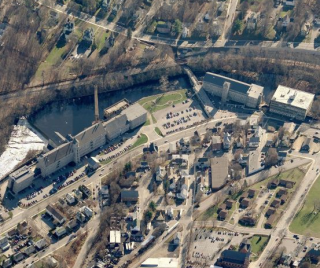
- 560; 480; 322; 320; 310 Main Street, Willimantic, Windham
- County
- Windham
- Historic Designation
- Associated Mill Community
- Historic Information
Companies Associated w/Complex
- American Thread Co.
- American Thread Co.
Use (Historic)
Largest Documented Workforce
1,300
Historic Narrative
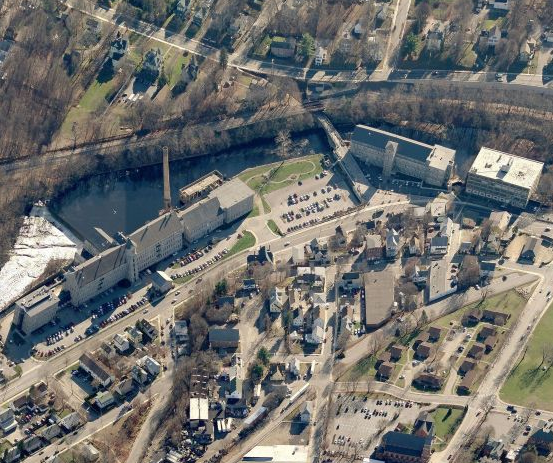
see National Register nomination http://www.nps.gov/nr/feature/places/pdfs/14000434.pdf Four local investors founded Willimantic Linen Co. in 1854. The firm had barely begun its intended production--manufacture of linen--when the Crimean War disrupted the European flax supply. Willimantic Linen then hired Gardiner Hall, Sr. and Timothy Merrick, experienced thread-makers from South Willington, to convert the operation to that manufacture. An 1825 cotton mill (not extant) held the firm until it built Mill No. 1 in 1857. Willimantic Linen ran 10,000 spindles here making 3-cord sewing thread. Sewing machines created a vast market for thread, but for mechanized sewing the stronger 6-cord thread was more suitable, and the company built Mill No.2 in 1864-65 for this production. In 1870 Willimantic Linen built the Dye House and Bleachery, and Inspection Building. After completion of these facilities the firm employed 217 men and 192 women; equipment included 144 carding machines and some 50,000 spindles. Many machines were built in-house, such as the bobbin winders, while others were purchased such as the 18 imported French combs. Under A. C. Dunham, son of one of the founders, Willimantic Linen made significant advances in the use of electric lighting in manufacturing. In 1878 Dunham installed a 6-lamp are-light system in a production area, one of the first such applications. Mill No.4, built in 1884, was designed specifically to be lit electrically. A. C. Dunham went on to serve as President of Hartford Electric Light Co., which under his leadership became one of the nation's most innovative electricity suppliers, conducting early experiments with low-head hydroelectric generation and long-distance transmission, and buying the first Westinghouse-parsons steam-turbine generator in 1900. American Thread Co. bought Willimantic Linen c.1896. American Thread still operates here and was reported to employ 1,300 people in the mid-1970s. (Roth)
- Architectural Information
Number of Existing Buildings
n/a
Dates of Construction
1857, 1864-65, 1870, 1884, 1895, 1907, 1910, 1915
Architect
n/a
Builder
n/a
Building Type
n/a
Architectural Description
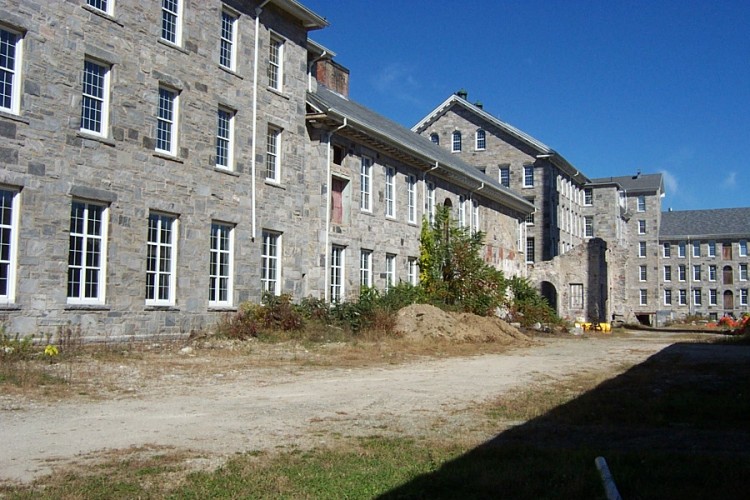
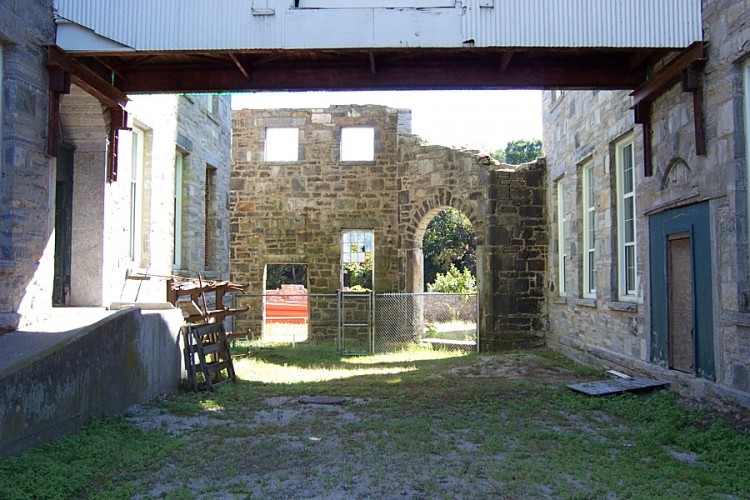
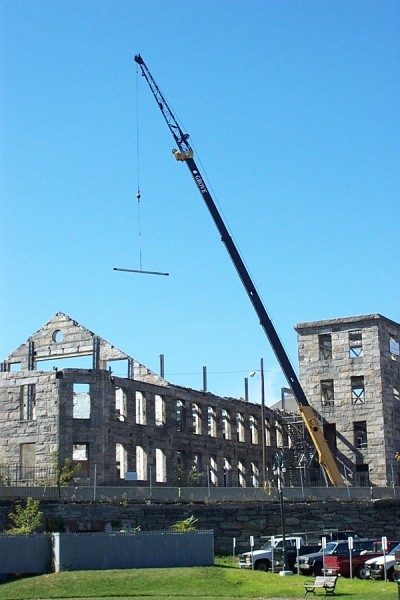
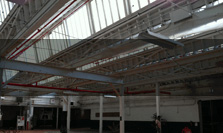
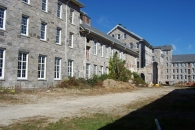
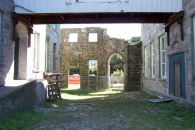
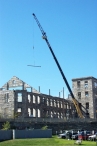
see National Register nomination http://www.nps.gov/nr/feature/places/pdfs/14000434.pdf 1857 Mill No. 1, 3 1/2-story, 200' x 68' with dormered gable roof and central stair tower, has coursed ashlar walls of granite blocks quarried from the banks of the adjacent Willimantic River. The 1864-65 gable-roofed Mill No. 2, 4 1/2-story and 400' X 70', has random-coursed granite walls, central stair tower and three round windows in each gable end. An ell extending back to the river held the wheelhouse, machine and carpenter shops. The 1-story stone office dates from 1865. In 1870 Willimantic Linen built the Dye House and Bleachery, 2 1/2-story with random-coursed stone walls and gable roof, west of Mill No.2, and the 4-story Inspection Building, with similar walls and a near-flat roof, to the east. Mill No. 3 (not extant) was a frame cotton mill bought by the company in 1882. Mill No.4, built in 1884, was designed specifically to be lit electrically. The extremely wide brick mill (1-story and 820' x 174') gained some illumination from its sawtooth monitor roof, but overhead arc-lamps were the primary source of light. In order to obtain maximum unobstructed light from both the monitors and the lamps, all shafting ran in tunnels beneath the floor. Willimantic Linen began Mill No.5 in 1895; the 4-story brick-pier mill has a flat roof, segmental-arch lintels and stone sills. American Thread built the 5-story, flat-roofed brick-pier Mill No.6 in 1907 and the similar (but 3-story) new dye house in 1910. The last structure in the complex, a 5-story reinforced concrete storehouse, was built c.1915. There are many related structures extant: the 2 1/2-story, randomcoursed stone barn; the 3-story, frame company store; four masonry dams; the 1869 stone-arch bridge over the river; and some 70 workers' dwellings, most of which are 1 1/2-story, gable-roofed, frame houses with single or double entry. (Roth)
Exterior Material(s)
n/a
Structural System(s)
n/a
Roof Form
Roof Material
n/a
Power Source
n/a
Condition
n/a
Condition Notes
n/a
- Property Information
-
Specific Location
North of Rt 32
Adjacent To
n/a
Exterior Visible from Public Road?
Yes
Parcel ID / Assessor Record Link
- 13-5/139/2-1 (for record, use link and type in address or parcel number) / Link →
- 14-5/140/9 (for record, use link and type in address or parcel number) / Link →
- 14-5/140/9-2 (for record, use link and type in address or parcel number) / Link →
- 14-5/145/2-1 (for record, use link and type in address or parcel number) / Link →
Acreage
35.52
Use (Present)
n/a
- Sources
-
Form Completed By
n/a
Date
n/a
Bibliography
- Roth, Matthew, et al, Connecticut: An Inventory of Historic Engineering and Industrial Sites (Washington DC: SIA, 1981).
- Representative View(s)Click on image to view full file
-
Photographer
n/a
Photography Date
n/a