Mill Record Norwich
RETURN TO ‘FIND MILLS’Disclaimer: Content for these properties was compiled in 2014-2017 from a variety of sources and is subject to change. Updates are occasionally made under Property Information, however the Connecticut Trust for Historic Preservation (dba Preservation Connecticut) makes no representation or warranty that the information is complete or up-to-date.
- Complex Name (Common)
- Clinton Mills Co.
- Complex Name (Historic)
-
- Clinton Mills Co.
- Address or Location
- 31 Clinton Avenue, Bean Hill, Norwich
- County
- New London
- Historic Designation
- Associated Mill Community
 What can you do at this mill?
- Historic Information
Companies Associated w/Complex
- Clinton Mills Co. 1864-1910
- Glen Woolen Mills ca. 1950-1960
- Hitchon Brothers ca. 1945-ca. 1950
- Saxton Woolen Corp. 1910-1943
- Turner & Stanton Co. 1963-late-20th c.
Use (Historic)
Largest Documented Workforce
130 (ca. 1890)
Historic Narrative
The Clinton Mills Company was organized for the production of ladies cloth, dress goods, and cloakings in 1864. The firm was led by J.D. Sturtevant, president; Francis Cabot, secretary and treasurer; and A.P. Sturtevant, agent. The company operated a sizable mill along the Yantic River in the Bean Hill section of Norwich and by the late 1880s employed 130 hands. By the early 1890s, the firm maintained 10 sets of carding machines and 56 broad looms and turned out 165,200 pounds of woolen dress goods per year. The Clinton Mills Company continued to operate until 1910, whereupon the firm was purchased by its agent, Lewis J. Saxton, who reorganized it as the Saxton Woolen Corporation. The latter firm eventually maintained the Clinton Mills along with a second plant located along the Yantic River roughly three-quarters-of-a-mile downstream. The Saxton Woolen Corporation remained in business until 1943, at which time the Clinton Mill was acquired by the Hitchon Brothers Company. Hitchon Brothers was organized by Walter G. and Herbert Hitchon, both of whom also held managerial roles at the Glen Woolen Mills, another local firm. The Glen Woolen Mills eventually took over the former Clinton Mills plant and operated it until 1960. In 1963, the plant was acquired by Turner and Stanton, a long-established Norwich manufacturer of braided cordage. Turner and Stanton remained in business into the late-20th century.
- Architectural Information
Number of Existing Buildings
Roughly three (3) adjoining primary blocks.
Dates of Construction
ca. 1864, mid-20th c.
Architect
n/a
Builder
n/a
Building Type
Architectural Description
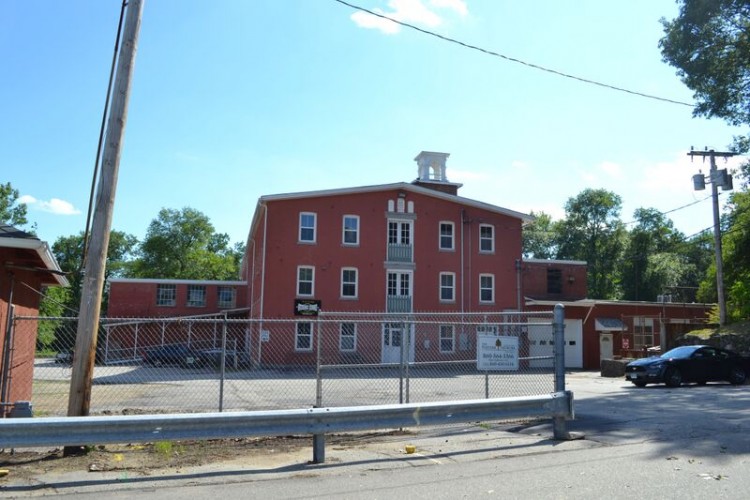
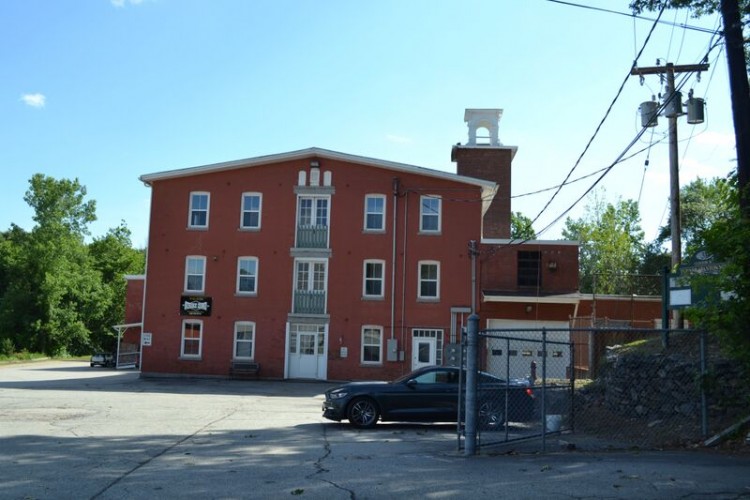
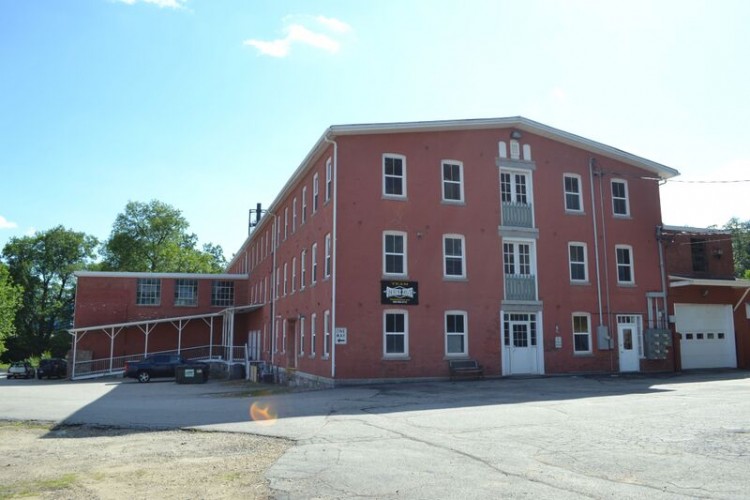
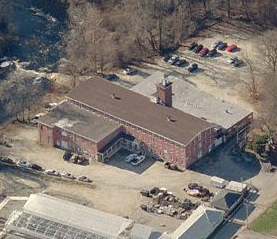
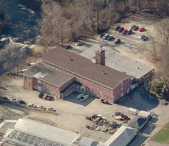
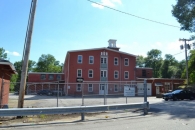
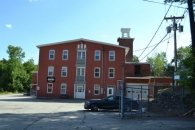
The former Clinton Mills Company plant is comprised of three primary adjoining blocks located on the south side of Clinton Avenue and north side of the Yantic River, roughly 0.15-mile south of Clinton Avenue’s intersection with West Town Street. The complex’s primary manufacturing block is also the plant’s oldest, this erected ca. 1865. The building is a three-story, 58’ x 176’ red brick structure of typical mill construction. It has a ganite foundation, circular masonry anchors, flat-arched window openings with stone sills, and a low-pitch front-facing gable roof with a moderate overhang. The building has a symmetrical five-bay façade (north elevation) comprised of centered entry or loading doors flanked by two bays of windows on all three floors. Three small, round-arched openings are located in the gable end. A four-story tower is centered on the building’s west (side) elevation. This is of red brick construction and is topped by a cupola with boxed columns, round-arched openings, scroll-cut brackets, and a pyramidal roof. A two-story covered porch extends to the west behind the stair tower to the western end of the elevation. A similar one-story porch is found on the east side of the building, this located at the intersection of the orginal mill and a later addition. Two red brick additions erected between 1934 and 1965 are located on the east and west (side) elevations of the mill. The eastern block is a two-story, 42’ x 84’ structure with large rectangular window openings, stone sills, multi-pane metal sash with hopper-style openings, and a flat roof. The western addition is a one-story, 77’ x 142’ building of similar design. Loading bays with a roll-up doors are located on its north and west elevations.
Exterior Material(s)
Structural System(s)
Roof Form
Roof Material
Power Source
Condition
Good
Condition Notes
The factory is in good condition and appears to be well maintained.
- Property Information
-
Specific Location
One legal parcel (31 Clinton Avenue) totaling 2.58-acres located on the south side of Clinton Avenue and north side of the Yantic River, roughly 0.15-mile south of Clinton Avenue’s intersection with West Town Street.
Adjacent To
Exterior Visible from Public Road?
Yes
Parcel ID / Assessor Record Link
- 58/ 2/ 45 / Link →
Acreage
2.58
Use (Present)
- Commercial
- Other: These factory buildings identified in 2022 Local Historic Inventory to encourage adaptive reuse.
- Vacant
- Sources
-
Form Completed By
Lucas A. Karmazinas
Date
06/24/2015
Bibliography
- List of Connecticut Manufacturers, 1922, 1924, 1930, 1932.
- Directory of Connecticut State Manufacturers, 1936, 1939.
- Industrial Directory of Connecticut, 1947.
- Register of War Production Facilities in Connecticut, 1951.
- Map of New London County; Baker, William A., 1854.
- Atlas of New London County, Beers, Ellis & Soule, 1868.
- Birdseye View of Norwich, Connecticut; Vogt, C.H., 1876.
- Aero View of Norwich, Connecticut; Hughes and Bailey, 1912.
- Sanborn Map Company, 1885, 1892, 1897, 1903, 1909, 1914, 1926, 1949.
- Norwich, Connecticut; Norwich Board of Trade, 1888.
- Norwich, The Rose of New England; Norwich Evening Record, 1894.
- Norwich, Century of Growth; Society of the Founders of Norwich, CT, 1978.
- Norwich; Plummer, Dale, 2003.
- Representative View(s)Click on image to view full file
-
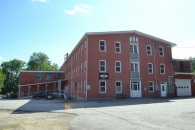
Photographer
Lucas A. Karmazinas
Photography Date
06/24/2015