Mill Record Thomaston
RETURN TO ‘FIND MILLS’Disclaimer: Content for these properties was compiled in 2014-2017 from a variety of sources and is subject to change. Updates are occasionally made under Property Information, however the Connecticut Trust for Historic Preservation (dba Preservation Connecticut) makes no representation or warranty that the information is complete or up-to-date.
- Complex Name (Common)
- Plume & Atwood Co. Brass Factory LARGE PART DEMO’d
- Complex Name (Historic)
-
- Plume & Atwood Co. Brass Factory LARGE PART DEMO'd
- Address or Location
- 235 East Main Street, Thomaston
- County
- Litchfield
- Historic Designation
- Associated Mill Community
- Historic Information
Companies Associated w/Complex
- Plume & Atwood Co. ca. 1875-1993
Use (Historic)
Largest Documented Workforce
Unknown.
Historic Narrative
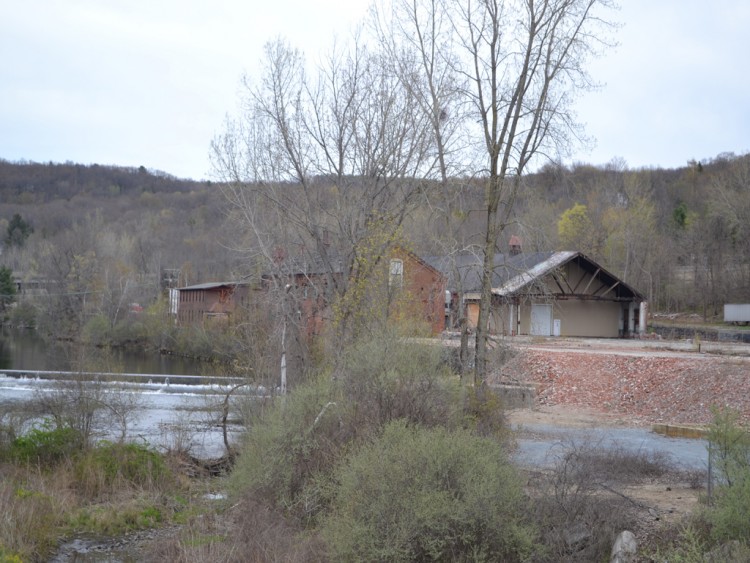
The development of the former Plume and Atwood Company complex began in 1853 after the Thomaston, Connecticut-based clockmaker Seth Thomas erected a brass mill in order to provide brass movements for his clocks. As Matthew Roth notes in his detailed history of the company published in ‘Connecticut; An Inventory of Historic Engineering and Industrial Sites,’ in 1980, ‘Seth Thomas's adoption in the late l830s of clock movements made from sheet brass involved him closely with the primary brass producers in Waterbury. When the brass producers began making clocks on their own, Thomas responded by planning his own brass mill. It was built in 1853-54. Thomas' sons sold the brass mill in 1869 to Holmes, Booth and Atwood, a Waterbury firm founded in that year; the name was changed to Plume and Atwood in 1871 to avoid confusion with Holmes, Booth and Haydens, another Waterbury firm. As a condition of the sale Plume and Atwood was required to supply Seth Thomas Clock Co. with all the brass for its clocks. The relationship between the two firms was solidified by David Plume, a partner in the new firm who had superintended the brass mill under the Thomas company. In 1870 Plume and Atwood employed 140 men at the mill. The firm rolled sheet and drew wire at this mill, and fabricated finished brass products at its Waterbury factory. Plume and Atwood started to rebuild the Thomaston plant in the l870s.’ At the time of his 1980 survey, Roth noted that the Plume and Atwood Company remained in operation as a division of Diversified Industries, Inc. The plant was eventually closed after Diversified Industries filed for bankruptcy in 1993. The majority of the structures associated with the company have since been lost, with the majority of the main manufacturing building having been demolished in 2013 after being deemed structurally unsound.
- Architectural Information
Number of Existing Buildings
Roughly ten (10) primary blocks.
Dates of Construction
ca. 1875, ca. 1900, ca. 1920, ca. 1940, ca. 1970.
Architect
n/a
Builder
n/a
Building Type
Architectural Description
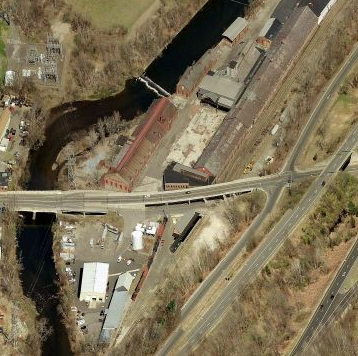
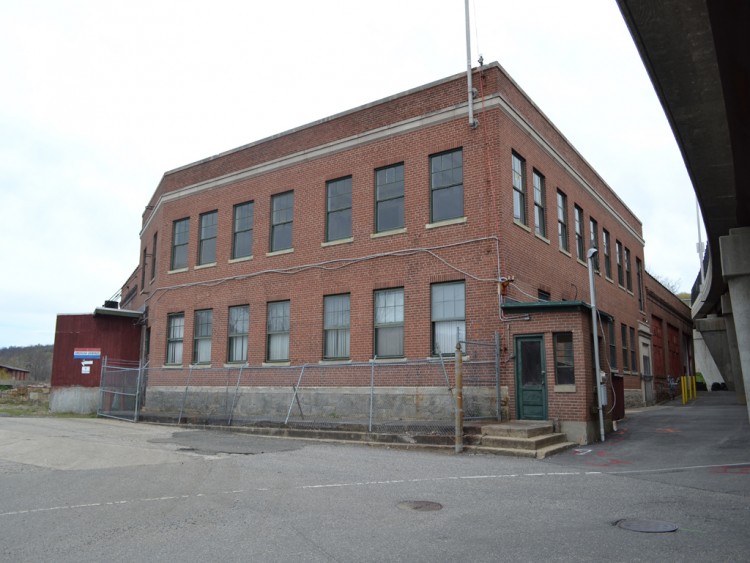
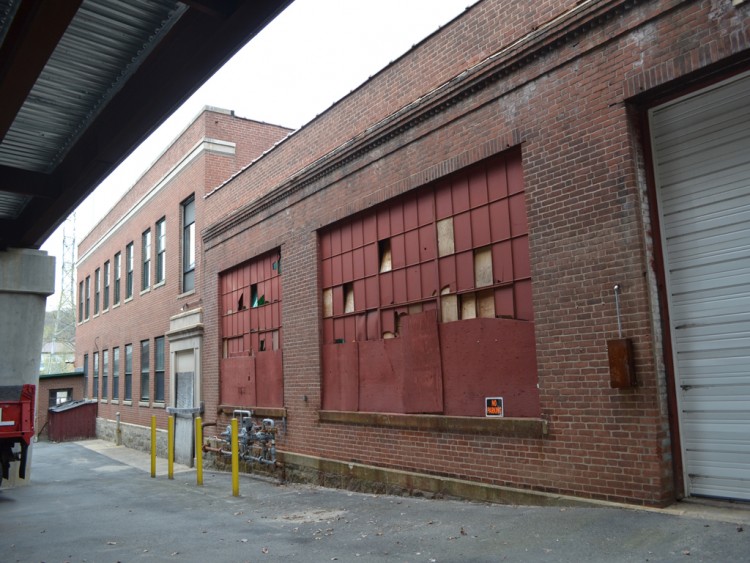
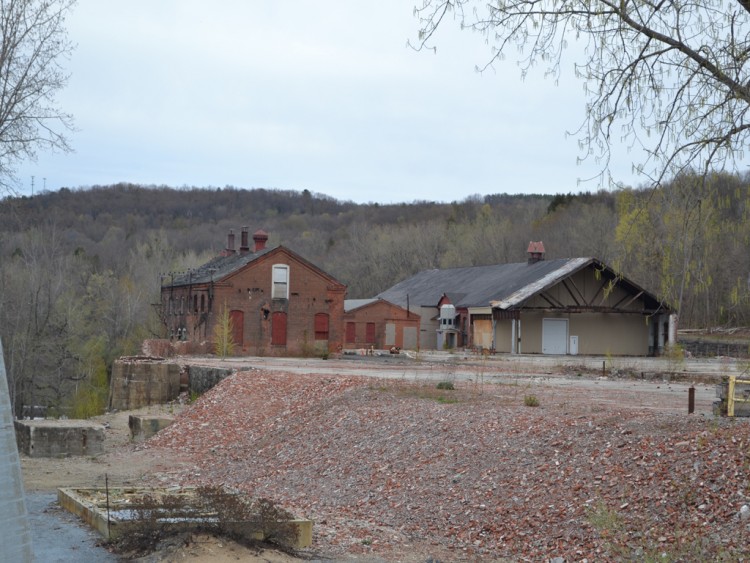
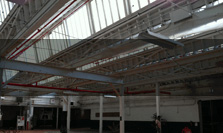
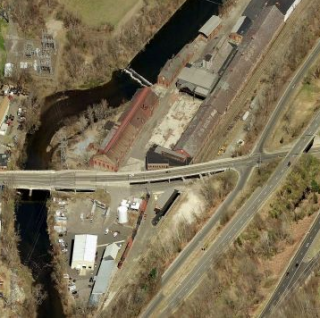
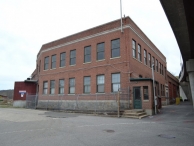
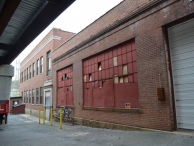
The former Plume and Atwood Company plant consists of roughly nine adjoining and freestanding primary buildings located on the north side of East Main Street, along the east bank of the Naugatuck River. When Matthew Roth surveyed the plant in 1980 the majority of the facility remained intact and in industrial use. Since that time, however, large portions of the complex have been demolished and those that survive are vacant. The most notable extant structure is the mill’s former office building, which is located at the southern end of the property. It was erected ca. 1940 and is a two-story, 70’ x 76’ red brick block with a polygonal footprint. The building has an ashlar stone foundation with a square-cut stone watertable, rectangular window openings with stone sills and solider-course brick lintels, six-over-one double-hung windows, a molded stone cornice, red brick parapet, stone coping, and a flat roof. The office’s main entrance is located at the eastern end of its south (façade) elevation. It has a stone surround consisting of a molded entablature supported by paneled pilasters. A one-story red brick ell wraps around the north and east sides of the office building. It measures roughly 140’ x 58’ and was erected ca. 1920. The ell has an ashlar stone foundation with a square-cut stone watertable, large rectangular window openings with stone sills and solider-course brick lintels, multipane metal windows with pivot-style sash, a denticulated and corbelled red brick cornice, red brick parapet, tile coping, flat roof, and a single clerestory monitor. Several additional manufacturing and ancillary blocks stand north and northeast of the office building. These include the plant’s boiler house, the carpentry/blacksmith shop, several storage buildings, and a portion of the plant’s rolling mill. The boiler house was built ca. 1875 and is located roughly 300’ north of the office. It is a two-story, 40’ x 82’ red brick block with segmental-arched window openings, stone sills, a denticulated and corbelled red brick cornice with cornice returns, and a front-facing gable roof. The surviving section of the rolling mill was erected ca. 1900 and stands 500’ northeast of the office building. It is a one-story, 85’ x 208’ red brick block with segmental-arched window openings, stone sills, a corbelled red brick cornice, and a front-facing gable roof. Three one-story additions to the northern end of the rolling mill were erected ca. 1970. These measure roughly 50’ x 62’, 50’ x 162’, and 85’ x 406’. The plant’s former carpentry/blacksmith shop adjoins the rolling mill’s west elevation. It was built ca. 1900 and measures 50’ x 80’. It has segmental-arched window openings, stone sills, a corbelled red brick cornice with cornice returns, and a front-facing gable roof.
Exterior Material(s)
Structural System(s)
Roof Form
Roof Material
Power Source
Condition
Fair
Condition Notes
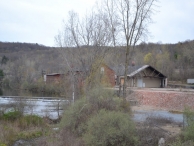
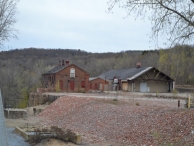
The plant is in fair to deteriorated condition. The majority of the rolling mill and all of the casting shop has been demolished, however the office, boiler plant, and several storage buildings appear structurally sound.
- Property Information
-
Specific Location
One 9.75-acre parcel (235 East Main St.) located on the north side of East Main Street, along the east bank of the Naugatuck River.
Adjacent To
Exterior Visible from Public Road?
Yes
Parcel ID / Assessor Record Link
Acreage
9.75
Use (Present)
- Sources
-
Form Completed By
Lucas A. Karmazinas
Date
04/28/2016
Bibliography
- List of Connecticut Manufacturers, 1922, 1924, 1930, 1932.
- Directory of Connecticut State Manufacturers, 1936, 1939.
- Industrial Directory of Connecticut, 1947.
- Register of War Production Facilities in Connecticut, 1951.
- Sanborn Map Company, 1884, 1900, 1924, 1962.
- Aerial Survey of Connecticut, 1934, 1951, 1965, 1970, 1985.
- Roth, Matthew, et al, Connecticut: An Inventory of Historic Engineering and Industrial Sites (Washington DC: SIA, 1981).
- Representative View(s)Click on image to view full file
-
Photographer
Lucas A. Karmazinas
Photography Date
04/28/2016